
Sep
19
19
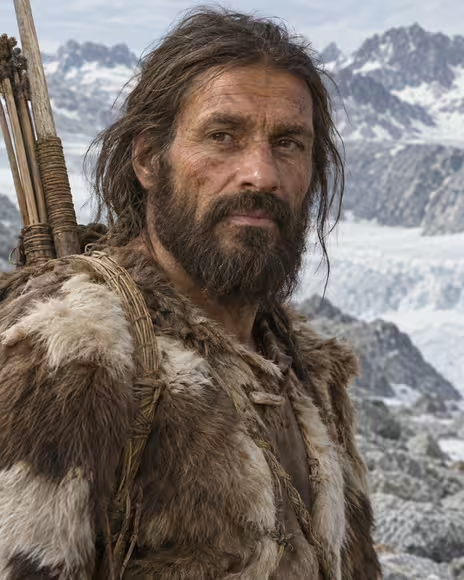
On September 19, 1991, German hikers Erika and Helmut Simon were crossing a high mountain pass in the Ötztal Alps when they noticed something dark protruding from the melting ice.
At first, it appeared to be the body of a mountaineer who had died in a recent accident.
Instead, the couple had stumbled upon one of the most extraordinary archaeological discoveries of the 20th century.
The frozen body belonged to a man who had died more than 5,300 years earlier, during the Copper Age.
He would become known around the world as Ötzi the Iceman.
A Discovery at More Than 3,000 Metres
Erika and Helmut Simon were on holiday in the Alps when they decided to hike near the Tisenjoch, a high mountain pass close to the modern border between Austria and Italy.
The location lies approximately 3,210 metres above sea level, beneath the Finailspitze in the Ötztal Alps.
During their descent, the Simons noticed what appeared to be a human torso emerging from meltwater and ice.
Only part of the body was visible.
The head, shoulders and upper back could be seen, while much of the rest remained frozen into the surrounding ice.
There was nothing immediately obvious to suggest that the dead man had been lying there for thousands of years.
The Simons therefore assumed that they had discovered the victim of a relatively recent mountaineering accident.
Police Are Called
The hikers reported the body to the keeper of the nearby Similaun mountain refuge.
Because the location lay extremely close to the Austrian-Italian border, both Austrian authorities and the Italian Carabinieri became involved.
The initial assumption remained that the body belonged to a missing climber.
An attempt was made to remove it from the ice the following day, but bad weather and the difficulty of the terrain forced rescuers to stop.
Only an unusual axe found near the body was taken down from the mountain.
Further recovery attempts were also delayed.
At this point, nobody yet understood that the axe was thousands of years old.
A Body Frozen in the Ice
The body was finally recovered on September 23, 1991.
The operation was carried out without archaeologists present because the remains were still believed to belong to a modern accident victim.
Workers used ice axes and other tools to free the corpse.
During the process, pieces of leather, hide, grass and equipment emerged from the ice around it.
A dagger and a long wooden object later identified as a bow were also found nearby.
The body was flown by helicopter to the Austrian village of Vent and then transported to the Institute of Forensic Medicine in Innsbruck.
Only there did specialists begin to realize that the discovery was something completely different from an ordinary mountaineering tragedy.
An Archaeological Sensation
On September 24, archaeologist Konrad Spindler of the University of Innsbruck examined the body and associated objects.
He quickly concluded that the mummy was ancient, estimating that it was at least several thousand years old.
Scientific dating later established that the man had lived during the Copper Age, more than 5,300 years ago.
The accidental discovery immediately became an archaeological sensation.
Unlike most prehistoric human remains, this man's body had not survived only as a skeleton.
Skin, tissue, internal organs, clothing and equipment had all been preserved to an extraordinary degree by the ice.
Why He Survived
Ötzi's preservation resulted from an unusual combination of circumstances.
After his death, his body came to rest in a small rocky depression approximately three metres by seven metres in size.
The depression protected him from much of the destructive movement of the surrounding glacier.
Snow and ice gradually covered the body.
Over the following millennia, the frozen conditions naturally preserved it.
Instead of being ground apart or carried away by moving ice, Ötzi remained largely protected in the hollow.
A particularly warm period in the summer of 1991 melted enough ice to expose his upper body shortly before the Simons passed the site.
Austria or Italy?
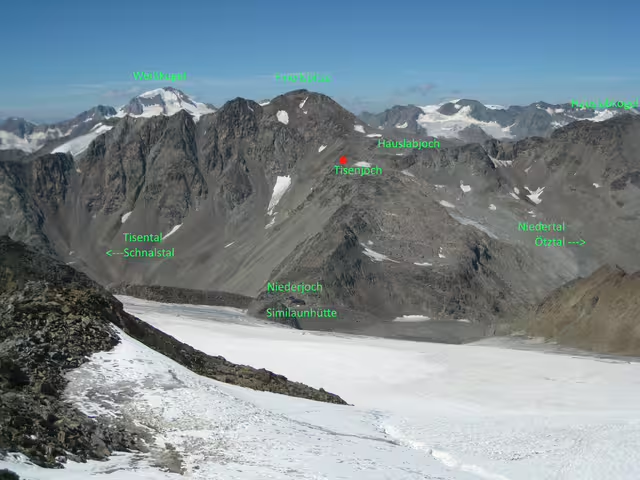
The discovery immediately created another unusual question: which country had Ötzi been found in?
The site was only a short distance from the border between Austria and Italy.
Because of the mountainous terrain and the history of how the boundary had been surveyed, its exact position in relation to the body was not immediately clear.
An official survey was therefore carried out on October 2, 1991.
The result showed that the discovery site was 92.56 metres inside Italian territory, on the South Tyrolean side of the border.
Ötzi therefore legally belonged to Italy.
For scientific reasons, however, the mummy initially remained in Innsbruck while researchers conducted their examinations.
Who Was Ötzi?
Scientific investigation gradually transformed the anonymous body from the ice into one of the most extensively studied individuals from prehistory.
Ötzi was a man approximately 45 to 46 years old when he died.
He stood about 1.60 metres tall and probably weighed around 50 kilograms during life.
He had brown eyes and dark hair and probably wore a beard.
Genetic and anatomical studies have revealed an extraordinary amount of information about his ancestry, health, diet and physical appearance.
Yet his name, occupation and precise position within his community remain unknown.
A Man of the Copper Age
Ötzi lived during a period when European societies were beginning to make increasing use of metal while still relying heavily on traditional stone technology.
This transitional period is generally known as the Copper Age.
The most striking object carried by Ötzi was a remarkably well-preserved copper axe.
The axe consisted of a wooden handle with a copper blade attached to it.
Copper was still a rare and valuable material, and ownership of such an object suggests that Ötzi may have occupied a relatively important position within his community.
Exactly what that position was remains uncertain.
A Complete Survival Kit
The objects found with Ötzi are almost as important archaeologically as the mummy itself.
He carried equipment that provides an extraordinary glimpse into everyday life in the Alps more than five millennia ago.
His possessions included a copper axe, a flint dagger, a longbow, a quiver, arrows, containers made from birch bark and tools for repairing and sharpening equipment.
His bow was approximately 1.82 metres long and made from yew wood.
Some of the arrows in his quiver were unfinished, suggesting that he had been repairing or preparing his equipment while travelling.
He also carried materials needed to make fire.
Together, these objects demonstrate sophisticated knowledge of wood, stone, fibres, leather and metal.
Clothing Made for the Mountains
Ötzi's clothing also survived in remarkable condition.
He wore garments made from different animal hides and plant materials, carefully selected and assembled for survival in a demanding Alpine environment.
His equipment included leggings, a loincloth, a coat and a fur cap.
His shoes were particularly sophisticated.
They combined leather and plant material to create footwear designed to provide insulation and grip in cold mountain conditions.
Very few complete prehistoric garments survive anywhere in the world, making Ötzi's clothing an exceptional archaeological record.
His Final Meal
Ötzi's preserved internal organs allowed scientists to investigate what he had eaten shortly before his death.
Analysis of his stomach contents revealed meat from wild animals, cereals and plant material.
More recent research identified a particularly high proportion of animal fat, together with meat and einkorn wheat.
Such a calorie-rich meal would have been valuable for someone travelling through a cold, high-altitude environment.
The discovery of food still present inside a man who died more than five millennia ago illustrates the extraordinary level of preservation achieved by the Alpine ice.
Sixty-One Tattoos
Researchers have also identified 61 tattoos on Ötzi's body.
They are mostly simple groups of parallel lines and crosses rather than decorative images.
The marks were created by making small cuts or punctures in the skin and introducing dark pigment, probably charcoal.
Many appear near joints and areas of the body affected by physical wear.
This has led researchers to suggest that at least some may have had a therapeutic rather than purely decorative purpose.
Their precise meaning, however, remains uncertain.
A Violent Death
For years after the discovery, the exact cause of Ötzi's death remained unclear.
Then, in 2001, X-ray examination revealed something dramatic inside his body.
A flint arrowhead was embedded in his left shoulder.
The arrow had entered from behind and damaged a major blood vessel.
Researchers concluded that the injury caused severe bleeding and was probably fatal within a short period of time.
Ötzi also suffered a serious head injury that may have resulted from a fall or a blow.
Evidence of a deep cut on his right hand suggests that he had also been involved in violent close-range combat shortly before his death.
A 5,300-Year-Old Murder Mystery
The evidence has turned Ötzi's final hours into one of archaeology's most famous murder mysteries.
Someone apparently shot him from behind while he was high in the mountains.
But the attack raises many unanswered questions.
Why was Ötzi there?
Was he fleeing from enemies?
Had the earlier wound on his hand resulted from a fight in his home community?
Why did his attacker leave behind his valuable copper axe?
If robbery was the motive, the abandonment of such an important object is difficult to explain.
More than five thousand years later, the identity and motive of Ötzi's killer remain unknown.
What Happened Before His Death?
Researchers have reconstructed fragments of Ötzi's final days from injuries, pollen, food remains and the condition of his equipment.
The picture suggests a man who had recently experienced conflict and was travelling through difficult terrain.
His damaged hand may indicate that he had fought someone several days before his death.
Some pieces of his equipment were unfinished or being repaired.
Yet he was still carrying a valuable axe, food and survival equipment.
Whatever brought him to the high mountain pass, his journey ended violently.
Older Than the Pyramids
The age of the Iceman is one of the facts that made the discovery so striking.
Ötzi had already been dead for centuries before the great pyramids of Egypt were constructed.
His life belonged to prehistoric Europe, long before written records described the peoples living in the Alpine region.
Yet because his body and personal possessions survived together, researchers can examine him with a level of detail rarely possible for prehistoric individuals.
His teeth, bones, DNA, stomach contents, clothing and tools all provide separate pieces of evidence.
Together they create an unusually personal view of life during the Copper Age.
How Ötzi Got His Name
The man obviously did not call himself Ötzi.
His real name disappeared with the society in which he lived.
After the discovery, journalists and researchers used several names for the mummy, including the Iceman and the Similaun Man.
Austrian journalist Karl Wendl introduced the nickname Ötzi, derived from the Ötztal Alps where the body was found.
The short and memorable name quickly became internationally recognized.
Today, Ötzi is one of the most famous archaeological individuals in the world.
From Innsbruck to Bolzano
Although Ötzi was initially studied in Austria, the official border survey established that he had been discovered on Italian territory.
Eventually, responsibility for the mummy passed to South Tyrol.
In 1998, Ötzi and his equipment were transferred to the South Tyrol Museum of Archaeology in Bolzano.
There, the mummy is preserved in a specially designed refrigerated chamber that recreates conditions similar to those that protected him in the glacier.
The temperature is maintained at approximately -6°C with extremely high humidity.
Visitors can see the mummy through a small window while conservation specialists carefully monitor its condition.
A Scientific Time Capsule
Ötzi has become much more than an archaeological curiosity.
Advances in medical imaging, genetics, chemistry and microscopic analysis have allowed scientists to return repeatedly to the mummy with new techniques.
Questions that could not have been answered in 1991 became possible years or decades later.
His genome has been studied.
His last meals have been reconstructed.
The origin of the copper in his axe has been investigated.
Microorganisms preserved inside his body have provided information about prehistoric human health.
Even after decades of research, new studies continue to reveal details about his life.
The Importance of the Ice
The Iceman also became an important example of what is now called glacial archaeology.
Ice can preserve organic material that normally disappears rapidly from archaeological sites.
Leather, wood, fibres, food and even human tissue may survive for thousands of years when frozen under stable conditions.
As glaciers and permanent ice fields retreat, archaeologists around the world are increasingly discovering objects that had previously remained sealed beneath the ice.
But once exposed to air, moisture and microorganisms, such finds can deteriorate rapidly.
Ötzi demonstrated both the extraordinary preservation potential of ice and the urgency of recovering newly exposed archaeological material.
The Place of Discovery Today
The high Alpine location where Ötzi was found is today marked by a large stone monument.
The surrounding landscape remains remote and demanding.
Standing there makes the circumstances of the discovery particularly striking.
For thousands of years, a human body and nearly complete collection of personal possessions remained hidden beneath the ice only a short distance from a mountain route used by modern hikers.
Then, during one unusually warm summer, the ice retreated just enough for two passing tourists to notice a dark shape in the meltwater.
September 19, 1991
On September 19, 1991, Erika and Helmut Simon had no reason to believe that their mountain hike would become part of archaeological history.
They thought they had encountered a tragic but relatively ordinary accident victim.
Instead, the body emerging from the ice belonged to a man who had lived more than five millennia before them.
The discovery preserved not only human remains but clothing, tools, weapons, food and evidence of a violent death.
From a copper axe and unfinished bow to tattoos and the arrowhead still lodged inside his shoulder, every detail added another piece to the story.
Ötzi transformed from an anonymous body in the ice into one of the most thoroughly studied people from the prehistoric world.
More than 5,300 years after his death, the Iceman continues to reveal new information about life, technology, health and violence in Copper Age Europe.
Other Events on This Day
- Annibale de Gasparis Discovers Asteroid Massalia from Naples
- Olympic Running Legend Emil Zátopek Is Born
Credits: 2nd photo by Mai-Sachme, licensed under CC BY-SA 4.0, via Wikimedia Commons.


