
Sep
19
19
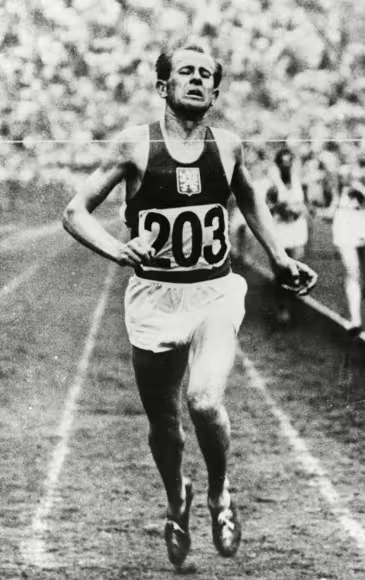
On September 19, 1922, one of the most remarkable distance runners in the history of athletics was born in the small Moravian town of Kopřivnice, then part of Czechoslovakia.
His name was Emil Zátopek.
Thirty years later, at the 1952 Olympic Games in Helsinki, he would accomplish something no distance runner had done before and none has repeated since.
Within eight days, Zátopek won the 10,000 metres, 5,000 metres and marathon.
The marathon was particularly extraordinary.
It was the first competitive marathon of his life.
His relentless training, unusual running style and extraordinary ability to endure physical discomfort earned him one of athletics' most famous nicknames: the Human Locomotive.
By the end of his career, Zátopek had won four Olympic gold medals, one Olympic silver medal and established 18 world records.
Born in Kopřivnice
Emil Zátopek was born into a working-class family in Kopřivnice in northern Moravia.
His father was a carpenter, and Emil was the seventh of eight children.
Nothing about his childhood suggested that he was destined to become one of the world's most celebrated runners.
As a boy, he was not particularly interested in competitive sport.
His path toward athletics began only after he left home as a teenager to work and study at the enormous Baťa shoe company in Zlín.
A Reluctant Runner
Zátopek entered his first important race almost by accident.
Workers and students connected with the Baťa factory were encouraged to take part in athletic events, and the young Zátopek was selected for a running competition.
He reportedly protested that he was not fit enough to race.
Nevertheless, he ran.
To his surprise, he finished near the front.
The experience changed the direction of his life.
Running had suddenly become something worth exploring.
Jan Haluza and the Beginning of Training
Zátopek soon came under the guidance of Czech runner and coach Jan Haluza.
Haluza introduced him to structured athletic training and helped develop the speed that would later distinguish Zátopek from many other long-distance runners.
But Zátopek eventually took the basic principles far beyond conventional training.
He became fascinated by the idea that a runner could improve by repeatedly alternating fast running with short periods of recovery.
This form of interval training already existed, but Zátopek used it with a volume and intensity that became legendary.
Hundreds of Fast Laps
Instead of spending all his training time running continuously at a moderate pace, Zátopek repeatedly ran sections of 200 or 400 metres at high speed.
As his fitness increased, so did the number of repetitions.
Some of his most extreme sessions reportedly included dozens of 400-metre intervals, and he eventually experimented with workouts involving as many as 100 repetitions of 400 metres.
He sometimes trained several times in a single day.
He ran in rain, snow and darkness.
During his army years he deliberately trained in heavy military boots and ran through deep snow, reasoning that difficult conditions would make racing on a track feel easier.
His methods appeared excessive to many observers.
For Zátopek, however, training was an experiment in discovering how much work the human body could absorb and adapt to.
A Running Style Nobody Could Forget
Zátopek did not look elegant while running.
His head rolled from side to side.
His arms appeared tense.
His face twisted with effort, and spectators sometimes thought he looked as if he were suffering terribly even while comfortably controlling a race.
The contrast between his appearance and his performance became part of his legend.
Other great runners seemed to float around the track.
Zátopek appeared to fight every metre.
Yet the apparently inefficient style carried him faster and farther than almost everyone he raced against.
The Human Locomotive
His combination of relentless rhythm, exceptional endurance and punishing training helped produce the nickname the Human Locomotive.
It suited him perfectly.
Once Zátopek established his pace, he seemed capable of maintaining it lap after lap while his opponents gradually disappeared behind him.
Unlike many elite athletes, however, his fierce competitive personality rarely extended beyond the race itself.
He became known among international runners for friendliness, humor and a willingness to speak with competitors despite the political divisions of the early Cold War.
London 1948
Zátopek arrived at the 1948 Olympic Games in London as an increasingly dangerous international competitor.
The Games provided the first great demonstration of what he could do on the Olympic stage.
His opening event was the 10,000 metres.
Zátopek dominated the race.
He finished in 29 minutes 59.6 seconds, becoming Olympic champion and finishing almost 48 seconds ahead of silver medallist Alain Mimoun of France.
It was the first Olympic gold medal of Zátopek's career.
A Dramatic 5,000 Metres
The 5,000-metre final produced a very different race.
Belgian runner Gaston Reiff built a substantial lead while Zátopek appeared to be too far behind to challenge him.
Then the Czech runner began one of the most memorable finishing efforts of his career.
Lap after lap, he reduced the gap.
Entering the final metres, Zátopek was rapidly closing on Reiff.
He almost caught him.
But the finish arrived just in time for the Belgian.
Zátopek took silver.
His first Olympics therefore ended with one gold and one silver medal.
Dana
The year 1948 was important for another reason.
Zátopek married Czech javelin thrower Dana Ingrová.
The coincidence surrounding their relationship was remarkable: Dana had also been born on September 19, 1922.
They shared exactly the same birthday.
Dana was an outstanding athlete in her own right and would become an Olympic champion and world record holder.
Together they became one of the most celebrated sporting couples in Czechoslovak history.
World Records Begin to Fall
After the London Olympics, Zátopek became increasingly dominant.
In 1949 he established his first world record in the 10,000 metres.
It was the beginning of a remarkable sequence.
Over the following years, he set world records at distances ranging from 5,000 metres to long track races lasting an hour or more.
He repeatedly improved his own performances, treating records almost as experiments in the limits of endurance.
More Than Twenty Kilometres in One Hour
One of Zátopek's most extraordinary achievements came in 1951.
Running continuously around a track for one hour, he covered more than 20 kilometres.
His distance was 20,052 metres.
No runner had previously broken the 20-kilometre barrier within sixty minutes.
During the same performance he also completed 20,000 metres in under an hour.
The records demonstrated that Zátopek's endurance extended far beyond the standard Olympic track distances.
That ability would soon become crucial.
Helsinki 1952
The 1952 Olympic Games in Helsinki became the defining competition of Zátopek's career.
He entered as the defending Olympic champion in the 10,000 metres and one of the most famous distance runners in the world.
But even his reputation did not suggest what was about to happen.
Zátopek would compete in three of the most demanding running events on the Olympic programme.
He would win all three.
First Gold: 10,000 Metres
The first event was the 10,000 metres.
Zátopek controlled the race and gradually broke away from his opponents.
His great French rival and friend Alain Mimoun finished second.
Zátopek crossed the line in an Olympic record.
He had successfully defended the title he had won four years earlier in London.
One gold medal was secured.
Second Gold: 5,000 Metres
The 5,000 metres was far less predictable.
With only a few hundred metres remaining, Zátopek appeared to be losing contact with the leaders.
Britain's Chris Chataway, Germany's Herbert Schade and France's Alain Mimoun were all fighting for victory.
Then Zátopek accelerated.
His famous grimace intensified as he surged around the outside and returned to contention.
Chataway stumbled after clipping the curb, while Zátopek continued toward the finish.
He crossed the line first.
Once again, he had set an Olympic record.
He now possessed two gold medals from the same Games.
Dana Wins Gold Too
The day became even more remarkable for the Zátopek family.
Shortly after Emil's victory in the 5,000 metres, Dana Zátopková competed in the women's javelin final.
Her first throw travelled 50.47 metres.
No competitor surpassed it.
Dana became Olympic champion on the same day as her husband.
Four years after marrying, the couple left Helsinki as Olympic gold medallists together.
One Race Remained
Most athletes would have considered two distance-running gold medals more than enough.
Zátopek decided to attempt something else.
He entered the Olympic marathon.
There was one obvious problem.
He had never competed in a marathon before.
The Olympic final would be his first attempt at racing the full distance of 42.195 kilometres.
He would be competing against specialists who had spent years learning how to distribute their energy through such a long race.
Following Jim Peters
Among the favorites was Britain's Jim Peters, one of the fastest marathon runners in the world.
Zátopek had little personal experience of correct marathon pace, so during the early stages he stayed close to Peters.
According to the famous account of the race, Zátopek even asked Peters whether the pace was fast enough.
Peters indicated that it was too slow.
Whether the exchange was tactical, humorous or simply typical Zátopek friendliness, the race soon became much harder.
Peters eventually dropped out.
Zátopek kept running.
Third Gold: The Marathon
During the later stages, Zátopek pulled clear of the remaining competitors.
He entered Helsinki's Olympic Stadium alone.
The crowd rose as his name echoed around the stands.
Zátopek crossed the finish line in 2 hours 23 minutes 3.2 seconds.
It was another Olympic record.
Argentina's Reinaldo Gorno finished more than two and a half minutes later.
In his first marathon, Zátopek had become Olympic champion.
A Triple That Still Stands Alone
The result completed one of the most unusual achievements in Olympic athletics.
Within eight days, Emil Zátopek had won the 5,000 metres, 10,000 metres and marathon.
All three victories came in Olympic-record performances.
No runner before him had completed that combination at a single Olympic Games.
No runner has repeated it since.
The achievement turned Zátopek from a great athlete into an international sporting legend.
Eighteen World Records
Zátopek's record-breaking continued after Helsinki.
In 1954, he ran the 5,000 metres in 13:57.2.
Only days later, in Brussels, he completed 10,000 metres in 28:54.2.
That performance made him the first man to run 10,000 metres in under 29 minutes.
Across his career, Zátopek established 18 officially recognized world records.
They included records at 5,000 and 10,000 metres as well as 20,000 metres, 25,000 metres, 30,000 metres and the one-hour run.
Alain Mimoun
One of the most important figures in Zátopek's athletic life was French runner Alain Mimoun.
The two competed against each other repeatedly, with Zátopek frequently finishing ahead of the Frenchman in major championships.
Yet their rivalry developed into a close friendship.
Mimoun finally experienced his own greatest Olympic moment at the 1956 Games in Melbourne.
There, he won the marathon.
Zátopek, no longer at the height of his powers, finished sixth.
The victory was especially significant to Mimoun after years of finishing behind his Czech friend.
The End of His Racing Career
By the second half of the 1950s, Zátopek's dominance was fading.
Years of extraordinary training had taken their toll, while a new generation of runners was emerging.
His competitive career ended near the close of the decade.
His statistics were extraordinary.
He had won four Olympic gold medals and one silver.
He had become a three-time European champion.
He had set 18 world records.
But numbers alone do not explain his influence.
A Different Approach to Training
Zátopek helped demonstrate that endurance runners could tolerate much greater quantities of intensive training than many coaches had previously believed.
His exact workouts were extreme and are not a blueprint followed literally by modern athletes.
But the principle behind them became fundamental to distance running.
Controlled periods of fast running separated by recovery intervals are now a normal part of training from amateur athletics to elite competition.
Zátopek relentlessly experimented on himself to discover what worked.
He also shared training ideas openly with competitors instead of treating them as secrets.
Friendship Across Borders
Zátopek was also remembered for relationships that extended beyond national and political divisions.
He spoke several languages and enjoyed meeting athletes from other countries.
Perhaps the most famous example involved Australian runner Ron Clarke.
Clarke was one of the outstanding distance runners of the 1960s and broke numerous world records, but he never won an Olympic gold medal.
During a visit in 1968, Zátopek secretly gave Clarke one of his own Olympic gold medals.
It was his 10,000-metre gold from Helsinki.
The extraordinary gift became one of the most famous stories associated with Zátopek's generosity toward fellow athletes.
A Shared Life With Dana
Dana and Emil Zátopek remained together for more than half a century.
Their athletic achievements made them an exceptional sporting partnership.
They had been born on the same day in the same year.
They married in 1948.
Four years later, both became Olympic champions in Helsinki.
Dana continued competing long after 1952 and later won an Olympic silver medal in Rome in 1960.
She also became an influential javelin coach.
Their partnership remained one of the most recognizable stories in Czech sporting history.
A Legacy Beyond Medals
International recognition of Zátopek continued long after his competitive career ended.
In 2012, he was among the first twelve athletes inducted into the newly created IAAF Hall of Fame.
His name continues to appear in books about running, training and Olympic history.
Statues, races and sporting events commemorate him in the Czech Republic and abroad.
For generations of runners, however, his greatest legacy remains something less tangible.
Zátopek represented the belief that endurance could be developed far beyond apparently natural limits through systematic, persistent training.
The Runner Who Looked Exhausted
Photographs of Zátopek racing often show a face contorted in apparent agony.
He never possessed the effortless appearance traditionally associated with beautiful running form.
Yet behind that expression was an athlete with extraordinary control over pace and fatigue.
The grimacing runner who appeared close to collapse could suddenly accelerate while everyone around him was actually reaching exhaustion.
His unusual style therefore became inseparable from his legend.
It reminded spectators that performance did not always have to look graceful.
November 2000
Emil Zátopek died in Prague in November 2000 at the age of 78.
His death brought tributes from athletes and sporting organizations around the world.
A ceremonial farewell was held at Prague's National Theatre, attended by leading representatives of international sport and many of his former competitors.
More than four decades had passed since his final Olympic appearance.
But the achievements of Helsinki remained unmatched.
September 19, 1922
When Emil Zátopek was born in Kopřivnice on September 19, 1922, there was no reason to imagine that the son of a carpenter would transform distance running.
He did not begin as a childhood sporting prodigy.
He discovered running almost accidentally while working for the Baťa company.
From there came increasingly demanding experiments with interval training, world records and Olympic victories.
In London in 1948, he won his first Olympic title.
In Helsinki four years later, he entered three distance events and won all three.
The last was the first marathon he had ever raced.
His career eventually produced four Olympic gold medals, one silver medal, three European titles and 18 world records.
But the numbers tell only part of the story.
Zátopek became an enduring symbol of distance running because he demonstrated what could happen when extraordinary physical ability was combined with experimentation, determination and an almost unmatched willingness to endure hard training.
Other Events on This Day
- Annibale de Gasparis Discovers Asteroid Massalia from Naples
- Ötzi the Iceman Is Discovered in the Alps
Credits: 1st photo: Photographer unknown, Nationaal Archief / Anefo. Licensed under CC BY-SA 3.0 NL, via Wikimedia Commons.


