
Sep
20
20
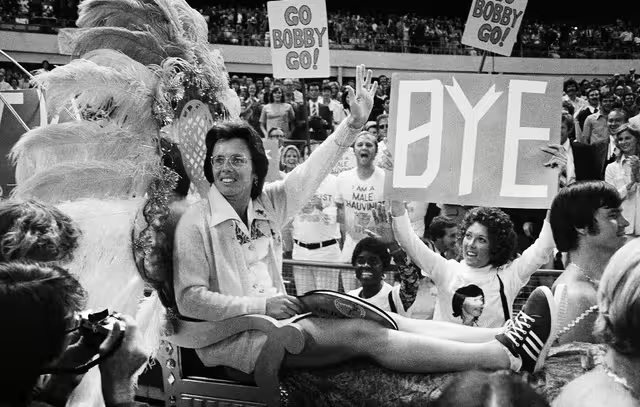
On September 20, 1973, more than 30,000 spectators filled the Houston Astrodome to watch one of the most famous tennis matches ever played.
On one side of the net stood Billie Jean King, a 29-year-old champion at the height of her career.
On the other stood Bobby Riggs, a 55-year-old former Wimbledon champion, celebrated gambler and relentless self-promoter who had spent months claiming that even at his age he could defeat the leading women in tennis.
The match had been promoted as the Battle of the Sexes.
It was part tennis contest, part television spectacle and part public debate about the status of women in professional sport.
King understood that millions of people would treat the result as something much larger than an exhibition match.
Less than two hours later, she had her answer.
Billie Jean King defeated Bobby Riggs in straight sets, 6–4, 6–3, 6–3.
Billie Jean King
By 1973, Billie Jean King was already one of the most accomplished tennis players in the world.
Born in California in 1943, she had begun playing tennis as a child and quickly developed into an exceptional competitor.
Her aggressive style, quick movement and willingness to attack the net made her particularly effective on fast surfaces.
King won her first Wimbledon singles championship in 1966.
More major titles followed.
By the time she entered the Astrodome in 1973, she had already established herself as one of the defining players of her generation.
But King was also fighting a battle away from the court.
The Fight for Women's Professional Tennis
Women's tennis had long been treated very differently from the men's professional game.
Female players frequently received far less prize money even when competing at the same tournaments and attracting substantial audiences.
King became one of the most prominent players demanding that women receive greater professional opportunities and financial recognition.
In 1970, she was among a group of nine players who broke away from the existing tennis establishment and signed symbolic one-dollar contracts to participate in a new women's professional circuit.
The group became known as the Original 9.
Their decision helped establish an independent professional structure for women's tennis.
The Birth of the WTA
The movement took another major step in June 1973.
More than sixty players met at the Gloucester Hotel in London shortly before Wimbledon.
There they created the Women's Tennis Association, with Billie Jean King as one of its central figures.
The organization brought women's professional players together under a unified association capable of negotiating over tournaments, schedules and prize money.
The timing was significant.
Only a few months later, King would play the most watched match of her life.
Equal Prize Money at the US Open
Another breakthrough came during the same extraordinary year.
When King won the 1972 US Open women's singles championship, she received $10,000.
The men's champion, Ilie Năstase, received $25,000.
King publicly challenged the disparity and indicated that women might not return unless the situation changed.
In 1973, the US Open became the first Grand Slam tournament to offer equal prize money to men and women.
Both singles champions received $25,000.
The change occurred only weeks before the Battle of the Sexes.
Bobby Riggs
Bobby Riggs was not simply a television comedian who happened to own a tennis racket.
Decades earlier, he had been one of the finest players in the world.
In 1939, Riggs won the men's singles championship at Wimbledon.
He also became a major figure in American tennis and later competed successfully as a professional.
But by 1973, his elite playing career was long over.
Riggs was now 55 years old.
He had discovered, however, that he could turn his considerable skill at publicity into another kind of career.
He began publicly arguing that the leading women players were overrated and that an older male champion could still defeat them.
The statements were deliberately provocative and fitted perfectly into the contemporary national debate over changing gender roles.
A Professional Hustler
Riggs had always enjoyed gambling, handicaps and unusual sporting challenges.
He understood how to attract publicity and how to transform a sporting contest into entertainment.
His public persona became that of a proudly self-described male chauvinist.
He made exaggerated claims about the supposed inferiority of women's tennis and repeatedly challenged leading female players.
Whether every statement represented his private beliefs mattered less than the fact that he knew those statements would generate headlines.
The strategy worked.
Television networks, newspapers and sponsors became fascinated by the idea of a man-versus-woman tennis showdown.
King Initially Says No
Riggs first wanted to play Billie Jean King.
King initially declined.
She considered his challenge largely a publicity stunt and saw little benefit in accepting it.
Another champion was willing to play him instead.
Margaret Court was one of the greatest players in tennis history and one of King's most important rivals.
She accepted Riggs's challenge.
The result changed everything.
The Mother's Day Massacre
Riggs and Court played on May 13, 1973, Mother's Day, in Ramona, California.
Riggs used drop shots, lobs and changes of pace to prevent Court from establishing her normal game.
The match was shockingly one-sided.
Riggs defeated Court 6–2, 6–1.
The media quickly gave the match a memorable nickname: the Mother's Day Massacre.
Riggs suddenly had exactly the publicity he wanted.
If one of the world's leading women could lose so easily to a 55-year-old retired champion, he argued, why should anyone take women's professional tennis seriously?
King now viewed the situation differently.
King Accepts the Challenge
Billie Jean King agreed to play Riggs.
The financial incentive was enormous.
The match offered a $100,000 winner-take-all prize.
But King later made clear that money was not the main reason she accepted.
She believed the credibility of the new women's professional tour was at stake.
Riggs had successfully turned his victory over Margaret Court into a public argument about the quality of women's tennis.
King wanted to answer that argument on the court.
A Match Built for Television
The confrontation was promoted with the energy normally associated with a championship boxing match.
The enormous Houston Astrodome was chosen as the venue.
Opened in 1965, the domed stadium was one of America's most futuristic sporting arenas and was popularly nicknamed the Eighth Wonder of the World.
A tennis court was constructed on the stadium floor.
Television network ABC scheduled the event during prime time.
Howard Cosell, one of America's most recognizable sports broadcasters, helped call the action.
The result was no ordinary tennis exhibition.
More Than 30,000 Spectators
More than 30,000 spectators entered the Astrodome for the match.
It was an extraordinary crowd for tennis.
Millions more watched on television.
Contemporary and later estimates commonly place the worldwide audience at approximately 90 million people, with around 50 million watching in the United States.
Whatever the exact figure, the Battle of the Sexes reached an audience on a scale tennis had rarely experienced.
September 20, 1973
The atmosphere inside the Astrodome was deliberately theatrical.
Riggs made his entrance aboard an elaborate rickshaw surrounded by models.
King arrived on a decorated litter carried by members of the Rice University men's track team.
Riggs wore a promotional warm-up jacket carrying the name of one of his sponsors.
King wore a specially designed tennis dress created by British designer Ted Tinling.
King even presented Riggs with a small piglet before the match, a playful response to the chauvinistic persona he had cultivated.
The spectacle generated laughter and television images.
But once play began, King treated the match with complete seriousness.
A Different Strategy
King had carefully studied Riggs and his victory over Margaret Court.
She knew that trying simply to overwhelm him with power could play into his strategy.
Riggs was exceptionally skilled at disrupting an opponent's rhythm.
His soft shots, lobs, changes of pace and ability to move opponents around the court had been central to his game for decades.
King therefore decided to remain patient.
Rather than constantly rushing the net, as she often did in championship tennis, she was prepared to engage Riggs from the baseline.
She would make him run.
The First Set
Riggs expected King to become impatient.
She did not.
Instead, she repeatedly directed the ball into difficult positions and forced him to cover large areas of the court.
Riggs attempted to change pace and disrupt her timing.
King continued returning the ball.
The first set remained competitive, but King secured the crucial advantage and won 6–4.
The enormous crowd had seen something very different from Riggs's easy victory over Margaret Court.
Riggs Changes His Game
As the match continued, Riggs realized that his original strategy was not working.
King was too consistent from the baseline and sufficiently fit to continue long rallies.
Riggs began approaching the net more frequently.
That exposed him to another part of King's game.
She could pass him.
Again and again, King forced the older player to move, stretch and change direction.
The physical demands steadily increased.
The Second Set
King took control of the second set.
Riggs continued trying different tactics, but he could not consistently disrupt her rhythm.
King remained disciplined.
She did not attempt to turn every point into a spectacular winner.
Instead, she concentrated on making Riggs play another ball and another point.
The second set ended 6–3.
King was now one set away from victory.
The Third Set
Riggs needed to reverse the match quickly.
But his age and King's tactics were increasingly visible in his movement.
King continued forcing him across the court while maintaining control of the rallies.
Riggs attempted to attack, defend and change pace.
Nothing produced a lasting change.
King took the third set 6–3.
The Battle of the Sexes was over.
6–4, 6–3, 6–3
The final score was decisive.
Billie Jean King defeated Bobby Riggs 6–4, 6–3, 6–3.
She had won three consecutive sets in a match promoted around the world as a test of women's tennis.
King collected the $100,000 winner's prize.
But the meaning attached to the result was far larger than the cheque.
What the Match Did Not Prove
The Battle of the Sexes was a hugely symbolic sporting event, but its result needs to be understood in context.
It was not a scientific test of the relative athletic abilities of men and women.
Riggs was 55 years old and decades removed from his years as an elite international champion.
King was 29 and competing near the peak of her professional career.
The two players came from different generations and very different stages of their athletic lives.
The significance of King's victory instead came from the way the match had been publicly framed.
Riggs had made women's professional tennis itself part of his challenge.
Millions of people were therefore watching to see whether King could answer him.
A Moment in a Larger Movement
The match took place during a period of major social change in the United States.
Women were challenging restrictions and discrimination in employment, education, politics and sport.
In 1972, the United States had enacted Title IX, prohibiting sex discrimination in federally funded educational programs.
Its eventual effect on school and university athletics would be enormous.
At the same time, professional women athletes were demanding better pay, greater visibility and control over their careers.
The Battle of the Sexes brought these debates into millions of homes through a tennis match.
King's Pressure
King later described the pressure surrounding the match as far greater than that of an ordinary tournament final.
She feared that a defeat would be used by opponents of women's professional sport as evidence supporting arguments they were already making.
In her recollection, losing could have set women's tennis back for years.
That explains why she approached an exhibition match against a retired champion with the seriousness of a major final.
Riggs After the Match
Riggs accepted his defeat publicly.
His defeat did not end his career as a celebrity.
He remained associated with the Battle of the Sexes for the rest of his life and continued appearing at tennis events and in the media.
King and Riggs also developed a genuine friendship after their famous rivalry.
The theatrical hostility used to promote the match did not define their later relationship.
Riggs died in 1995.
The Dress in the Smithsonian
The tennis dress worn by Billie Jean King became an artifact of American sporting history.
Designed by Ted Tinling, the outfit was created specifically for the televised spectacle of the match.
King later donated it to the Smithsonian's National Museum of American History.
The garment is preserved there as an object connected not only with tennis but with the changing place of women in American sport and society.
A Remarkable Year
The Battle of the Sexes becomes even more significant when viewed as part of everything that happened in women's tennis during 1973.
In June, players established the Women's Tennis Association.
At the US Open, men and women competed for equal prize money for the first time at a Grand Slam tournament.
Then, on September 20, King defeated Riggs before an enormous television audience.
These were separate developments, but together they made 1973 a defining year in the history of women's professional tennis.
More Than a Publicity Stunt
The Battle of the Sexes undeniably contained elements of spectacle.
There were extravagant entrances, sponsors, costumes, jokes and deliberate provocation.
The entire event was constructed to attract as much public attention as possible.
Riggs understood publicity exceptionally well.
King understood something else.
If millions of people were going to watch, she could use the spectacle to make them pay attention to women's tennis.
The result transformed what might have been remembered as a bizarre exhibition into one of the most recognizable sporting events of the 20th century.
A Global Audience
Estimates of the precise television audience vary between historical sources.
But contemporary accounts and major sporting institutions commonly cite approximately 90 million viewers worldwide.
That extraordinary audience explains why the match became culturally important far beyond the tennis world.
Many people who had never watched a professional women's tennis match before saw King compete that night.
For them, the Battle of the Sexes became an introduction both to King and to the rapidly developing women's professional tour.
King's Career Continued
The victory did not mark the end of Billie Jean King's competitive career.
She continued winning major championships and playing an important role in the development of professional tennis.
Across her career, King won 39 Grand Slam titles across singles, doubles and mixed doubles, including 12 singles championships.
She later helped establish the Women's Sports Foundation and remained closely involved with campaigns for equality in sport.
Her influence eventually extended far beyond her record of victories on the court.
The Battle Remembered
Decades later, images of King and Riggs entering the Astrodome remain immediately recognizable.
The event has inspired books, documentaries and dramatizations.
Its fame comes partly from the unusual matchup and extraordinary promotional campaign.
But the match endured in public memory because it occurred at a moment when the place of women in professional sport was changing rapidly.
King did not create that transformation with one victory.
Nor did equality suddenly follow from a tennis match.
But her victory became one of the most visible symbols of a much broader change already underway.
September 20, 1973
On September 20, 1973, Billie Jean King walked onto a temporary tennis court inside the Houston Astrodome knowing that millions of people were watching.
Across the net stood Bobby Riggs, a former champion who had built the match through months of provocative claims about women and sport.
King refused to become distracted by the spectacle surrounding them.
She made Riggs move, controlled the rallies and remained patient.
She won the first set 6–4.
Then she won the second 6–3.
And the third 6–3.
The $100,000 prize belonged to her.
More importantly, the enormous audience had watched one of the world's leading women athletes perform under exceptional pressure and win decisively.
The Battle of the Sexes became more than an exhibition tennis match: it became one of the defining sporting images of the struggle for recognition and equality in women's professional sport.
Other Events on This Day
Credits: 1st photo: Associated Press, photographer uncredited. Public Domain in the United States, via Wikimedia Commons.


