
Sep
20
20
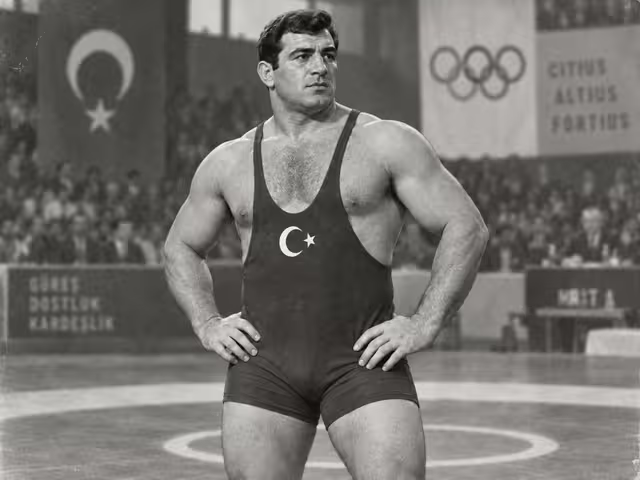
On September 20, 1934, one of the greatest heavyweight wrestlers in Turkish sporting history was born in the small town of Hamamözü in Amasya Province.
His name was Hamit Kaplan.
Growing up in a country with a centuries-old wrestling tradition, Kaplan began wrestling as a young man before developing into an international competitor capable of succeeding in both freestyle and Greco-Roman wrestling.
His greatest achievements came in freestyle.
Across three consecutive Olympic Games, Kaplan won gold, silver and bronze in the heavyweight division.
He became Olympic champion in Melbourne in 1956, finished second in Rome in 1960 and completed his remarkable Olympic medal collection with bronze in Tokyo in 1964.
Between those Games, he also became a world champion and repeatedly reached the podium at major international championships.
Growing Up in Hamamözü
Hamit Kaplan was born in Hamamözü, a small town in northern central Turkey.
Wrestling occupied a special place in Turkish sporting culture, particularly through traditional forms practiced at festivals and local competitions.
Kaplan was introduced to wrestling while still young.
One important influence was his uncle Adil Candemir, himself an accomplished wrestler who had represented Turkey internationally.
Kaplan began serious wrestling training in his teenage years and quickly demonstrated the size, strength and competitive ability required for the heavyweight divisions.
Turkey and Wrestling
Few sports were as closely associated with Turkey as wrestling.
Traditional yağlı güreş, or oil wrestling, had been practiced for centuries, while modern freestyle and Greco-Roman wrestling became major sources of international success for the Turkish Republic.
At the Olympic Games after the Second World War, Turkish wrestlers became particularly formidable.
Champions such as Yaşar Doğu, Celal Atik and Mustafa Dağıstanlı helped establish Turkey as one of the leading wrestling nations in the world.
Kaplan entered international competition during this extraordinary period.
From Traditional Wrestling to the Mat
Kaplan's early wrestling experience included traditional Turkish wrestling, but international competition required him to master the standardized rules of modern Olympic wrestling.
He proved capable of competing in both major international styles.
In freestyle wrestling, competitors may attack their opponent's legs and use their own legs in offensive and defensive techniques.
In Greco-Roman wrestling, holds below the waist are prohibited.
The two disciplines therefore demand different tactical approaches.
Kaplan became unusual in being able to compete successfully at the highest international level in both.
Joining the National Team
Kaplan's progress was rapid.
During his military service, he wrestled for a naval sports team and continued developing his technique.
In 1954, he was selected for the Turkish national team.
He soon found himself competing against some of the strongest heavyweight wrestlers in Europe and the Soviet Union.
At approximately 1.90 metres tall and around 100 kilograms during much of his career, Kaplan possessed an imposing physical presence.
But strength alone was not enough at the international level.
Heavyweight wrestling required patience, balance, tactical discipline and the ability to control enormously powerful opponents.
First World Championship Medal
Kaplan's international breakthrough came at the 1955 World Wrestling Championships in Karlsruhe, West Germany.
Competing in Greco-Roman heavyweight wrestling, he won a bronze medal.
He was still only 20 years old.
The performance demonstrated that Turkey had produced another heavyweight capable of competing against the world's best.
Only a year later, Kaplan would travel halfway around the world for his first Olympic Games.
Melbourne 1956
The 1956 Summer Olympics were held in Melbourne, Australia.
Kaplan represented Turkey in both freestyle and Greco-Roman heavyweight wrestling.
He was also given the honor of carrying the Turkish flag at the opening ceremony.
In Greco-Roman wrestling, Kaplan produced an excellent performance but finished just outside the medals in fourth place.
The freestyle competition would be different.
Heavyweight Freestyle
The Olympic heavyweight freestyle competition began on November 28, 1956.
Eleven wrestlers represented eleven countries.
The scoring system was very different from the simple knockout tournaments familiar to many modern sports fans.
Wrestlers accumulated penalty points depending on whether they won by fall, won by decision, drew or lost.
Accumulating too many penalty points meant elimination.
A wrestler therefore had to think not only about winning but about how he won.
An Olympic Champion at 22
Kaplan successfully navigated the difficult heavyweight tournament.
By the end of the competition, he had secured the Olympic gold medal.
At just 22 years old, he was the heavyweight freestyle champion of the Olympic Games.
The victory immediately placed him among the leading figures in Turkish sport.
Yet Melbourne was not the peak of a brief career.
It was the beginning of nearly a decade in which Kaplan remained among the world's leading heavyweights.
World Champion in Istanbul
The following year brought another major triumph.
At the 1957 World Wrestling Championships, held in Istanbul, Kaplan competed in freestyle heavyweight wrestling.
Performing before a home crowd, he won the world championship.
Within approximately a year, Kaplan had therefore become both Olympic and world champion.
His position at the top of international heavyweight wrestling seemed secure.
But maintaining that position would prove increasingly difficult as an extraordinary generation of heavyweight wrestlers emerged across Europe and the Soviet Union.
A Golden Age of Heavyweights
Kaplan's career overlapped with several exceptional wrestlers.
Among them was Germany's Wilfried Dietrich, one of the most versatile heavyweight wrestlers of his generation.
The Soviet Union was also producing increasingly powerful wrestlers through a highly organized state sporting system.
Heavyweight matches could become tactical contests in which a single mistake determined the result.
Kaplan remained remarkably consistent despite the increasingly difficult competition.
Success in Both Styles
Although freestyle produced Kaplan's greatest Olympic success, he continued competing in Greco-Roman wrestling as well.
At the 1958 World Championships in Budapest, he won another Greco-Roman heavyweight bronze medal.
In freestyle, he remained one of the world's leading competitors.
His ability to switch between styles distinguished him from many wrestlers who concentrated entirely on one discipline.
It also meant facing an unusually demanding international schedule.
Silver in Tehran
At the 1959 World Championships in Tehran, Kaplan returned to the freestyle heavyweight podium.
This time he won silver.
The result confirmed that three years after his Olympic victory he was still competing at the highest level.
He entered the next Olympic Games as the defending heavyweight champion and one of the most respected wrestlers in the tournament.
Rome 1960
The 1960 Olympic Games in Rome provided one of the most memorable settings in wrestling history.
Matches were held inside the ruins of the ancient Basilica of Maxentius, a Roman building completed more than sixteen centuries earlier.
Kaplan entered the freestyle heavyweight competition attempting to defend his Olympic title.
Seventeen wrestlers participated.
Among his strongest opponents was Wilfried Dietrich, representing the United Team of Germany.
Kaplan Against Dietrich
Both Kaplan and Dietrich survived the elimination rounds and advanced to the final stage.
The two heavyweights eventually faced each other directly.
Their match ended in a draw.
Under the complicated penalty-point system used at the time, however, that did not mean the two wrestlers shared the title.
Dietrich had accumulated fewer penalty points during the earlier rounds.
He therefore won the Olympic gold medal.
Kaplan received silver.
Still Among the World's Best
Losing the Olympic title did little to diminish Kaplan's status.
He had now reached the Olympic podium at two consecutive Games.
And he continued competing.
At the 1961 World Championships, Kaplan again collected major international medals.
His career demonstrated an unusual level of durability for a heavyweight competing repeatedly against the strongest wrestlers from the Soviet Union, Eastern Europe, Iran and the rest of the international wrestling world.
The Demands of Heavyweight Wrestling
Heavyweight wrestling placed enormous demands on the body.
Matches required explosive strength but could also become prolonged battles of balance and endurance.
A wrestler had to resist being thrown while simultaneously searching for an opportunity to move an opponent who might weigh as much or more than he did.
Kaplan became known particularly for his physical strength and defensive ability.
Opponents found him extremely difficult to move or defeat decisively.
This made him particularly effective under the tournament scoring systems of the period.
World Championship Bronze in 1963
Even as younger heavyweight wrestlers emerged, Kaplan continued reaching international podiums.
In 1963, he won bronze at the World Championships in freestyle.
He also won a bronze medal in Greco-Roman competition that year.
Almost a decade had passed since his first appearances with the Turkish national team.
Yet Kaplan remained capable of winning medals in both wrestling styles.
Tokyo 1964
Kaplan traveled to the 1964 Olympic Games in Tokyo for his third Olympics.
The heavyweight division had changed.
The upper weight boundary had been reorganized, and Kaplan competed in the freestyle category above 97 kilograms.
He was now 30 years old and facing another generation of elite heavyweights.
Among them was Soviet wrestler Aleksandr Ivanitsky, who would become Olympic champion.
A Complete Olympic Medal Set
Kaplan finished the Tokyo freestyle tournament with the bronze medal.
The result completed a remarkable sequence.
In Melbourne he had won gold.
In Rome he had won silver.
In Tokyo he won bronze.
Three consecutive Olympic Games had produced three different medals.
Few athletes remain competitive at Olympic medal level through such a long period, particularly in a physically demanding sport such as heavyweight wrestling.
Gold, Silver and Bronze
Kaplan's Olympic record therefore formed an unusually elegant progression:
1956 Melbourne – Gold.
1960 Rome – Silver.
1964 Tokyo – Bronze.
All three medals came in heavyweight freestyle wrestling.
His Olympic career alone would have been sufficient to secure his place in Turkish sporting history.
Combined with his world championship performances, it made his record even more impressive.
A Career in Two Wrestling Worlds
Kaplan belonged to a transitional period in wrestling history.
He had grown out of Turkey's deep traditional wrestling culture but competed in an increasingly international and highly organized Olympic sport.
His opponents came from countries with very different wrestling traditions.
Iran possessed its own celebrated wrestling culture.
The Soviet Union developed a powerful centralized sports program.
Germany, Sweden, Bulgaria and other European countries produced formidable heavyweights.
Kaplan repeatedly faced all of them.
Retirement
Kaplan continued competing after the Tokyo Olympics but his career was approaching its end.
In 1965, after more than a decade at international level, he retired from competitive wrestling.
He had represented Turkey through one of the country's strongest periods in the sport.
His collection of Olympic and world medals made him one of the most successful Turkish heavyweights of the era.
A Life Cut Short
Kaplan did not live to old age.
On January 5, 1976, he was involved in a traffic accident near Çorum in Turkey.
He died at the age of only 41.
His death ended the life of an athlete who had spent much of the 1950s and early 1960s carrying the Turkish flag at some of the world's most important sporting events.
He was buried in his hometown of Hamamözü.
Remembered in Hamamözü
Kaplan's connection with his birthplace remained strong after his death.
His former home in Hamamözü was eventually restored and transformed into the Hamit Kaplan Museum House.
The museum preserves the memory of the local boy who became an Olympic and world champion.
Sports facilities in the region have also carried his name.
For Hamamözü, Kaplan became more than a successful athlete.
He became one of the town's defining historical figures.
Hall of Fame
International wrestling also continued to recognize Kaplan's achievements.
In 2011, he was inducted into the United World Wrestling Hall of Fame.
The honor placed him among athletes whose careers had made a lasting contribution to the history of the sport.
More than half a century after his Olympic championship, his medal record still provided a remarkable summary of consistency at the highest level.
Three Olympics, Three Medals
Individual championships often depend on an athlete reaching peak condition at exactly the right moment.
Kaplan did something more difficult.
He remained an Olympic medal contender across eight years.
From his gold medal in Melbourne in 1956 to his bronze in Tokyo in 1964, the opponents changed, the weight categories evolved and new champions appeared.
Kaplan remained.
That longevity is one of the strongest measures of his career.
September 20, 1934
When Hamit Kaplan was born in Hamamözü on September 20, 1934, he entered a culture in which wrestling had been practiced and celebrated for generations.
He carried that tradition onto the international mat.
At 22, he became Olympic heavyweight freestyle champion in Melbourne.
A year later, he became world champion in Istanbul.
In Rome in 1960, he added an Olympic silver medal.
Four years later in Tokyo, he completed the set with bronze.
He also competed successfully in Greco-Roman wrestling and remained an international medal contender for much of a decade.
Hamit Kaplan's gold, silver and bronze medals from three consecutive Olympic Games made him one of the defining heavyweight wrestlers of Turkey's great postwar wrestling era.
Other Events on This Day


