
Sep
21
21
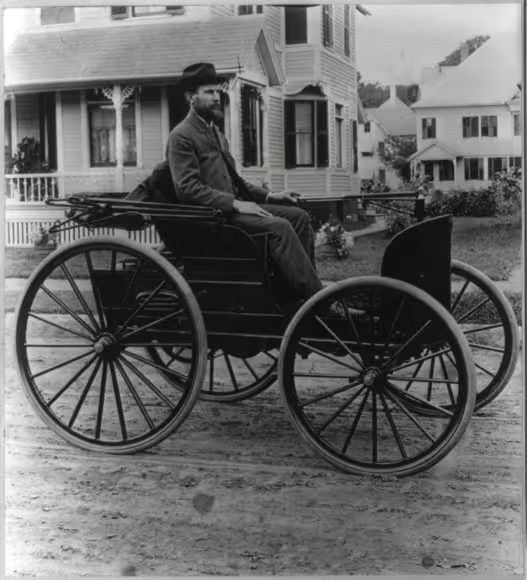
On September 21, 1893, an extraordinary machine emerged onto the streets of Springfield, Massachusetts.
It looked much like an ordinary horse-drawn carriage.
But there was no horse.
Hidden beneath the body was a small gasoline engine designed to propel the vehicle under its own power.
The experimental machine had been developed by American brothers Charles E. Duryea and J. Frank Duryea, pioneers whose work would become closely associated with the birth of the American automobile industry.
That September road trial was far from perfect.
The transmission caused trouble, the vehicle stopped during the journey, and its builders still faced months of experimentation.
But the strange carriage moving through Springfield without an animal pulling it represented something remarkable.
Americans were beginning to build practical gasoline-powered automobiles of their own.
Before the Automobile
At the end of the 19th century, American streets belonged overwhelmingly to horses.
People traveled in carriages, wagons and streetcars, while railroads connected towns and cities over longer distances.
Self-propelled road vehicles were not entirely new.
Steam-powered vehicles had been demonstrated decades earlier, and inventors in Europe and the United States were experimenting with electric and internal-combustion propulsion.
In Germany, Karl Benz had patented his gasoline-powered three-wheeled vehicle in 1886.
Gottlieb Daimler and Wilhelm Maybach were developing their own internal-combustion vehicles at roughly the same time.
Across the Atlantic, American mechanics began wondering whether similar machines could be built for American roads.
The Duryea Brothers
Charles Duryea was born in 1861 and developed an early fascination with mechanical transportation.
His younger brother Frank, born in 1869, proved particularly skilled at practical mechanical work.
Both became involved in the rapidly growing bicycle industry.
The connection was significant.
Bicycle manufacturers understood lightweight construction, bearings, wheels, steering and the challenge of producing efficient personal transportation.
Many early automobile pioneers would emerge from the bicycle business.
Charles became increasingly convinced that a compact gasoline engine could power a road carriage.
In the early 1890s, the brothers began working toward that goal in Springfield, Massachusetts.
Building a Horseless Carriage
The brothers did not begin by constructing an automobile from the ground up.
Instead, they worked with an existing horse-drawn carriage and attempted to transform it into a self-propelled vehicle.
The approach made sense.
There was not yet an established concept of what an automobile should look like.
For early experimenters, a carriage without a horse was the most obvious starting point.
The Duryea project was carried out with the assistance of local machine shops and financial supporters in Springfield.
One important supporter was Erwin F. Markham, who helped finance the experiments.
The work proved far more difficult than simply attaching an engine to a carriage.
The inventors needed a fuel system, ignition, transmission, controls, cooling and some means of transferring power reliably to the wheels.
Charles Leaves Springfield
In September 1892, Charles Duryea moved to Peoria, Illinois, where he continued working in the bicycle business.
At that point, the experimental automobile was still incomplete.
The responsibility for turning the project into a functioning road vehicle fell largely to Frank.
The brothers continued communicating by letter, but Frank remained in Springfield and handled the practical development of the machine.
This distinction later became important.
Charles and Frank eventually disagreed bitterly over how much credit each deserved for creating their first automobile.
The argument continued for decades.
Surviving letters, business records and testimony have allowed historians to reconstruct much of the development process, but the brothers themselves never fully agreed on the story.
Frank Starts Again
The original engine proved disappointing.
After repeated attempts to make it work successfully, Frank concluded that a substantial redesign was necessary.
In early 1893, he began designing a new engine based on more conventional mechanical principles.
The result was a single-cylinder, four-cycle, water-cooled gasoline engine.
Frank also developed or adapted an electric ignition system, carburetor, muffler and other components required to make the machine operate.
The engine was installed almost horizontally beneath the carriage body.
By late summer 1893, the machine was approaching the point where it could finally be tested on a road.
The Transmission Problem
One of the greatest challenges was transferring the engine's power to the wheels.
The first version used a friction transmission.
Instead of the sophisticated gearbox familiar in later automobiles, the system relied on friction between rotating surfaces to transmit power and vary the vehicle's speed.
In theory it offered smooth control.
In practice it absorbed a great deal of the engine's limited power and proved unreliable.
Nevertheless, the Duryea carriage was ready for its first serious road trial.
September 21, 1893
On September 21, the completed machine was taken from the Russell machine shop in Springfield.
Even getting it out of the building presented a problem.
The carriage was too long to fit normally into the elevator.
The men therefore raised its front end and rested the weight of the machine on its rear wheels while lowering it.
Once outside, the vehicle was moved into the space between nearby buildings.
After dark, it was pulled by horse to the area around Spruce and Florence Streets, where the road tests could begin.
For a machine intended to eliminate the horse, beginning its historic journey behind one was an appropriately ironic moment.
A Carriage With No Horse
The sight quickly attracted attention.
A local newspaper reported that residents near Florence Street rushed to their windows when they saw what appeared to be a normal carriage moving along the road without shafts and without a horse.
The vehicle traveled through the neighborhood under gasoline power.
According to the contemporary account, Will Bemis, Markham's son-in-law, operated the vehicle during the trial described by the newspaper.
Frank Duryea supervised the development and testing of the machine and recorded the results for his brother.
The experiment initially appeared promising.
Then the carriage stopped.
The First Breakdown
The failure came from the friction-drive mechanism.
A surface had become too smooth to transmit power effectively.
The solution was wonderfully simple.
The experimenters sprinkled water onto the friction surface.
Enough grip returned for the vehicle to continue.
The carriage completed the remainder of the test route and returned along Spruce Street.
It was hardly the flawless demonstration that later automobile advertisements might have preferred.
But experimental machines are valuable precisely because their failures reveal what must be improved.
Frank Writes to Charles
The following day, Frank reported the results to his brother in Peoria.
The most important conclusion was clear.
The engine worked.
The transmission did not.
Frank stopped further testing while considering a better method of transferring power to the wheels.
The September trial therefore represented both a success and a failure.
The Duryea automobile had demonstrated that it could propel itself along a public road.
At the same time, the test showed that the machine was still far from ready for ordinary use.
An Automobile Is More Than an Engine
The experience illustrated a problem faced by virtually every early automobile pioneer.
Building a gasoline engine was only one part of creating a useful motorcar.
The engine had to start reliably.
Its heat had to be controlled.
Fuel had to be delivered in the correct mixture with air.
The driver needed to control speed and direction.
Power had to reach the wheels without destroying the transmission.
Brakes had to stop a machine considerably heavier and faster than a bicycle.
Every successful automobile therefore represented the integration of many technologies rather than a single invention.
A Better Transmission
Frank continued redesigning the vehicle.
The troublesome friction system was eventually replaced by a gear transmission.
By early 1894, the Duryea machine had been substantially improved.
The vehicle preserved today reflects some of these later modifications rather than precisely the configuration used during the first September 1893 test.
This is an important distinction when viewing the surviving automobile.
Like many experimental machines, it evolved repeatedly as its builders discovered problems and introduced better solutions.
Was It America's First Automobile?
The Duryea vehicle is often described as the first successful or first practical gasoline-powered automobile built in the United States.
The history of technological firsts, however, is rarely simple.
Other American experimenters also developed self-propelled vehicles, and claims have been made for gasoline automobiles built or tested before the Duryea machine.
Much depends on how the word automobile is defined and whether a one-time experimental vehicle, a reliably operating machine or a commercially produced vehicle is being discussed.
For that reason, modern museum descriptions often use more careful language and describe the 1893 Duryea as one of the earliest American-made automobiles.
What is much less disputed is what happened next.
The Duryeas moved from experimentation toward competition and commercial production.
The Automobile Race of 1895
Two years after the Springfield experiments, automobiles remained exotic machines unfamiliar to most Americans.
The Chicago Times-Herald decided to organize a competition to demonstrate the possibilities of the new technology.
On November 28, 1895, motor vehicles set out from Chicago for a race to Evanston and back.
The distance was approximately 54 miles.
Conditions were miserable.
Snow, ice and cold made roads difficult even for conventional horse-drawn transportation.
For fragile experimental automobiles, the journey was a severe test.
Frank Duryea drove a newer Duryea vehicle.
After more than ten hours on the road, he finished first.
The victory gave the Duryea name national publicity.
From Experiment to Business
The brothers now had something more valuable than a successful prototype.
They had public proof that an American gasoline automobile could survive a demanding road journey.
In 1896, Charles and Frank joined financial backers to establish the Duryea Motor Wagon Company in Springfield.
The company produced thirteen similar automobiles during its first year.
Thirteen cars may seem insignificant compared with the millions later built by American manufacturers.
At the time, however, it represented a fundamental change.
The Duryeas were no longer simply constructing an experimental machine.
They were building a series of automobiles intended for customers.
America's First Series-Produced Automobile
The Henry Ford museum describes the 1896 Duryea Runabout as the first series-produced automobile in the United States.
The thirteen vehicles were intentionally built as copies of the same design rather than as unrelated experimental machines.
The production model used a two-cylinder engine producing approximately six horsepower.
Its controls still bore little resemblance to those of a modern car.
A multifunction tiller handled steering, gear selection and acceleration.
The automobile could reach roughly 20 miles per hour under favorable conditions.
Today, only one of the original thirteen production vehicles is known to survive.
Before Ford
The Duryea experiments took place years before the companies that would later dominate the American automobile industry appeared.
Henry Ford did not test his first Quadricycle until 1896.
Ford Motor Company would not be established until 1903.
Ransom Olds, Alexander Winton and many other pioneers were also developing their own vehicles during the final years of the 19th century.
There was no guarantee that gasoline would ultimately dominate.
Steam and electric automobiles were serious competitors.
For a time, all three forms of propulsion existed side by side.
A City of Mechanical Innovation
Springfield proved a fitting location for the Duryea experiments.
The Massachusetts city had a strong tradition of precision manufacturing and mechanical engineering.
Machine shops provided craftsmen capable of producing unusual parts that could not simply be purchased from an automobile supplier.
There was, after all, no established American automobile-parts industry in 1893.
Every experimental vehicle demanded improvisation.
Components were borrowed from bicycles, carriages, stationary engines and industrial machinery.
The earliest automobiles were assembled from technologies that had originally been developed for entirely different purposes.
The Brothers Separate
The partnership between Charles and Frank did not last.
Differences over business and over credit for their inventions eventually drove them apart.
The original Duryea Motor Wagon Company ceased operation after only a short period.
Both brothers remained involved with automobiles in different ways.
Frank later became associated with the Stevens-Duryea company, which produced prestigious automobiles into the early decades of the 20th century.
Charles continued pursuing his own vehicle designs.
Their disagreement over who deserved primary credit for the pioneering 1893 car became increasingly bitter with age.
The Original Car Survives
The experimental Duryea automobile itself had an unusually fortunate fate.
After its pioneering period ended, it was stored rather than destroyed.
In 1920, it was presented to what is now the Smithsonian's National Museum of American History.
The vehicle was later restored.
It survives as a physical link to a period when nobody yet knew what an American automobile industry would become.
Its carriage body, narrow wheels and exposed mechanical systems make it look radically different from a modern car.
Yet the basic idea is immediately recognizable.
A compact internal-combustion engine provides power to a wheeled vehicle controlled by its driver.
From Thirteen Cars to a National Industry
Within little more than a decade of the Duryea road test, automobiles were becoming an increasingly familiar sight on American streets.
Manufacturers appeared across the country.
New industries developed to supply tires, gasoline, engines, electrical equipment and replacement parts.
Roads themselves began changing in response to motor traffic.
Automobiles altered where Americans lived, how they worked and how they traveled.
Eventually they would transform the physical landscape of the United States through highways, suburbs, service stations and parking infrastructure.
None of that was obvious on a Springfield street in September 1893.
A Road Test Rather Than a Triumph
What makes the first Duryea road trial especially interesting is that it was not a polished moment of technological victory.
The machine had to be awkwardly removed from a workshop.
It was initially moved with the assistance of a horse.
Its transmission wasted much of the engine's limited power.
It stopped in the middle of the test.
Water had to be applied to the friction mechanism so that the journey could continue.
Frank returned from the experiment knowing that major changes were necessary.
This is often how important technologies actually develop.
Progress comes through repeated failures, modifications and another attempt.
September 21, 1893
On September 21, 1893, residents of Springfield watched a familiar-looking carriage move down the street in an unfamiliar way.
There was no animal between the shafts because there were no shafts.
A gasoline engine beneath the carriage was doing the work.
The machine stopped, was repaired and continued.
It was still an experiment.
But the experiment did not end there.
Frank Duryea improved the vehicle, the brothers developed another automobile, and two years later a Duryea won America's first major automobile race.
In 1896, their company began producing a series of thirteen cars for sale.
The awkward horseless carriage tested on the streets of Springfield became one of the machines that helped turn the automobile from a mechanical curiosity into an American industry.
Other Events on This Day
- J.R.R. Tolkien's The Hobbit Is Published for the First Time
- Nobel Prize-Winning Microbiologist Charles Nicolle Is Born
Credits: 1st photo: Photographer unknown. Public Domain, via Library of Congress / Wikimedia Commons.


