
Sep
21
21
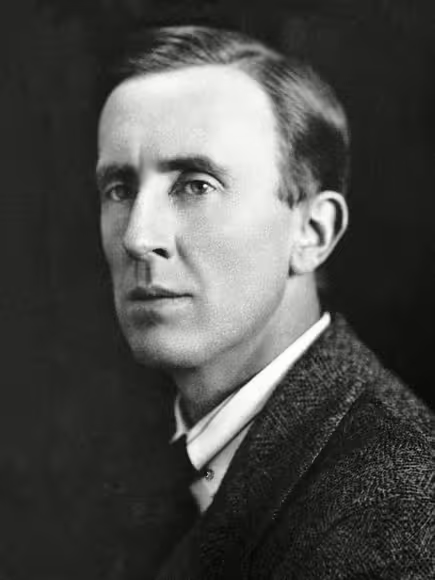
On September 21, 1937, a children's fantasy novel by an Oxford professor appeared in British bookshops.
Its full title was The Hobbit, or There and Back Again.
Its author was J.R.R. Tolkien, a scholar of languages and medieval literature who had spent years creating imaginary languages, legends and histories largely for his own interest.
The new book told the story of an unadventurous hobbit named Bilbo Baggins, who is unexpectedly drawn into a journey with the wizard Gandalf and thirteen dwarves seeking to recover a treasure guarded by the dragon Smaug.
The publisher, George Allen & Unwin, initially printed only 1,500 copies.
Within three months, they were sold out.
The success surprised both publisher and author.
More importantly, it prompted Tolkien to begin writing another story about hobbits.
That story eventually became The Lord of the Rings.
An Oxford Professor
John Ronald Reuel Tolkien was not primarily known as a novelist when The Hobbit appeared.
He was an academic specializing in Old and Middle English, Germanic languages and medieval literature.
Since 1925, he had held the position of Rawlinson and Bosworth Professor of Anglo-Saxon at the University of Oxford.
Languages fascinated Tolkien from childhood.
He did not simply study existing languages.
He invented his own.
But Tolkien discovered that creating a language naturally encouraged him to imagine the people who might speak it, their history, their mythology and the world in which they lived.
Long before Bilbo Baggins appeared, Tolkien had already begun creating the vast collection of myths and legends that would eventually form the background of Middle-earth.
A Sentence on a Blank Page
The origin of The Hobbit was unexpectedly ordinary.
Around 1930, Tolkien was marking a large number of examination papers.
One student had left a page blank.
On that empty space, Tolkien suddenly wrote:
“In a hole in the ground there lived a hobbit.”
He later admitted that he did not know why he had written the sentence or even exactly what a hobbit was.
But the word interested him.
If a hobbit lived in a hole, what kind of creature was it?
What did it eat?
How did it live?
And what might happen if such a comfortable creature were suddenly forced to leave home?
Those questions gradually became a story.
Stories for the Tolkien Children
Tolkien often created stories for his children.
Some were written down, while others developed through storytelling at home.
The Hobbit grew in a similar environment.
The central character became Bilbo Baggins, a respectable and comfortably settled hobbit who values meals, routine and the safety of his home at Bag End.
His peaceful existence changes when the wizard Gandalf arrives.
Soon Bilbo's home is filled with thirteen dwarves led by Thorin Oakenshield.
They intend to travel to the Lonely Mountain and recover the treasure of Thorin's ancestors from the dragon Smaug.
To Bilbo's horror, Gandalf has suggested that the hobbit accompany them as their burglar.
A Journey Into a Larger World
Bilbo's adventure carries him far beyond the familiar landscape of his home.
He encounters trolls, goblins, elves, giant spiders, wolves and the great dragon himself.
He travels through Rivendell, crosses the Misty Mountains and enters the dangerous forest of Mirkwood.
The journey gradually changes him.
The hesitant figure who leaves Bag End becomes increasingly resourceful, courageous and independent.
But Tolkien's story is not simply about physical bravery.
Bilbo repeatedly succeeds because of intelligence, restraint, compassion and an ability to see situations differently from the warriors around him.
The Creature in the Darkness
One of the most important moments occurs beneath the Misty Mountains.
Separated from the dwarves, Bilbo finds himself alone in underground tunnels.
There he encounters a strange creature named Gollum.
The two challenge each other with riddles.
During this episode, Bilbo also obtains a mysterious ring that can make its wearer invisible.
In the original 1937 book, the ring was primarily a useful magical object within Bilbo's adventure.
Tolkien had not yet developed it into the central instrument of power that would later dominate The Lord of the Rings.
That transformation would eventually require Tolkien to revise part of The Hobbit.
The Story Is Finished
By January 1933, the main story of The Hobbit was essentially complete.
Yet Tolkien did not immediately attempt to publish it.
For several years, the manuscript remained something shared mainly with family members and friends.
Tolkien read the story to his children and lent copies of the manuscript to people he knew.
Without one particular chain of events, the story might have remained private for much longer.
Elaine Griffiths
One of the people who knew about the manuscript was Tolkien's former student Elaine Griffiths.
In 1936, Griffiths mentioned the story to Susan Dagnall, who worked with the publishing firm George Allen & Unwin.
Dagnall became curious.
She asked Tolkien if she could read the manuscript.
She liked what she saw and believed the story might be suitable for publication.
Tolkien was encouraged to prepare a complete typescript for formal consideration by the publisher.
During 1936, he revised the text and prepared the unfinished portions of the manuscript for submission.
The Ten-Year-Old Reader
The manuscript eventually reached publisher Stanley Unwin.
Unwin had a useful method for judging children's books.
He sometimes gave them to his own children to read.
The Hobbit was handed to his ten-year-old son Rayner Unwin.
Rayner was paid a small fee to produce a reader's report.
His verdict was enthusiastic.
He believed the story would appeal strongly to children.
Stanley Unwin trusted his young reader's judgment.
George Allen & Unwin decided to publish the book.
Rayner Unwin would eventually become an important figure in Tolkien's publishing career and, years later, would strongly support the publication of The Lord of the Rings.
Tolkien the Illustrator
Tolkien's involvement in the book went far beyond writing the text.
He was also a talented amateur artist and had produced drawings and maps while developing the story.
The publisher initially believed that maps would be sufficient.
Tolkien disagreed.
George Allen & Unwin eventually accepted a number of his illustrations.
Tolkien also designed the striking dust jacket, using mountains, trees, symbols and a dragon to create a visual introduction to Bilbo's world.
The first printing contained eleven one-colour drawings and maps, together with an additional halftone image of Mirkwood.
The combination of text, maps and illustrations meant that much of the first edition's visual identity came directly from Tolkien himself.
September 21, 1937
On September 21, 1937, The Hobbit, or There and Back Again was officially published in Britain by George Allen & Unwin.
The first printing consisted of just 1,500 copies.
The book was bound in green cloth decorated with Tolkien's designs.
Its maps appeared on the endpapers.
The colorful dust jacket was also based on Tolkien's own artwork.
No one involved yet knew that surviving copies of this modest first printing would eventually become some of the most valuable modern first editions in book collecting.
An Immediate Success
The response was much stronger than the publisher had expected.
Reviews were enthusiastic.
Children enjoyed the adventure, but adults also recognized the unusual depth behind Tolkien's apparently simple fairy tale.
The entire first printing was sold out by December 1937, less than three months after publication.
A second impression was quickly prepared.
This new printing included additional color artwork by Tolkien.
Four full-color plates were added, depicting locations and scenes including Hobbiton, Rivendell and Smaug's treasure.
The book was no longer a small publishing experiment.
It had become a success.
Across the Atlantic
The Hobbit soon reached readers outside Britain.
An American edition followed, bringing Bilbo's adventure to a much larger market.
The book received further recognition when it was honored by the New York Herald Tribune as an outstanding juvenile story of the season.
The expanding readership surprised Tolkien.
He had written a story rooted in his private interests in language, mythology and northern European literature.
Yet readers with no academic knowledge of those traditions responded immediately to Bilbo, Gandalf, Gollum and Smaug.
A Children's Book With Deep Roots
The Hobbit was marketed primarily as a children's book, and Tolkien deliberately adopted the voice of a storyteller addressing younger readers.
Behind that accessible surface, however, lay decades of scholarship.
Tolkien drew inspiration from Old English and Old Norse literature, Germanic legend, medieval heroic poetry and fairy tales.
Even the names of many dwarves had roots in Old Norse tradition.
The dragon Smaug belonged to a literary family extending back through medieval dragon legends, including the dragon in Beowulf, a poem Tolkien knew exceptionally well as a scholar.
Yet the book never required readers to recognize these sources.
They simply made its imaginary world feel older and deeper than the story occurring on the page.
Middle-earth Was Already There
Tolkien did not invent his entire mythology specifically for The Hobbit.
For many years he had already been developing stories about elves, ancient kingdoms, great wars and invented languages.
These writings would eventually form the foundation of The Silmarillion.
When he began The Hobbit, Bilbo's adventure was comparatively separate from this mythology.
But elements of Tolkien's older world gradually entered the story.
Names, places and historical references linked Bilbo's journey with the much larger imaginary history Tolkien had been creating privately.
Tolkien later described the process as Bilbo's comic adventure being drawn toward the edge of his greater mythology.
The Publisher Wants Another Hobbit
The commercial success of the book created an immediate question.
What could Tolkien publish next?
George Allen & Unwin wanted another book about hobbits.
Tolkien initially offered material from his much older collection of legends that would eventually become The Silmarillion.
The publisher did not consider it an appropriate follow-up.
What they wanted was a sequel to The Hobbit.
In December 1937, only a few months after Bilbo first appeared in bookshops, Tolkien began writing one.
The Sequel Becomes Something Else
At first, Tolkien did not know exactly what another hobbit story should contain.
Many of the obvious ingredients had already been used.
There had been dwarves, goblins, elves, trolls, a dragon and a journey across Middle-earth.
But one apparently minor object remained available.
Bilbo's ring.
As Tolkien worked on the new story, the ring began to acquire a much darker history.
It became the One Ring, connected directly with Sauron and the central struggle of the Third Age.
The cheerful sequel requested by the publisher gradually became a far larger and more serious work.
Tolkien spent more than a decade writing it.
Changing The Hobbit
The development of The Lord of the Rings created a problem.
The original 1937 version of Bilbo's encounter with Gollum did not entirely fit the new history of the Ring.
In the first edition, Gollum was less possessive about the ring and was even prepared to give it to Bilbo as the prize in their riddle contest.
Once Tolkien had transformed the ring into an object capable of corrupting its possessor, that behavior no longer made sense.
Tolkien therefore rewrote significant portions of the chapter Riddles in the Dark.
In the revised version, Gollum desperately wants to keep the ring, while Bilbo finds it accidentally and later escapes using its power.
The revised account became the version familiar to most modern readers.
Bilbo's Original Story Becomes Part of the Fiction
Tolkien even found an ingenious way to explain the contradiction between the two versions.
Within the fictional history of Middle-earth, Bilbo had originally lied about exactly how he obtained the Ring.
The earlier published story could therefore be treated as Bilbo's own misleading account.
What began as a practical revision of an earlier children's book became part of the mythology itself.
It was an example of Tolkien's unusual determination to make his imaginary world appear internally historical, complete with unreliable accounts and competing versions of events.
The Lord of the Rings
The sequel begun in late 1937 eventually became The Lord of the Rings.
The work grew far beyond the scale originally imagined by George Allen & Unwin.
Instead of another short adventure for children, Tolkien produced an enormous narrative involving war, language, history, mythology, politics and the destruction of the Ring Bilbo had discovered beneath the Misty Mountains.
It was published in three volumes between 1954 and 1955.
Bilbo remained an important figure, but the central journey passed to his younger relative Frodo Baggins.
Without the unexpected success of The Hobbit, the book that became The Lord of the Rings might never have been written in its familiar form.
The Hobbit's Own Identity
The later fame of The Lord of the Rings sometimes causes The Hobbit to be treated simply as its introduction.
But the earlier book was created as an independent story.
Its scale is smaller, its narrator more playful and its structure closer to a traditional fairy tale.
Its central concern is not the fate of the entire world but the transformation of one ordinary individual.
Bilbo begins as someone who dislikes uncertainty and considers adventure an unwelcome disruption.
He returns home materially wealthier, but the more important change is in the way he sees the world and himself.
A Different Kind of Hero
Bilbo was an unusual fantasy hero.
He was not a warrior, king or chosen champion.
He was a comfortable middle-aged householder who enjoyed food, furniture and routine.
His size and temperament made him appear insignificant beside heroic figures such as Thorin.
Yet his apparent ordinariness was central to Tolkien's idea.
Bilbo repeatedly succeeds because the qualities others dismiss as weaknesses become strengths.
He listens.
He thinks before acting.
He shows mercy.
And when the expedition becomes consumed by pride and treasure, Bilbo is capable of recognizing the danger before many of the supposed heroes around him.
Smaug
The dragon Smaug became one of the book's most memorable creations.
He is enormously powerful but is not simply a monster waiting to be defeated.
Smaug speaks.
He is intelligent, manipulative, vain and extremely dangerous.
His conversations with Bilbo turn the confrontation into a battle of language as well as courage.
The treasure he guards also introduces one of the darker themes of the story.
Possession of wealth can become destructive even after the dragon himself is gone.
The final conflict is therefore not merely about killing a monster.
It is about what happens when different groups believe they have a right to the same treasure.
Maps of an Imaginary World
Tolkien's maps also helped establish a feature that would become strongly associated with modern fantasy literature.
Readers could follow Bilbo's route geographically.
Mountains, rivers, forests and settlements existed in relation to one another rather than merely appearing whenever the story required them.
Tolkien's academic interest in languages worked in a similar way.
Places and peoples appeared to possess histories extending far beyond the events being described.
This sense of a larger world became one of the most influential features of Tolkien's fiction.
From 1,500 Copies to a Literary Phenomenon
The first printing of only 1,500 copies now seems extraordinarily small.
Those copies disappeared from bookshops within months.
More editions followed.
Translations introduced Bilbo to readers around the world.
The Tolkien Estate records that The Hobbit has been translated into around 60 languages.
The book has remained in print through generations of readers and has become one of the best-known works of 20th-century fantasy literature.
A Rare First Edition
Original copies from September 1937 are now highly prized by collectors.
They can be identified by details of the binding, illustrations, maps and dust jacket that changed in later impressions.
The small size of the first print run makes surviving copies particularly scarce.
Copies retaining Tolkien's original dust jacket are rarer still.
What began as a modest children's book printed in only 1,500 copies has become an important artifact of modern literary history.
An Unexpected Beginning
Tolkien did not sit down in 1930 intending to create a global publishing phenomenon.
He was marking examination papers when an empty page prompted him to write a sentence about a creature called a hobbit.
He did not initially know what the creature was.
The story developed gradually, was told to his children and then remained unpublished for years.
A former student mentioned it to someone connected with a publisher.
A ten-year-old boy recommended that his father publish it.
A first printing of 1,500 copies appeared.
And readers wanted more.
September 21, 1937
On September 21, 1937, British readers encountered Bilbo Baggins for the first time in a published book.
They entered Bag End, met Gandalf and Thorin's company, crossed the Misty Mountains, encountered Gollum and traveled toward the Lonely Mountain and Smaug.
The story was immediately successful, and its first printing was exhausted before the end of the year.
Its publisher asked J.R.R. Tolkien for another story about hobbits.
Tolkien began writing that sequel in December.
It would take years to finish and eventually become The Lord of the Rings.
But it began because readers had responded so strongly to the small green book released by George Allen & Unwin that September.
The publication of The Hobbit did more than introduce Bilbo Baggins to the world. It opened the door through which Tolkien's vast mythology of Middle-earth entered modern popular culture.
Other Events on This Day
- Nobel Prize-Winning Microbiologist Charles Nicolle Is Born
- The Duryea Brothers' Gasoline Automobile Takes to the Road
Credits: 1st photo: Photographer unknown. Public Domain, via Wikimedia Commons.


