
Sep
21
21
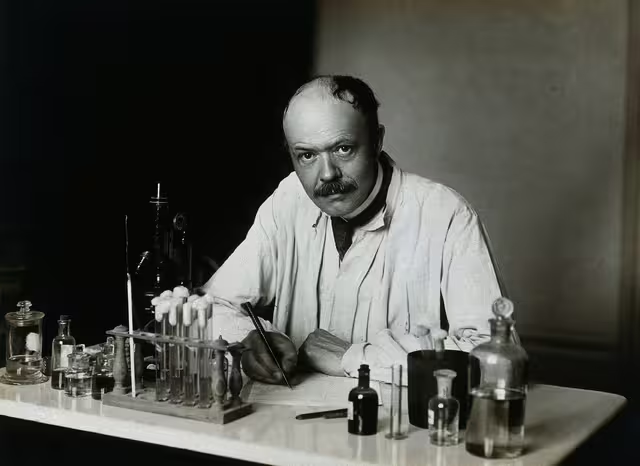
On September 21, 1866, French physician and microbiologist Charles Jules Henri Nicolle was born in Rouen, Normandy.
More than four decades later, while directing the Institut Pasteur in Tunis, Nicolle would solve one of medicine's long-standing mysteries.
He discovered that epidemic typhus was transmitted by lice.
The finding made it possible to attack the disease not only by treating patients but by breaking the chain of transmission through delousing, washing and the treatment of contaminated clothing.
For his work on typhus, Nicolle received the 1928 Nobel Prize in Physiology or Medicine.
His career also produced important research on toxoplasmosis, leishmaniasis, relapsing fever, measles and other infectious diseases.
Perhaps most importantly, Nicolle helped develop the idea that people could carry an infection without showing obvious symptoms, a concept that became fundamental to modern epidemiology.
Born Into a Medical Family
Charles Nicolle was born in Rouen in northern France on September 21, 1866.
His father, Eugène Nicolle, was a physician who worked in the hospitals of Rouen and encouraged his sons toward intellectual and scientific careers.
Charles was not the only member of the family to enter science.
His older brother Maurice Nicolle also became a microbiologist, while his younger brother Marcel became an art critic and museum specialist.
Charles himself initially possessed interests extending far beyond medicine.
Literature, history, philosophy and the arts remained important to him throughout his life.
Nevertheless, influenced in part by his father, he chose medicine.
Medical Studies in Rouen and Paris
Nicolle began his medical education in Rouen before moving to Paris for advanced training.
There he entered a scientific world being transformed by the discoveries associated with Louis Pasteur and the emerging science of microbiology.
At the Institut Pasteur, Nicolle studied in an environment shaped by scientists such as Émile Roux and Élie Metchnikoff.
The ability to identify microorganisms, reproduce infections experimentally and develop vaccines or serum treatments was changing the practice of medicine.
Nicolle became fascinated by this new approach.
In 1893, he completed his medical doctorate with research on chancroid, a sexually transmitted bacterial infection.
Hearing Loss Changes His Career
During his early medical career, Nicolle developed progressive hearing loss.
For a physician working directly with patients, the condition presented an obvious difficulty.
Traditional clinical examination depended heavily on hearing, particularly when using a stethoscope.
Nicolle increasingly turned toward laboratory medicine, where careful observation through microscopes, cultures and experiments mattered more than hearing.
A physical limitation therefore helped push him toward the field in which he would make his greatest discoveries.
Back to Rouen
After completing his studies, Nicolle returned to his native Rouen.
He worked in medicine while attempting to establish modern bacteriological research in the city.
In 1896, he became head of a bacteriology laboratory connected with the medical school.
He was also involved in the preparation and use of antidiphtheria serum, one of the important medical innovations of the Pasteurian era.
But his years in Rouen were professionally difficult.
Nicolle encountered resistance to some of his plans for expanding microbiological teaching and research.
An opportunity eventually appeared far across the Mediterranean.
The Institut Pasteur in Tunis
At the beginning of the 20th century, a position became available at the Institut Pasteur de Tunis.
Tunisia was then a French protectorate, and the institute formed part of the expanding network of Pasteur institutions studying infectious diseases around the world.
Nicolle accepted the challenge.
He moved to Tunis at the end of 1902 and assumed leadership of the institute, which he would direct from the beginning of 1903 until his death more than three decades later.
The move transformed both Nicolle's career and the scientific reputation of the institute.
A Laboratory Facing Real Epidemics
North Africa presented Nicolle and his colleagues with infectious diseases that were widespread among the population and could be studied under conditions very different from those in northern France.
The institute investigated malaria, typhus, leishmaniasis, brucellosis, trachoma, relapsing fever, cholera and other infections.
Nicolle believed that infectious diseases had to be studied not only as microorganisms inside laboratories but as biological phenomena moving through real populations.
Who became infected?
How did the pathogen move from one person to another?
Could animals act as reservoirs?
Why did some infected individuals become seriously ill while others appeared healthy?
These questions would shape much of his scientific career.
Toxoplasma Gondii
One of the institute's important discoveries involved a small North African rodent known as the gundi.
In 1908, Charles Nicolle and his colleague Louis Manceaux observed an unusual protozoan parasite in tissues from the animal.
At first they believed they were looking at a form of Leishmania.
Further investigation showed that the organism belonged to an entirely different group.
They eventually named it Toxoplasma gondii.
The name Toxoplasma refers to the curved or bow-like form of the organism, while gondii refers to the gundi in which Nicolle and Manceaux had observed it.
Today, Toxoplasma gondii is recognized as one of the world's most widespread parasites.
The Mystery of Typhus
The discovery most closely associated with Nicolle began with another disease.
Epidemic typhus had terrified populations for centuries.
The disease could spread explosively under conditions of poverty, overcrowding, war, imprisonment and displacement.
Patients developed high fever, severe headache, rash and neurological symptoms.
Large outbreaks could kill enormous numbers of people.
Yet at the beginning of the 20th century, doctors still did not understand exactly how typhus passed between humans.
It is important not to confuse epidemic typhus with typhoid fever.
Despite the similarity of their names, they are different diseases caused by different organisms and spread in different ways.
A Strange Pattern in the Hospital
Nicolle noticed something peculiar among typhus patients arriving at a hospital in Tunis.
Outside the wards, the disease appeared highly contagious.
Family members, people caring for patients and staff involved in receiving them could become infected.
Yet once a typhus patient had been admitted to the hospital ward, other patients lying nearby frequently remained unaffected.
Doctors and nurses working inside the ward were also much less likely to contract the disease.
The observation seemed contradictory.
How could a highly contagious patient apparently stop being contagious simply by entering the hospital?
The Hospital Door
Nicolle later described the moment when the solution occurred to him.
As he approached the hospital, he saw a sick man who had collapsed near the entrance.
The scene forced Nicolle to think about what happened to a typhus patient between arriving outside and entering the ward.
The answer was simple.
At admission, the patient's clothing was removed.
The patient was washed and shaved and given clean hospital clothes.
If patients were dangerous before that process but much less dangerous afterward, perhaps the agent responsible for transmitting the disease was not something that remained inside the patient.
Perhaps it lived on the patient's body or clothing.
Nicolle suspected lice.
The Body Louse
The human body louse thrives particularly well when clothing cannot be washed regularly and people live in crowded conditions.
Such circumstances were common during wars, refugee movements, prisons and periods of extreme poverty.
Nicolle's hypothesis therefore fitted the epidemiological behavior of typhus remarkably well.
But observation was not enough.
He needed experimental evidence.
Testing the Hypothesis
Nicolle and his colleagues first succeeded in reproducing typhus experimentally in primates.
In 1909, blood from a human typhus patient was used to infect a chimpanzee.
The infection was then transferred to macaques.
Nicolle and his collaborators allowed lice to feed on infected animals and later transferred those lice to other animals.
The previously healthy animals developed infection.
The experiments demonstrated that lice could carry typhus from one host to another.
In September 1909, Nicolle, together with colleagues Charles Comte and Ernest Conseil, reported the experimental transmission of typhus by the body louse.
How Typhus Actually Spreads
Later research clarified an important detail.
The principal danger is not usually the louse bite itself.
The microorganism responsible for epidemic typhus, now known as Rickettsia prowazekii, multiplies inside infected lice.
The insects excrete infectious material onto the skin.
When a person scratches an irritated bite, contaminated louse feces can be rubbed into small breaks in the skin.
Infection can also occur when contaminated material reaches the eyes or other mucous membranes.
Nicolle had not yet identified every biological detail, but he had revealed the essential epidemiological fact: the louse was the vector connecting one human case to another.
A Discovery With Immediate Practical Value
The importance of the discovery was enormous because lice could be attacked directly.
People could be washed.
Clothes and bedding could be disinfected or treated with heat.
Patients could be deloused before entering communal wards.
Medical authorities could focus preventive efforts on clothing and personal hygiene rather than relying only on isolation.
These measures became particularly important during wartime, when typhus had historically devastated armies and civilian populations.
The discovery helped turn a mysterious epidemic disease into an infection whose chain of transmission could be deliberately interrupted.
War and Typhus
The timing was significant.
Only five years after Nicolle's discovery, Europe entered the First World War.
Millions of soldiers and civilians lived under conditions that could support enormous louse populations.
Typhus outbreaks became particularly severe in parts of Eastern Europe and the Balkans.
Understanding the role of lice meant that military and public-health authorities could use delousing stations, clean clothing and disinfection as weapons against epidemics.
The war demonstrated how valuable epidemiological knowledge could become when large populations were displaced and crowded together.
Infection Without Disease
Nicolle's scientific importance extended beyond identifying particular microbes or vectors.
He became deeply interested in people and animals that carried infections without appearing seriously ill.
Experiments sometimes showed that an animal exposed to an infectious agent failed to develop obvious fever or other symptoms.
Initially, such cases could easily be dismissed as failed experiments.
Nicolle recognized that something more important might be occurring.
An organism could become infected without developing recognizable disease.
He described such cases as inapparent infections.
The Hidden Part of an Epidemic
The concept changed the way epidemics could be understood.
If only visibly sick patients carried an infection, finding and isolating those patients might be sufficient to control an outbreak.
But if apparently healthy people could also become infected and transmit pathogens, much of an epidemic might remain invisible.
The number of diagnosed patients would represent only part of the biological reality.
This distinction between infection and clinical disease is now fundamental to epidemiology.
Modern medicine routinely recognizes asymptomatic and subclinical infections, but the concept was far less obvious during Nicolle's era.
Diseases Have Histories
Nicolle also thought about infectious diseases over much longer periods of time.
He argued that diseases themselves have histories.
They appear, change, spread into new populations and sometimes disappear.
A pathogen, its host, its vector and the surrounding environment form an evolving relationship.
For Nicolle, an epidemic was therefore not simply an attack by an unchanging microorganism.
It was part of a biological process that could change across generations.
These ideas later appeared in his writings on what he called the destiny of infectious diseases.
Research Far Beyond Typhus
The Institut Pasteur de Tunis under Nicolle investigated a remarkable range of diseases.
His teams worked on leishmaniasis, brucellosis, relapsing fever, measles, malaria, trachoma and toxoplasmosis, among others.
Nicolle's work frequently focused on the relationship between pathogens, animals, insects and humans.
This ecological way of thinking about infection anticipated approaches that remain essential to infectious-disease research today.
A Scientific Center in Tunis
Under Nicolle, the Institut Pasteur de Tunis became an internationally recognized center of microbiological research.
Scientists from outside Tunisia came to work there, while local medical problems generated research with global importance.
Nicolle also created the Archives de l'Institut Pasteur de Tunis in 1906, providing a scientific publication for research produced by the institute.
The institution's reputation became closely associated with his name.
Yet Nicolle increasingly considered Tunis itself his intellectual and personal home rather than merely a temporary overseas assignment.
The Nobel Prize
By the 1920s, Nicolle's work on typhus had received international recognition.
In 1928, the Nobel Assembly awarded him the Nobel Prize in Physiology or Medicine.
The official citation was concise:
“For his work on typhus.”
The prize recognized research that had transformed understanding of one of history's most destructive infectious diseases.
Nicolle was then 62 years old.
More Than a Laboratory Scientist
Nicolle never abandoned the literary and philosophical interests of his youth.
He wrote fiction, essays and works dealing with the philosophy of medicine and biology.
His books explored questions that reached beyond individual laboratory experiments.
How do diseases arise?
What determines whether they disappear?
How should scientists think about discovery?
What responsibilities come with medical knowledge?
For Nicolle, science was part of a broader attempt to understand life rather than a collection of isolated technical problems.
The French Academy of Sciences
Scientific recognition continued after the Nobel Prize.
Nicolle had been a corresponding member of the French Académie des sciences since 1920.
In 1929, he was elected a full member.
This is the academy most directly associated with Nicolle, rather than the Académie française devoted primarily to language and literature.
His election placed him among the leading figures of French science.
The Collège de France
In 1932, Nicolle was appointed to a chair at the prestigious Collège de France in Paris.
By this time he had spent almost three decades working in Tunis.
His lectures allowed him to discuss not only specific diseases but broader principles of experimental medicine.
He continued publishing works on the nature and evolution of infectious diseases while remaining director of the Institut Pasteur de Tunis.
Science in a Colonial Setting
Nicolle's work in Tunis also belonged to a particular historical setting.
Tunisia was under a French protectorate throughout his years at the institute.
European colonial institutions possessed power and resources that were distributed very unequally across society.
At the same time, the infectious diseases Nicolle studied were real public-health problems affecting people throughout Tunisia.
His discoveries therefore emerged from the complicated intersection of scientific medicine, colonial administration and the everyday health conditions of North African communities.
Understanding that context is important when considering the history of tropical and colonial medicine.
A Scientist Who Watched Carefully
The story of Nicolle's typhus discovery illustrates one of the simplest and most difficult scientific skills: noticing something that everyone else has seen without understanding.
Doctors had watched typhus patients enter hospitals for years.
They knew the disease spread outside the wards and seemed to stop spreading after admission.
The facts were visible.
What was missing was the connection between them.
Nicolle asked what physically changed when a patient crossed the hospital threshold.
The answer led from clothing and washing to lice, from lice to experiments, and from experiments to a new strategy for preventing epidemics.
The Difference Between Observation and Proof
Nicolle's reasoning also showed why scientific discovery requires more than intuition.
The hospital observations suggested that lice were responsible.
But Nicolle did not stop there.
He constructed experiments capable of transferring the disease through lice between animals.
The observation produced the hypothesis.
The experiment provided the evidence.
This combination of field epidemiology and laboratory investigation became characteristic of the research tradition associated with the Pasteur institutes.
A Lasting Influence on Epidemiology
Modern infectious-disease control depends heavily on the same kinds of questions Nicolle asked.
What is the pathogen?
Where does it live?
How does it move between hosts?
Does an insect or animal serve as a vector or reservoir?
Can people transmit infection without appearing sick?
Which point in the transmission chain can be interrupted most effectively?
Technology has changed enormously since Nicolle's laboratory experiments, but these epidemiological questions remain familiar.
Death in Tunis
Charles Nicolle remained closely connected with the Institut Pasteur de Tunis until the end of his life.
He died in Tunis on February 28, 1936, aged 69.
He had spent more than half of his adult scientific career there.
According to the Institut Pasteur de Tunis, Nicolle wished to be buried at the entrance of the institute wearing his white laboratory coat.
His grave remains closely associated with the institution he transformed into an internationally recognized center of infectious-disease research.
September 21, 1866
When Charles Nicolle was born in Rouen on September 21, 1866, microbiology itself was still a young science.
Louis Pasteur's germ theory revolution was only beginning to transform medicine.
During Nicolle's lifetime, researchers learned that bacteria, parasites and insect vectors could explain diseases that had terrified humanity for centuries.
Nicolle became one of the scientists who pushed that transformation forward.
In Tunis, he and his colleagues identified Toxoplasma gondii.
He demonstrated that lice transmit epidemic typhus.
He helped establish the importance of infections that produce no obvious symptoms.
And he encouraged scientists to think of infectious diseases not as static entities but as biological relationships that evolve through time.
In 1928, those achievements brought him the Nobel Prize in Physiology or Medicine.
His most famous discovery began with a remarkably simple question: why did typhus seem to stop spreading when a patient crossed the door of a hospital?
Other Events on This Day
- J.R.R. Tolkien's The Hobbit Is Published for the First Time
- The Duryea Brothers' Gasoline Automobile Takes to the Road
Credits: 1st photo: Wellcome Collection, licensed under CC BY 4.0, via Wikimedia Commons.


