
Sep
18
18
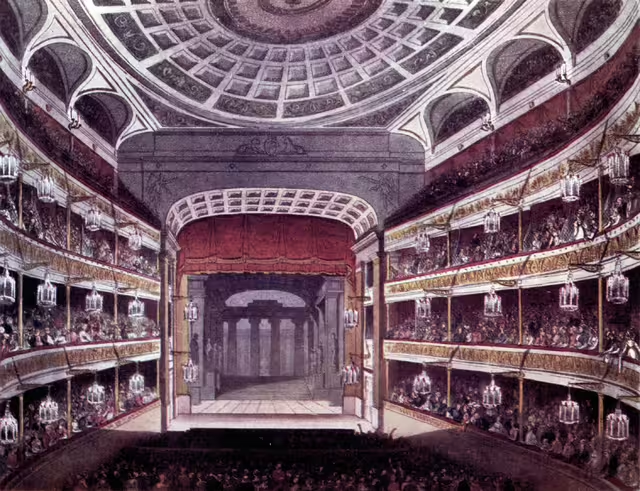
On September 18, 1809, a magnificent new theatre opened in London's Covent Garden.
Known as the Theatre Royal, Covent Garden, it stood on the site occupied today by the Royal Opera House.
The building had been constructed with remarkable speed after its predecessor was destroyed by fire less than a year earlier.
Designed by architect Robert Smirke, the enormous new theatre represented one of the most ambitious entertainment buildings in Georgian London.
Its opening night should have been a celebration.
Instead, it became the beginning of one of the strangest audience rebellions in British theatrical history.
When management increased ticket prices to help pay for the expensive new building, spectators responded with shouting, whistles, rattles, banners and organized disruption.
The disturbances became known as the Old Price Riots and continued for weeks.
The theatre that eventually evolved into London's Royal Opera House therefore began its second great chapter not with polite applause, but with an audience in revolt.
Covent Garden Before the Opera House
The history of theatre at Covent Garden began long before 1809.
The first Theatre Royal, Covent Garden opened on December 7, 1732.
It had been built by actor and theatre manager John Rich, who had earned considerable money from the extraordinary success of John Gay's The Beggar's Opera.
At the time, London theatre operated under a system of royal patents.
Covent Garden and the Theatre Royal, Drury Lane were effectively the two principal London theatres legally permitted to perform spoken drama.
The rivalry between them became one of the defining features of theatrical life in the British capital.
Handel at Covent Garden
Although the early Covent Garden theatre was primarily a playhouse, music quickly became an important part of its identity.
Beginning in 1735, composer George Frideric Handel became closely associated with the theatre.
He presented seasons there as both composer and organist, and several of his important operas and oratorios were performed at Covent Garden.
Among the works associated with the theatre were Alcina and Semele.
Handel eventually left his organ to theatre manager John Rich.
That instrument remained at Covent Garden until disaster destroyed the original theatre.
Fire in 1808
In the early hours of September 20, 1808, fire swept through the Theatre Royal.
The blaze spread rapidly through a building filled with timber, scenery, costumes and other highly combustible materials.
The theatre was completely destroyed.
Valuable scenery, manuscripts, costumes and Handel's organ were lost.
The tragedy was made considerably worse when part of the structure collapsed, killing 23 firefighters.
For Covent Garden, one of London's most important theatres had disappeared almost overnight.
Rebuilding Almost Immediately
The owners decided to rebuild without delay.
The commission went to Robert Smirke, a young architect who would later design major sections of the British Museum.
Smirke embraced the increasingly fashionable Greek Revival style.
His new theatre featured a monumental classical exterior dominated by a large Doric portico facing Bow Street.
The design presented the theatre not merely as a place of entertainment, but almost as a temple dedicated to drama and culture.
Historic England describes it as an important early example of monumental Greek Doric architecture in London.
The Prince of Wales Lays the Foundation Stone
On December 31, 1808, the Prince of Wales, the future King George IV, laid the foundation stone of the new theatre.
The rebuilding effort then proceeded at extraordinary speed.
Less than nine months later, the theatre was ready to receive an audience.
The foundation stone itself survived the later destruction of the building and was eventually incorporated into the present Royal Opera House complex.
A Technologically Advanced Theatre
The new Covent Garden theatre was not simply larger than its predecessor.
It incorporated unusually ambitious engineering for the period.
The auditorium accommodated thousands of spectators, with multiple levels of boxes and galleries surrounding the stage.
The building also incorporated sophisticated systems for heating and ventilation.
Historic England notes that it appears to have been Britain's first centrally heated theatre, using a steam-heating and ventilation system associated with the engineering firm Boulton and Watt.
For audiences accustomed to cold and uncomfortable theatres, such technology represented an important improvement.
An Expensive New Building
Constructing such a large theatre was extremely expensive.
The rebuilding cost approximately £187,000, an enormous amount of money in the early 19th century.
The theatre's management needed to recover the investment.
The solution seemed obvious.
Ticket prices would rise.
That decision would turn the opening night into chaos.
John Philip Kemble
One of the central figures in the rebuilt theatre was John Philip Kemble, one of Britain's most celebrated Shakespearean actors.
Kemble came from an extraordinary theatrical family.
His sister Sarah Siddons was widely regarded as one of the greatest tragic actresses of her generation.
Both were closely involved with the management and performances at Covent Garden.
Kemble intended the new building to provide London with a theatrical institution worthy of its growing population and cultural importance.
But audiences had their own ideas about what a public theatre should be.
The New Prices
Before the reopening, management announced that admission prices would increase.
The price of a seat in the pit rose from three shillings and sixpence to four shillings.
Admission to the regular boxes increased from six shillings to seven.
Another source of resentment was the creation of additional private boxes intended for wealthy subscribers.
To modern audiences, the increases may appear relatively modest.
But many London theatregoers regarded the changes as an attack on something they considered almost a public institution.
They believed that management was making the theatre more exclusive and reducing the space available to ordinary spectators.
September 18, 1809
The new Theatre Royal finally opened on September 18, 1809.
The principal production was Shakespeare's Macbeth.
John Philip Kemble played Macbeth, while Sarah Siddons appeared as Lady Macbeth.
The tragedy was followed by a musical entertainment called The Quaker.
On paper, it was an impressive program for the opening of one of Europe's largest theatres.
In practice, much of the performance was almost impossible to hear.
The Audience Revolts
As Kemble appeared before the audience, spectators began shouting and hissing.
Cries demanding Old Prices spread through the auditorium.
People blew whistles and horns, shook rattles and struck objects together.
Some spectators turned their backs on the stage.
Others displayed signs carrying the letters O.P., meaning Old Prices.
The noise became so intense that much of Macbeth was drowned out.
The actors continued performing, but the audience had effectively created an entirely different spectacle inside the auditorium.
The Old Price Riots Begin
The opening-night disturbance was not a spontaneous protest that disappeared the following morning.
It became an organized campaign.
Night after night, protesters returned to Covent Garden.
They brought bells, whistles, horns, rattles and banners.
They sang songs and performed their own dances while actors attempted to continue the scheduled plays on stage.
The disturbances became known as the Old Price Riots, or simply the O.P. Riots.
Theatre as a Public Space
The dispute involved more than the cost of a ticket.
Georgian theatres were important public gathering places where audiences expected to participate actively in performances.
Spectators openly applauded actors they liked and loudly criticized those they disliked.
Many regarded this behavior as part of their traditional rights as paying members of the audience.
The creation of expensive private boxes therefore carried symbolic significance.
To protesters, it suggested that a public cultural space was being reorganized for the benefit of wealthy patrons.
The argument over prices became an argument about who the theatre belonged to.
Macbeth Versus the Audience
The contrast on opening night must have been extraordinary.
On stage, some of Britain's most respected actors attempted to perform one of Shakespeare's darkest tragedies.
In the auditorium, thousands of spectators were producing an alternative performance of their own.
Trumpets sounded.
Bells rang.
Placards appeared.
Spectators shouted slogans at management.
The disturbance continued into the night, and authorities were called to restore order.
But the conflict had only begun.
More Than Sixty Nights of Protest
The protests continued for more than 60 performances.
Management hired additional security and attempted to identify leading protesters.
Magistrates warned that participants could face arrest.
These measures did little to calm the situation.
Instead, efforts to suppress the protesters sometimes strengthened their determination.
London newspapers eagerly reported developments, turning the dispute into a citywide public controversy.
O.P. Becomes a Symbol
The letters O.P. appeared everywhere in the theatre.
Supporters displayed them on hats, badges and banners.
Political cartoons and satirical prints transformed the dispute into popular entertainment beyond the theatre itself.
The protesters developed songs, slogans and even an O.P. dance.
What had started as anger over several additional pence became one of the most unusual organized consumer protests of Georgian Britain.
Management Finally Gives Way
By December, the continuing disturbances were costing the theatre heavily.
Instead of producing profitable performances in its expensive new building, management was spending money on security while audiences disrupted the shows.
Kemble eventually negotiated with representatives of the protesters.
A compromise restored the old price for the pit and promised changes to some of the controversial private-box arrangements.
Kemble publicly apologized.
The sustained O.P. campaign had largely succeeded.
Opera Was Not Yet the Main Attraction
Although the building stood on the site of today's Royal Opera House, the Theatre Royal of 1809 was not primarily an opera house.
Its program was remarkably varied.
Audiences might see Shakespeare, comedy, pantomime, musical performances, ballet or spectacular entertainment during the same season.
This diversity reflected Georgian theatrical culture, in which an evening at the theatre might contain several entirely different types of performance.
Opera was important at Covent Garden, but it did not yet dominate the institution.
From Theatre Royal to Opera House
Covent Garden gradually became more closely associated with opera during the 19th century.
A major transformation came after conductor Michael Costa left Her Majesty's Theatre with many of its singers.
The Covent Garden auditorium was extensively remodelled.
On April 6, 1847, it reopened as the Royal Italian Opera with a performance of Gioachino Rossini's Semiramide.
By then, the institution was moving much closer to the identity associated with Covent Garden today.
Fire Strikes Again
The magnificent theatre of 1809 would not survive permanently.
On March 5, 1856, fire once again destroyed the Covent Garden theatre.
For the second time in less than half a century, the site was left without its great auditorium.
Plans for another reconstruction followed.
This time the architect was Edward Middleton Barry.
The Building Seen Today
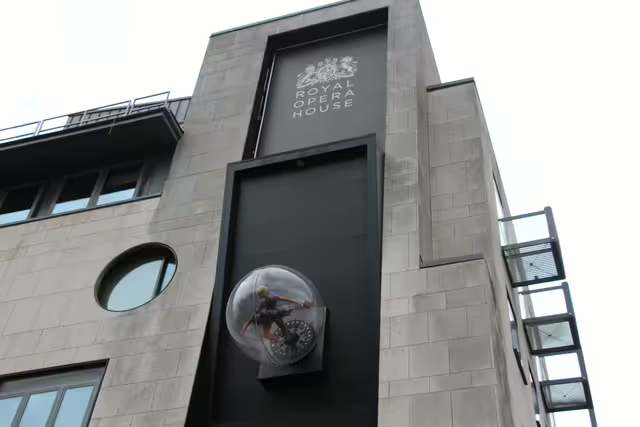
The third theatre at Covent Garden opened on May 15, 1858.
It is this building, heavily restored and expanded over time, that forms the historic core of today's Royal Opera House.
Its grand classical façade and portico therefore date primarily from the Victorian reconstruction rather than the theatre that opened in 1809.
This distinction is important when historical photographs or illustrations of Covent Garden are used.
The present building is the successor to the 1809 theatre, not the same structure.
Becoming the Royal Opera House
The familiar name Royal Opera House came still later.
In 1892, as the repertory expanded beyond predominantly Italian opera to include works in other languages, the institution adopted the name by which it is now internationally known.
Opera and ballet increasingly became the principal forms associated with Covent Garden.
In the 20th century, the building became the permanent home of major British opera and ballet companies.
Today it is associated with The Royal Opera and The Royal Ballet.
Three Theatres on One Site
The history of the Royal Opera House is therefore really the history of three major theatre buildings.
The first opened in 1732 and burned in 1808.
The second opened on September 18, 1809 and burned in 1856.
The third opened in 1858 and, after repeated renovations and expansions, survives today.
Each building reflects a different period in the history of British theatre.
Yet all three occupy essentially the same cultural location at Covent Garden.
A Remarkable Opening Night
The opening of the second theatre in 1809 remains particularly memorable because the audience refused to behave as management expected.
An expensive new building had been completed in less than a year.
Two of Britain's greatest Shakespearean actors were on stage.
The architectural surroundings were spectacular.
But the central event of the evening became the audience itself.
The spectators transformed a dispute over ticket prices into weeks of organized theatrical protest.
September 18, 1809
When the new Theatre Royal, Covent Garden opened on September 18, 1809, it represented London's determination to rebuild one of its great cultural institutions after disaster.
Designed by Robert Smirke and completed with remarkable speed after the devastating fire of 1808, the theatre was intended to begin a triumphant new era.
Instead, its first performance of Macbeth was overwhelmed by an audience demanding the restoration of the old ticket prices.
The resulting Old Price Riots became almost as famous as the building itself.
The 1809 theatre would later evolve into the Royal Italian Opera before another fire destroyed it in 1856.
Its successor, opened in 1858, eventually became known as the Royal Opera House.
So the evening of September 18, 1809 was not literally the opening of today's Royal Opera House.
But it was an important chapter in the long history of Covent Garden as one of London's great centres of theatre, opera and ballet.
Other Events on This Day
- George I Arrives in Britain as the First Hanoverian King
- George Washington Lays the Cornerstone of the U.S. Capitol
Credits: 1st photo by Thomas Rowlandson and Augustus Charles Pugin. Public Domain, via Wikimedia Commons.; 2nd photo by Fred Romero, licensed under CC BY 2.0, via Wikimedia Commons.


