
Sep
17
17
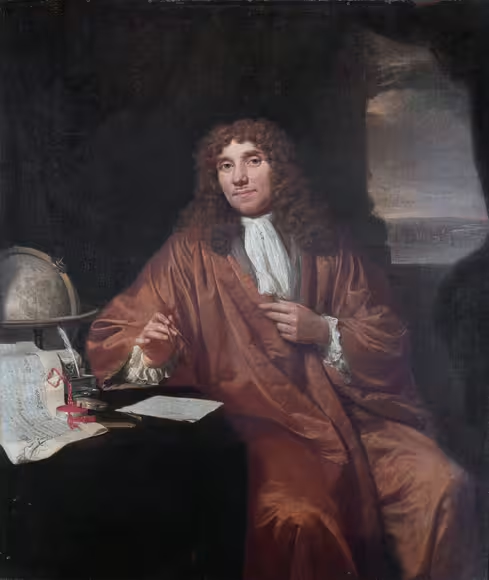
On September 17, 1683, Dutch microscopist Antonie van Leeuwenhoek wrote a remarkable letter describing tiny living creatures he had discovered in material taken from human teeth.
Looking through one of his powerful single-lens microscopes, Leeuwenhoek saw an invisible world moving before his eyes.
He described enormous numbers of tiny organisms swimming through material taken from dental plaque, observing several different shapes and patterns of movement.
He called them animalcules, or little animals.
Today, many of the organisms he described are recognized as bacteria.
The letter became one of the foundational documents in the history of microbiology, revealing that the human mouth contained an entire living community invisible to the naked eye.
A World Nobody Could See
For almost all of human history, people had no idea that microscopic organisms existed.
They could see insects, worms and other tiny animals, but below the limits of ordinary vision was another world containing organisms thousands of times smaller.
The existence of bacteria was not simply unknown.
There was no practical way for people to observe them.
That began to change during the 17th century as improvements in glassmaking and optics allowed investigators to magnify objects far beyond what the human eye could normally resolve.
Among the most remarkable of those investigators was a cloth merchant from the Dutch city of Delft.
Antonie van Leeuwenhoek
Antonie van Leeuwenhoek was born in Delft in the Dutch Republic in 1632.
He was not a university professor or formally trained physician.
He worked as a merchant and later held several municipal positions in Delft.
Yet he developed an extraordinary fascination with lenses and magnification.
Instead of relying on the compound microscopes used by some contemporary researchers, Leeuwenhoek perfected extremely small instruments containing a single carefully made lens.
The device itself could be only a few centimeters across.
A specimen was mounted on a tiny pin and positioned in front of the lens using screws. The observer then held the instrument extremely close to the eye and adjusted the specimen until it came into focus.
Although these microscopes looked simple, Leeuwenhoek's finest lenses were extraordinarily powerful for their time, with some capable of magnifying objects roughly 250 times.
A Microscope Made by Hand
Leeuwenhoek guarded many details of his lens-making methods closely.
He manufactured numerous microscopes during his lifetime, often constructing a new instrument for a particular type of observation.
His instruments lacked the appearance of modern laboratory microscopes.
There was no large tube, eyepiece or mechanical stage.
Instead, the tiny lens was held between metal plates, while the specimen sat on an adjustable point directly in front of it.
The design required patience and excellent eyesight.
But in skilled hands it offered remarkably sharp magnification.
Leeuwenhoek began pointing these instruments at almost anything he could find.
Water, Blood and an Invisible World
Leeuwenhoek examined blood, muscle fibers, insects, plant tissues, crystals, sperm cells and samples of water.
In 1674, he reported seeing tiny living organisms in water taken from a lake near Delft.
Some of these microorganisms would today be described as protozoa or other microscopic protists.
Two years later, while examining water and infusions of substances such as pepper, he described organisms even smaller than those he had previously observed.
His discoveries dramatically expanded the known boundaries of life.
Organisms could exist at scales that natural philosophers had never seriously imagined.
Writing to the Royal Society
Leeuwenhoek communicated many of his discoveries through letters.
Beginning in the 1670s, he sent detailed descriptions of his observations to the Royal Society of London, one of Europe's most important scientific institutions.
The Society had been founded in 1660 to encourage experimental investigation of the natural world.
Its members included some of the leading scientific thinkers of the period, including Robert Hooke.
Leeuwenhoek wrote primarily in Dutch, and his letters were translated and discussed in London.
Some were subsequently published in the Royal Society's journal, Philosophical Transactions.
Extraordinary Claims Require Witnesses
Leeuwenhoek's descriptions were sometimes difficult for other scientists to believe.
The microscopic organisms he reported were smaller than anything most observers had ever seen.
Because Leeuwenhoek's lenses were unusually powerful and he did not freely distribute his best instruments, reproducing his observations could be difficult.
The Royal Society therefore sought independent confirmation of some of his discoveries.
Robert Hooke and other observers eventually succeeded in seeing similar microscopic organisms, strengthening Leeuwenhoek's credibility.
In 1680, the Royal Society elected him as a member.
By the time of his famous dental observations three years later, Leeuwenhoek had become a respected international correspondent despite never following a conventional academic career.
Looking at His Own Teeth
Leeuwenhoek's great discovery of 1683 began with something extremely ordinary.
He looked at his teeth.
Even though he considered his teeth relatively clean, he noticed a whitish substance collecting between them.
Today we would recognize this material as dental plaque, a complex biological film containing microorganisms and substances from the mouth.
Leeuwenhoek suspected that something interesting might be hidden inside it.
He removed a small sample and mixed it with clean rainwater or saliva.
Then he placed it under his microscope.
What he saw astonished him.
The Plaque Was Alive
The apparently lifeless material from his teeth was filled with microscopic organisms.
Leeuwenhoek observed enormous numbers of small living creatures moving through the liquid.
Some moved rapidly.
Others appeared to spin or bend as they traveled.
Still others were so small that he could barely distinguish their form.
He described several different types based on their size, shape and movement.
Modern microbiologists examining his drawings have recognized forms resembling cocci, rod-shaped bacteria, fusiform bacteria and spirochetes.
Without knowing it, Leeuwenhoek was observing part of what we now call the human oral microbiome.
An Ecosystem Inside the Human Mouth
The idea would have been almost unimaginable to people of the 17th century.
A person's mouth did not merely contain traces of dirt or food.
It contained an enormous population of living microorganisms.
Modern science has shown that hundreds of microbial species can inhabit the human oral cavity.
They interact with one another, with food and with tissues in the mouth, forming complex biological communities.
Some are associated with good health, while others can contribute to tooth decay, gum disease and other conditions when the microbial community becomes disturbed.
Leeuwenhoek knew none of this.
But for the first time, he could actually see members of that community.
Three Days Without Cleaning
Leeuwenhoek was an exceptionally persistent observer.
He did not stop after examining a single sample.
He deliberately avoided cleaning his teeth for three days and then examined material collected from around his gums.
Again he found living microorganisms.
He also began collecting samples from other people's mouths.
This transformed a curious observation into something closer to a systematic experiment.
If similar organisms appeared in different people, they were unlikely to be an accidental contamination unique to Leeuwenhoek himself.
A Man Who Had Never Cleaned His Teeth
One of Leeuwenhoek's subjects was an elderly man whose teeth were heavily coated.
Leeuwenhoek asked when the man had last cleaned his mouth.
The answer was extraordinary: according to Leeuwenhoek's account, the man said he had never washed his mouth in his life.
Leeuwenhoek collected material from between his teeth and examined it under the microscope.
The sample contained enormous numbers of moving microorganisms.
He considered some of them among the most active microscopic creatures he had yet observed.
To Leeuwenhoek, even the water in the sample seemed almost alive with movement.
Alcohol Was Not Enough
Leeuwenhoek also examined another older man whose habits were very different.
This man regularly drank strong spirits and wine and used tobacco.
Leeuwenhoek wondered whether exposure to alcohol might kill the microorganisms in his mouth.
Yet material collected from between the man's teeth still contained many living microorganisms.
The observation demonstrated something Leeuwenhoek would investigate further: organisms hidden inside dental deposits could survive conditions that killed exposed organisms.
The Vinegar Experiment
Leeuwenhoek then performed a particularly revealing experiment on himself.
He rinsed his mouth thoroughly with strong wine vinegar.
Afterward, he washed his mouth with clean water and again collected material from his teeth.
To his surprise, he still found enormous numbers of living microorganisms deeper within the dental material.
But when he mixed vinegar directly into a microscopic sample, the organisms quickly stopped moving.
Leeuwenhoek concluded that the vinegar used to rinse his mouth could kill organisms near the surface but could not penetrate deeply enough into the material lodged between the teeth to reach them all.
More than three centuries later, the experiment is striking because it hints at a fundamental property of microbial communities living in biofilms: organisms embedded inside a structured layer can be more protected than organisms exposed directly to an antimicrobial substance.
More Creatures Than People in a Kingdom
Leeuwenhoek repeatedly tried to understand the astonishing scale of the microscopic populations he observed.
He made estimates based on the apparent size and number of microorganisms inside tiny samples.
He became convinced that the number living in material from human teeth could exceed the number of people living in an entire kingdom.
Although his calculations could not have matched modern microbiological measurements, the central realization was correct.
Microscopic life existed in extraordinary abundance.
A world that appeared empty to the naked eye could contain millions of living organisms.
The Letter of September 17, 1683
Leeuwenhoek documented these observations in a letter dated September 17, 1683.
The letter was sent from Delft to Francis Aston, secretary of the Royal Society.
Its subjects extended beyond dental microorganisms.
Leeuwenhoek also discussed structures associated with the nose, skin and other parts of the human body.
But his observations of the microorganisms living on teeth became the letter's most historically significant contribution.
The Royal Society received and discussed the report later that year.
Published in Philosophical Transactions
An English abstract of Leeuwenhoek's letter was published in 1684 in the Royal Society's Philosophical Transactions.
Its title described microscopic observations concerning animals found in the material covering human teeth.
The published account included descriptions of the different microorganisms and their movements.
Readers elsewhere in Europe could therefore encounter a startling idea: an apparently ordinary human mouth contained a population of tiny living creatures that could be observed only with powerful magnification.
The publication became one of the earliest important documents in the history of bacteriology.
Bacteria or Protozoa?
Leeuwenhoek could not classify his discoveries using modern biological categories.
Words such as bacterium, protozoan and microorganism did not yet have their modern scientific meanings.
He therefore used terms meaning little animals or animalcules for many microscopic forms of life.
This can cause confusion when his observations are described today.
Some of the larger organisms Leeuwenhoek had observed in water beginning in 1674 were microorganisms we would broadly associate with protozoa or protists.
But the organisms described in his famous September 1683 observations of dental plaque were predominantly forms that modern scientists recognize as bacteria.
The distinction was impossible for Leeuwenhoek himself to make because modern microbial classification lay centuries in the future.
Before Germ Theory
Leeuwenhoek's discovery did not immediately produce the modern germ theory of disease.
That scientific revolution would come much later.
During the 19th century, researchers including Louis Pasteur, Robert Koch and others demonstrated that specific microorganisms could cause fermentation and disease.
Leeuwenhoek did not possess that conceptual framework.
He was primarily interested in discovering what existed and describing what he could see.
This is an important distinction.
Seeing bacteria and understanding their role in disease were two different scientific achievements separated by generations of research.
The Birth of Microbiology
Nevertheless, Leeuwenhoek's observations were essential because scientific explanations of microorganisms could not develop until scientists knew that microorganisms existed.
He opened a biological world far below the scale visible to human eyes.
His letters described bacteria, microscopic protists, sperm cells, blood cells and many other structures with extraordinary persistence and attention to detail.
For this reason, Leeuwenhoek is often described as one of the founders or fathers of microbiology.
He did not create the modern discipline by himself, nor did he invent microscopy.
But few people did more to demonstrate just how much life existed beyond ordinary human vision.
Robert Hooke and the Microscopic World
Leeuwenhoek was not the only great microscopist of the 17th century.
English scientist Robert Hooke had published his famous book Micrographia in 1665.
Hooke used a compound microscope to reveal detailed structures in insects, plants and other objects.
His drawing of cork helped introduce the biological term cell.
Hooke also illustrated microscopic fungi.
But Leeuwenhoek's exceptionally powerful single lenses allowed him to resolve much smaller objects.
Together, the work of Hooke and Leeuwenhoek transformed microscopy from a curiosity into a powerful instrument for investigating nature.
A Scientist Without a University
One of the most remarkable aspects of Leeuwenhoek's story is that he achieved these discoveries outside the conventional academic world.
He had no university degree and wrote his scientific correspondence in Dutch rather than the Latin commonly used by European scholars.
His professional life included work as a cloth merchant and municipal official.
Yet his observational skills, patience and extraordinary lenses allowed him to make discoveries that university scholars could not easily reproduce.
His relationship with the Royal Society demonstrated an important principle of the emerging scientific culture: observations could matter more than social or academic status if they could eventually be verified.
The Human Microbiome, Three Centuries Early
Modern biology increasingly describes the human body not as a single organism living in isolation but as a habitat shared with vast communities of microorganisms.
Bacteria live on the skin, in the mouth, throughout the digestive system and in many other parts of the body.
Collectively, these microbial communities are known as the human microbiome.
Scientists now study how these organisms interact with human nutrition, immunity, metabolism and disease.
Leeuwenhoek obviously had no concept of a microbiome.
Yet when he scraped material from his teeth in 1683 and watched countless organisms swimming beneath his lens, he was observing exactly such a microbial community.
In that sense, his dental experiment represents one of the earliest glimpses of a field that remains at the forefront of biological research today.
A Letter That Changed the Scale of Life
The importance of Leeuwenhoek's discovery was not simply that he found something unusual on human teeth.
He demonstrated that life existed on a scale completely hidden from ordinary human perception.
A small amount of material that appeared almost featureless could contain an enormous and diverse population of organisms.
The discovery forced natural philosophers to expand their understanding of what a living creature could be.
Life did not end at the smallest insect the eye could see.
There were entire biological worlds below that boundary.
September 17, 1683
When Antonie van Leeuwenhoek wrote his letter on September 17, 1683, he could not have known that his observations would eventually become part of the foundations of microbiology.
He was simply following his extraordinary curiosity into another everyday substance, this time the material collecting on human teeth.
Through his tiny lens, the ordinary became astonishing.
The plaque contained organisms moving, bending and swimming in numbers almost impossible for him to calculate.
What Leeuwenhoek called animalcules would eventually be recognized as members of the vast microbial world surrounding and inhabiting every human being.
More than three centuries later, his observation remains extraordinary for its simplicity.
He took something from between his teeth, placed it beneath a lens and discovered an invisible world of life that had been there all along.
Other Events on This Day
- Pittsburgh's Civic Arena Opens with a Revolutionary Retractable Roof
- The First Linux Kernel Is Released Online
Credits: 1st photo: Portrait of Antonie van Leeuwenhoek by Jan Verkolje, c. 1680–1686. Public Domain, via Rijksmuseum / Wikimedia Commons.


