
Sep
16
16
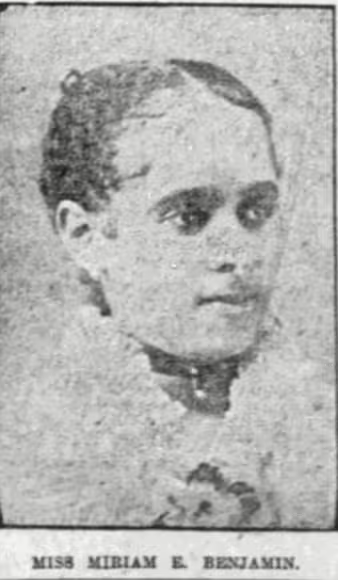
On September 16, 1861, Miriam Elizabeth Benjamin, an American educator, inventor and pioneering patent practitioner, was born in Charleston, South Carolina.
In 1888, while living in Washington, D.C., Benjamin received a U.S. patent for an ingenious device she called the Gong and Signal Chair.
The invention allowed a seated person to summon an attendant simply by pressing a button. A gong sounded and a visible signal appeared on the chair, identifying exactly who required assistance.
Simple as the idea may seem today, it anticipated a basic feature of modern life: the call button.
Born During the Civil War
Miriam Benjamin was born in Charleston during the first year of the American Civil War.
She was born free, but her childhood unfolded in a country where millions of other African Americans remained enslaved and where racial discrimination would continue long after slavery itself was abolished.
After the war, opportunities for Black Americans expanded in some areas while remaining severely restricted in others.
Education became particularly important to African American families seeking greater economic and professional opportunities.
Benjamin's family eventually moved north to Boston, Massachusetts, where she received an education that would help prepare her for an unusually varied professional career.
Becoming an Educator
Teaching was one of the relatively few professional occupations available to educated Black women during the late 19th century.
Benjamin pursued a career in education and taught first in Florida and later in Washington, D.C.
By the 1880s, Washington had developed a significant community of African American teachers, civil servants, professionals and business owners.
Benjamin became part of that emerging Black middle class while working in a society still shaped by racial and gender discrimination.
But teaching was only one of her interests.
An Inventor in Washington
Benjamin began thinking about a problem familiar to anyone who had visited a busy hotel or restaurant.
How could a guest attract the attention of an attendant without shouting, clapping or repeatedly attempting to catch someone's eye?
Her solution was to build the signaling mechanism directly into a chair.
On October 1, 1887, she filed a patent application describing what she called improvements in Gong and Signal Chairs.
The United States Patent Office granted her Patent No. 386,289 on July 17, 1888.
Benjamin had become one of the earliest Black women known to receive a United States patent.
How the Gong and Signal Chair Worked
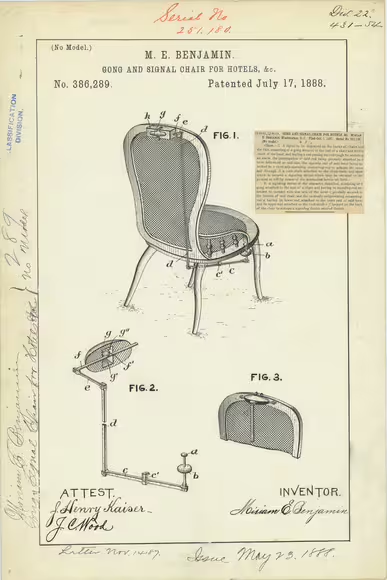
The basic idea was remarkably straightforward.
A person sitting in the chair could press a small button within reach of the hand.
The mechanism would sound a gong while simultaneously operating a visible signal attached to the back of the chair.
In Benjamin's patent design, a rotating signaling element could display a red surface, allowing an attendant to identify which chair had requested assistance.
After responding, the attendant could reset the signal for the next request.
It combined an audible alert with a visual indicator, solving two problems at once: attracting attention and identifying the person who required service.
More Than a Hotel Invention
Although the patent was titled a Gong and Signal Chair for hotels, Benjamin imagined a much broader range of uses.
Her patent specifically proposed installing the device in hotels, restaurants, steamboats, railroad trains, theaters, hospitals and legislative chambers.
A patient in a hospital could summon an attendant.
A passenger could request assistance without leaving a seat.
A legislator could call a page without creating noise across a crowded chamber.
Benjamin understood that the real invention was not simply a special chair. It was a system for discreet communication between a person and an attendant.
Replacing Shouting and Hand-Clapping
Benjamin explained that one purpose of her invention was to eliminate the need for people to clap their hands or call loudly when they wanted service.
She also argued that an efficient signaling system could allow hotels and similar establishments to operate with fewer attendants.
Instead of workers constantly watching every customer for signs that someone required assistance, the customer could communicate that need directly.
The principle is instantly recognizable today.
Hospitals use bedside call buttons. Airplane passengers press buttons to summon cabin crew. Restaurants and service businesses use electronic paging systems.
Benjamin's mechanism was mechanical rather than electronic, but the underlying concept was strikingly similar.
An Idea for the U.S. Congress
Benjamin was not content merely to obtain a patent.
She actively tried to promote her invention.
One of her most ambitious proposals was to have the system installed in the United States House of Representatives.
Members of Congress frequently needed to summon pages to carry messages or perform errands, and the traditional practice of attracting their attention could contribute to the noise inside the chamber.
Benjamin believed her signaling system offered a more orderly alternative.
The House ultimately did not adopt her particular patented mechanism, although a different and more elaborate signaling system was later installed.
Her attempt nevertheless demonstrates that Benjamin viewed herself not simply as someone with an interesting idea but as an inventor attempting to find a practical market for it.
Displayed as an Example of Black Innovation
Benjamin's invention attracted considerable attention in the African American press and among people documenting Black technological achievement.
In 1895, a model of her Gong and Signal Chair was displayed at the Cotton States and International Exposition in Atlanta.
The exposition included a building devoted to achievements by African Americans in education, business, agriculture, industry and technology.
At a time when racist theories routinely claimed that Black Americans were incapable of intellectual or technological achievement, displays of patented inventions carried significance far beyond the objects themselves.
They provided tangible evidence of African American creativity and professional accomplishment.
Henry Baker and the Search for Black Inventors
Benjamin's name also became connected with the work of Henry E. Baker, an African American employee of the U.S. Patent Office.
Baker spent years researching and documenting inventions patented by Black Americans.
This was difficult because the Patent Office did not routinely record an inventor's race.
Baker therefore contacted attorneys, patent officials, community leaders and inventors across the country to identify African American patent holders.
Miriam Benjamin appeared on his lists of Black inventors, helping preserve knowledge of her achievement for later generations.
Beyond Teaching and Invention
Benjamin's career became remarkably diverse.
She passed a competitive civil service examination and worked in the federal government, another important source of professional employment for African Americans in Washington during the period.
She also briefly studied medicine at Howard University.
Some older biographies state that she later graduated from Howard's law school, but surviving university records do not appear to support that claim.
What is much more clearly documented is that Benjamin developed expertise in the patent system and eventually worked as a patent practitioner.
A Pioneer in Patent Law
Benjamin's experience obtaining her own patent apparently became part of a much broader professional interest in intellectual property.
Surviving patent documents show that she acted professionally in connection with patent applications filed by members of her own family.
Later records identified her occupation as a patent attorney.
Modern historical research has therefore identified Benjamin as possibly the first Black woman known to practice professionally in American patent law.
This achievement is particularly striking because both women and African Americans faced enormous obstacles entering the legal profession during her lifetime.
An Inventive Family
Miriam was not the only member of the Benjamin family interested in invention.
Her brothers also obtained patents.
Her brother Edgar P. Benjamin, for example, patented a device associated with protecting trousers while riding a bicycle.
Miriam's involvement in her brothers' patent applications provides some of the strongest surviving evidence of her own work as a patent practitioner.
The Benjamin family therefore represents an unusual example of African American participation in the American patent system during a period when professional and financial barriers made such participation exceptionally difficult.
A Second Patent
Benjamin continued inventing long after the Gong and Signal Chair.
In 1917, nearly three decades after her first patent, she received another patent for a special sole for footwear.
The design incorporated material intended to help keep the foot warm and promote comfort and circulation.
The patent demonstrated that invention had remained part of her life even as she pursued other professions.
Music Under Another Name
Benjamin's creativity apparently extended beyond technology.
She also composed music under the name E. B. Miriam.
Contemporary reports associated her with published marches and other musical compositions.
The use of initials gave the composer's gender less prominence at a time when female composers faced many of the same professional prejudices encountered by women in science, engineering and law.
Her involvement in music adds another remarkable dimension to a life already spanning education, invention, public service and patent work.
Why the Patent Mattered
The Gong and Signal Chair did not transform the world through mass production of Benjamin's particular mechanism.
Its historical importance lies partly in the idea it represented.
Benjamin recognized that a person needing assistance should be able to communicate that need quickly, quietly and from a fixed location.
The same principle appears everywhere in modern service systems.
A passenger aboard an aircraft presses a button above the seat.
A hospital patient calls a nurse without leaving the bed.
A customer receives service through a numbered electronic signal.
These modern systems are technologically different from Benjamin's mechanical chair, and they cannot simply be described as direct copies of her invention.
But they demonstrate how enduring the problem she was attempting to solve has been.
A Black Woman in the Patent System
Benjamin's achievement becomes even more significant when viewed in the context of the 1880s.
The United States Patent Office formally allowed inventors to apply for patents regardless of race or gender, but equal legal eligibility did not create equal opportunity.
Obtaining a patent required technical knowledge, time, money and familiarity with a complicated legal process.
African Americans also faced widespread discrimination in education, employment, finance and business.
Women faced additional restrictions on their professional and economic independence.
Benjamin succeeded inside that environment not only as an inventor but eventually as someone helping others navigate the patent system.
An Often Overlooked Pioneer
Miriam Benjamin never achieved the widespread fame later associated with inventors such as Thomas Edison or Alexander Graham Bell.
Much of her life remains difficult to reconstruct, and even basic biographical claims have sometimes been repeated without strong documentary evidence.
But the surviving records are remarkable enough.
She was an educator, a federal employee, an inventor with multiple patents, a patent practitioner and a composer.
She pursued these careers during an era when the professional world offered very few easy paths to a Black woman.
September 16, 1861
When Miriam Benjamin was born on September 16, 1861, the United States was only months into the Civil War.
Slavery still shaped much of American society, women had no national voting rights and professional opportunities for Black women were extraordinarily limited.
Yet Benjamin would eventually enter classrooms, government offices and the United States patent system.
Her most famous invention began with a simple observation: people should not have to shout or clap their hands merely to ask for assistance.
From that everyday problem came a chair equipped with a button, a gong and a visible signal.
More than a century later, the technology has changed completely, but the idea remains familiar every time someone presses a button to call for help or service.
Other Events on This Day
- The Xerox 914, the First Successful Plain-Paper Copier, Is Unveiled
- W.O. Bentley, Founder of Bentley Motors, Is Born
Credits: 1st photo: Photographer unknown. Originally published in The Boston Globe, May 20, 1906. Public Domain, via Wikimedia Commons.; 2nd photo: Public Domain, National Archives and Records Administration, via Wikimedia Commons.


