
Sep
16
16
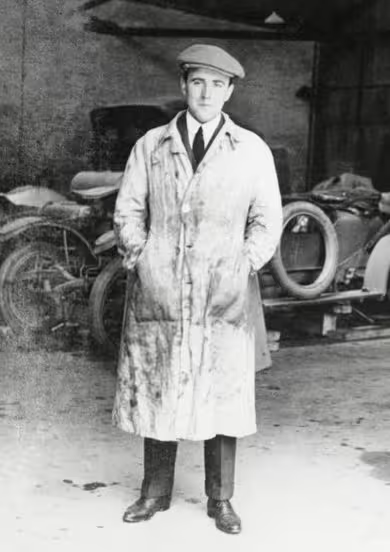
On September 16, 1888, Walter Owen Bentley, the English engineer, racing enthusiast and founder of Bentley Motors, was born in Hampstead, London.
Known throughout his life simply as W.O., Bentley became one of the most influential figures in British automotive history.
His ambition was straightforward but demanding: to build cars that were fast, durable and exceptionally well engineered.
That philosophy produced machines capable of crossing continents in comfort and competing at the highest levels of motor racing. During the 1920s and 1930, Bentley cars won the 24 Hours of Le Mans five times, creating a sporting reputation that remains central to the Bentley name more than a century later.
But W.O. Bentley's engineering career extended far beyond luxury automobiles. Before founding his company, he developed aircraft engines during the First World War, experimented with lightweight aluminium pistons and competed on motorcycles and in cars.
His life became a story of engineering ambition, spectacular racing success, financial collapse and an automotive legacy that survived even after he lost control of the company bearing his own name.
A Childhood Fascination With Machines
Walter Owen Bentley was born in Hampstead as the youngest of nine children.
His fascination with mechanical objects appeared early. As a boy, he bought a second-hand bicycle and dismantled it because he wanted to understand how it worked.
But his greatest childhood fascination was not initially the automobile.
It was the steam locomotive.
At the age of 16, Bentley left school and began a five-year apprenticeship with the Great Northern Railway at Doncaster.
The work provided him with a practical education in heavy engineering. He learned how complex machines were designed, manufactured, assembled and maintained.
He also achieved one of his childhood ambitions by working aboard a steam locomotive, helping keep its enormous firebox supplied with coal.
The railway taught Bentley an engineering principle that would remain important throughout his career: machinery had to be not only powerful, but also strong enough to survive prolonged hard use.
Motorcycles and Competition
Even while training as a railway engineer, Bentley became increasingly fascinated by another rapidly developing technology: the internal combustion engine.
He bought a Quadrant motorcycle and began competing in long-distance motorcycle trials.
In 1907, he entered the London-to-Edinburgh trial. Mechanical trouble nearly ended his attempt, but he repaired the motorcycle and completed the event successfully.
Further competitions followed.
He also raced motorcycles and discovered that competition provided an excellent laboratory for engineering.
A racing machine revealed weaknesses quickly. Components that seemed perfectly adequate during ordinary use could fail when subjected to high speed, heat and continuous stress.
For Bentley, racing and engineering therefore became closely connected.
He was interested not simply in driving faster, but in discovering why one machine could be made faster and more reliable than another.
From Railways to Cars
After completing his railway apprenticeship, Bentley briefly studied theoretical engineering at King's College London and worked in the growing motor industry.
In 1912, he and his brother Horace Millner Bentley established a business importing French automobiles made by Doriot, Flandrin & Parant, usually known as DFP.
W.O. was not satisfied simply selling the cars.
He wanted to improve them.
During a visit to France, an apparently insignificant object gave him an idea that would influence both his automotive and aviation careers.
It was an aluminium paperweight.
The Aluminium Piston
Automobile engine pistons at the time were commonly made from materials considerably heavier than aluminium.
Bentley wondered whether a lightweight aluminium alloy could reduce the mass of the moving components inside an engine and allow it to operate more efficiently at high speed.
The challenge was heat.
Pure aluminium was not suitable for the extreme temperatures and stresses inside a combustion engine, so Bentley experimented with alloys.
He eventually developed pistons using a mixture dominated by aluminium with copper added for strength.
The results were impressive.
Modified DFP cars equipped with Bentley's lightweight pistons performed successfully in competition at Brooklands, Britain's famous motor racing circuit.
A DFP using his improvements achieved a flying-mile speed of approximately 89.7 miles per hour, an exceptional performance for the period.
The experiment established Bentley's reputation as an engineer who understood how lightweight materials could improve high-performance engines.
War Takes Bentley Into the Air
When the First World War began in 1914, Bentley's plans for automobile development were interrupted.
Instead, his expertise became valuable to military aviation.
Bentley served with the Royal Naval Air Service and applied his experience with aluminium pistons to aircraft engines.
Early aircraft engines had to combine several difficult qualities. They needed high power while remaining relatively light, and they had to continue operating reliably under conditions in which mechanical failure could immediately become fatal.
Bentley worked on improving rotary aero engines and eventually became associated with two designs carrying his name: the Bentley Rotary 1, or BR.1, and the BR.2.
The BR.1 was used in aircraft including the famous Sopwith Camel.
His wartime work demonstrated that many of the principles he had explored in racing cars could be equally valuable in the air: low weight, strength, power and reliability.
Recognition for His Wartime Engineering
Bentley's contribution to aircraft engine development earned official recognition.
He was appointed a Member of the Order of the British Empire after the war and received a substantial financial award for his inventions.
The money gave him an opportunity to pursue the ambition he had postponed during the conflict.
W.O. Bentley wanted to build his own automobile.
Not merely another inexpensive form of transportation, but a machine designed around performance and engineering excellence.
Bentley Motors Is Born
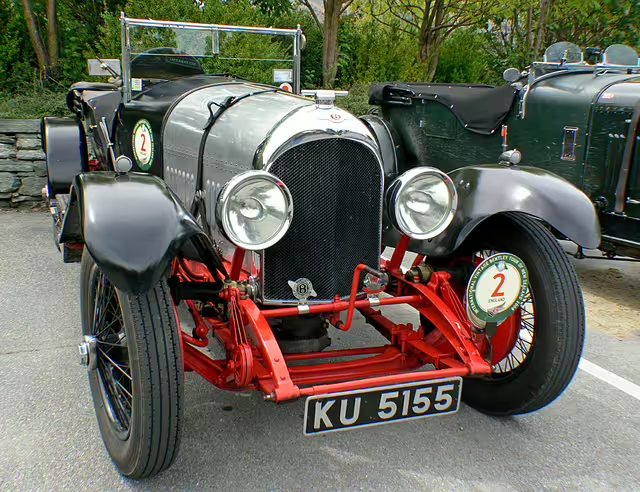
On July 10, 1919, W.O. Bentley founded Bentley Motors in London.
His philosophy was summarized in a statement that became closely associated with him: he wanted to build a fast car, a good car and the best car in its class.
The young company began developing a sporting automobile with a large four-cylinder engine.
The resulting Bentley 3 Litre established many of the qualities that would define the marque.
It was powerful, technically advanced and exceptionally robust.
Rather than building a lightweight racing machine useful only on a circuit, Bentley wanted a road car capable of combining speed with endurance.
Customers could travel long distances quickly and then compete with essentially the same machinery.
Engineering for Endurance
The 3 Litre engine incorporated several sophisticated features for its time, including four valves per cylinder, twin spark plugs and extensive use of lightweight metals.
But absolute maximum power was not W.O.'s only objective.
Reliability mattered just as much.
This philosophy made Bentley automobiles particularly well suited to endurance racing, where surviving hour after hour at high speed could be more important than having the fastest car for a single lap.
That combination would soon connect the Bentley name permanently with a new motor race held in France.
A Crazy Race Called Le Mans
The first 24 Hours of Le Mans was held in 1923.
When Bentley owner John Duff proposed entering a 3 Litre, W.O. was initially skeptical.
The idea of racing a car continuously for 24 hours seemed almost unreasonable.
Cars, he believed, were not designed to withstand such punishment.
But Duff entered with Bentley works driver Frank Clement.
Their performance changed W.O.'s mind.
The Bentley finished fourth and recorded the fastest lap, despite losing considerable time after its fuel tank was damaged.
W.O. recognized that Le Mans offered an extraordinary opportunity to prove exactly what he valued most in an automobile: speed combined with durability.
Bentley Wins Le Mans
In 1924, John Duff and Frank Clement returned to Le Mans with stronger factory support.
This time, they won.
The victory transformed Bentley's reputation.
Here was a British automobile capable of surviving one of the most demanding tests in motorsport while maintaining extraordinary speed.
Bentley won Le Mans again in 1927.
Then came an extraordinary period of domination.
Bentleys won in 1928, 1929 and 1930, giving the company five victories between 1924 and 1930.
The small manufacturer from London had become one of the dominant forces in international motor racing.
The Bentley Boys
The company's racing success became inseparable from a group of wealthy British drivers and enthusiasts popularly known as the Bentley Boys.
They included figures such as Woolf Barnato, Tim Birkin, Dudley Benjafield and others whose combination of money, courage and enthusiasm helped create the mythology surrounding the company.
They drove Bentleys hard both on racing circuits and on public roads and became symbols of the glamorous world of 1920s motoring.
Woolf Barnato became particularly important.
A wealthy businessman and accomplished driver, he invested heavily in Bentley Motors when the company needed financial support.
Barnato was also extraordinarily successful at Le Mans, winning every time he entered the race: in 1928, 1929 and 1930.
The Bentley Boys provided publicity and excitement.
W.O. provided the engineering philosophy that made their exploits possible.
More Power Without Compromise
As competitors became faster, Bentley continually developed larger and more powerful cars.
The 3 Litre was followed by models including the 4½ Litre and the six-cylinder 6½ Litre.
A high-performance development of the latter became the Speed Six.
The Speed Six represented W.O.'s preferred approach to obtaining more power: increase engine capacity while maintaining reliability and smoothness.
It proved spectacularly successful.
The Speed Six won Le Mans in both 1929 and 1930.
W.O. Bentley Versus the Blower
One of the most famous Bentley racing cars was also one that W.O. Bentley personally disliked.
Racing driver Tim Birkin believed the 4½ Litre engine should be fitted with a supercharger to produce considerably more power.
W.O. disagreed.
He believed increasing engine capacity was a more reliable method and worried that supercharging would compromise the integrity of his design.
Birkin nevertheless obtained financial backing and developed the supercharged Blower Bentley.
The car became one of the most recognizable Bentleys ever built, but it never achieved the same competitive success at Le Mans as W.O.'s naturally aspirated Speed Six.
The disagreement illustrates something fundamental about Bentley's engineering philosophy.
He was interested in performance, but not performance at any cost.
Speed had to be combined with mechanical strength.
The 8 Litre
W.O. Bentley's ultimate automobile for his own company appeared in 1930.
The enormous Bentley 8 Litre combined a nearly eight-liter six-cylinder engine with extraordinary refinement.
W.O. wanted to create a car capable of approximately 100 miles per hour while remaining exceptionally quiet and smooth.
It represented his idea of the ultimate grand touring automobile: powerful enough to travel at remarkable speed yet sophisticated enough for comfortable long-distance driving.
Technically, it was one of Bentley Motors' greatest achievements.
Commercially, its timing could hardly have been worse.
The Great Depression
The Wall Street Crash of 1929 triggered a worldwide economic crisis.
The market for extremely expensive high-performance automobiles collapsed.
Bentley's engineering ambitions had always been costly, and motor racing consumed additional resources.
Even financial support from Woolf Barnato could not protect the company indefinitely.
Only around 100 examples of the Bentley 8 Litre were produced.
In 1931, Bentley Motors entered serious financial difficulty and receivership.
The company was ultimately acquired by Rolls-Royce.
W.O. Bentley had lost control of the company bearing his own name.
Working for His Former Rival
The takeover was personally difficult for W.O.
He remained connected with the new Rolls-Royce-owned Bentley organization for several years, but he no longer possessed the freedom he had enjoyed when designing his own automobiles.
Rolls-Royce developed a new generation of Bentley cars under its own engineering direction.
The marque survived, but the company W.O. had created had fundamentally changed.
In 1935, when his contractual obligations allowed him to move on, Bentley joined another British automobile manufacturer.
It was called Lagonda.
A Second Engineering Career at Lagonda
At Lagonda, W.O. once again had an opportunity to apply his engineering ideas more directly.
He became technical director and helped develop improved versions of the company's large sporting automobiles.
He was involved in the development of the LG45 and a sophisticated new V12.
The Lagonda V12 became one of the great British high-performance automobiles of the late 1930s.
Two specially prepared V12 Lagondas finished third and fourth at Le Mans in 1939, shortly before the Second World War brought European motor racing to a halt.
More than a decade after Bentley cars had dominated the race, W.O.'s engineering influence could still be seen at Le Mans.
An Engine That Would Power Aston Martin
During and after the Second World War, Bentley and the Lagonda engineering team developed a new twin-cam six-cylinder engine for a smaller postwar automobile.
Then another famous name entered the story.
In 1947, industrialist David Brown acquired Lagonda after having already purchased Aston Martin.
The engine designed by a team under W.O. Bentley's leadership became an important part of the newly combined company's future.
A development of the Bentley-led Lagonda six-cylinder engine powered the Aston Martin DB2.
W.O.'s engineering influence therefore reached far beyond automobiles carrying the Bentley name.
Long after losing his original company, his ideas were helping establish another legendary British sports-car marque.
More Than a Car Manufacturer
W.O. Bentley's career is sometimes summarized simply as the story of the man who founded a luxury automobile company.
That description misses much of what made him important.
He was fundamentally an engineer.
He worked with steam locomotives, motorcycles, racing cars, aircraft engines and grand touring automobiles.
He understood racing not merely as entertainment but as a severe engineering test.
If a component survived 24 hours at racing speed, the lessons learned could help create a better road car.
That relationship between competition and production automobiles became one of the central principles of performance car development throughout the 20th century.
Performance Without Fragility
Perhaps the most important feature of W.O. Bentley's philosophy was his belief that speed should not make a machine fragile.
His best automobiles were large, powerful and extremely strong.
They were not always the lightest or most delicate racing machines, but their ability to continue operating under enormous stress made them formidable endurance competitors.
The same qualities appealed to wealthy road-car customers.
A Bentley was expected to travel quickly across great distances while combining sporting performance with craftsmanship and comfort.
That concept eventually became known as the grand tourer, and it remains deeply associated with Bentley today.
The Man Behind the Initials
Walter Owen Bentley preferred to be known simply as W.O.
By the later decades of his life, those two initials had become immediately recognizable within the British motor industry.
He had watched automobiles develop from unreliable experimental machines into sophisticated high-speed transportation.
He had seen racing circuits transform from rough tests of mechanical survival into organized international motorsport.
He had also lived through the rise of aviation, two world wars and enormous changes in engineering technology.
Few automotive pioneers had participated in so many stages of that transformation.
The Death of W.O. Bentley
W.O. Bentley died on August 13, 1971, in Woking, England, at the age of 82.
By then the Bentley company was very different from the independent manufacturer he had created in 1919.
Yet the name had survived.
More importantly, so had the basic concept behind it: automobiles combining exceptional performance with long-distance refinement and engineering strength.
A Name That Outlived the Company He Created
There is an unusual irony in W.O. Bentley's story.
He controlled Bentley Motors for little more than a decade.
The company lost its independence in 1931, and W.O. spent much of the remainder of his career designing automobiles for other manufacturers.
Yet more than a century after the company's founding, his surname remains one of the most recognizable names in motoring.
Bentley's racing victories, especially at Le Mans, created an identity powerful enough to survive changes of ownership, factories, technology and generations of customers.
The modern Bentley is technically separated from W.O.'s original machines by an enormous gulf, but the combination of speed, endurance, luxury and grand touring ability remains central to the marque.
September 16, 1888
When Walter Owen Bentley was born on September 16, 1888, the automobile was still an experimental invention and powered flight had not yet been achieved.
During his lifetime, he would help develop engines for both cars and aircraft.
He raced motorcycles, experimented with aluminium pistons, designed wartime aircraft engines and created automobiles capable of dominating the world's most demanding endurance race.
His company would eventually pass out of his control, but his engineering reputation survived that loss.
W.O. Bentley did not merely give a luxury car manufacturer its name.
He helped establish an idea that still defines great performance automobiles today: a truly fast car should also be strong, refined and capable of going the distance.
Other Events on This Day
- African American Inventor and Educator Miriam Benjamin Is Born
- The Xerox 914, the First Successful Plain-Paper Copier, Is Unveiled
Credits: 1st photo: Photographer unknown. Public Domain, via Wikimedia Commons.; 2nd photo by Bernard Spragg. CC0 1.0, via Wikimedia Commons.


