
Sep
18
18
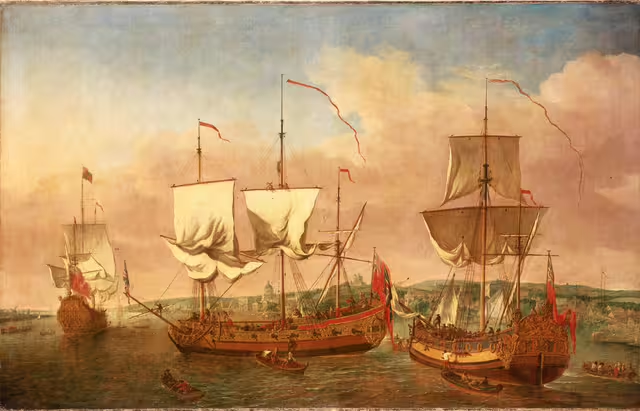
On September 18, 1714, a royal yacht sailed up the River Thames toward Greenwich carrying a man who had already been King of Great Britain and Ireland for more than six weeks.
His name was George Louis, Elector of Hanover.
Following the death of Queen Anne on August 1, he had inherited the British throne as George I under the succession established by the Act of Settlement.
Now, at the age of 54, the German-born monarch was finally arriving in the country he had been called to rule.
His landing at Greenwich marked the physical arrival of a new royal dynasty in Britain: the House of Hanover.
A Crown Without a Direct Heir
The events that brought George to the British throne had developed over many years.
Queen Anne had endured numerous pregnancies, but none of her children survived to adulthood.
Her last surviving child, Prince William, Duke of Gloucester, died in 1700 at the age of eleven.
His death created a serious problem for the Protestant succession.
Anne's father, King James II, had been removed from power during the Glorious Revolution of 1688 and replaced by his Protestant daughter Mary II and her husband William III.
James and his descendants remained Roman Catholic, and many members of Parliament were determined to prevent a Catholic restoration.
The question was therefore not simply who was related most closely to the royal family.
It was also who could legally inherit the Crown under the religious settlement that had developed after 1688.
The Act of Settlement
In 1701, Parliament passed the Act of Settlement.
The legislation established that if William III and Princess Anne produced no surviving Protestant heirs, the Crown would pass to Sophia, Electress of Hanover, and her Protestant descendants.
Sophia was a granddaughter of King James I through his daughter Elizabeth Stuart.
There were numerous Catholic relatives who were genealogically closer to the throne, but the Act excluded Catholics from the succession.
The legislation therefore deliberately directed the Crown toward the Protestant branch of the royal family in Hanover.
England and Scotland Become Great Britain
The succession question was also connected with the relationship between England and Scotland.
Before 1707, the two kingdoms shared a monarch but retained separate parliaments.
Scottish politicians were not initially obliged to accept the same successor chosen by the English Parliament.
This raised the possibility that after Queen Anne's death, England and Scotland might choose different monarchs.
The political problem contributed to negotiations that resulted in the Acts of Union of 1707.
England and Scotland became the Kingdom of Great Britain with a single Parliament at Westminster.
The Hanoverian succession was consequently recognized throughout the new kingdom.
Sophia Almost Becomes Queen
For more than a decade, Sophia of Hanover remained the designated successor to Queen Anne.
Had events occurred only slightly differently, Britain might have received an elderly queen from Hanover rather than her son.
But Sophia died in June 1714, only weeks before Anne.
The right of succession therefore passed to Sophia's eldest son, George Louis, Elector of Hanover.
When Queen Anne died on August 1, 1714, George immediately became King George I of Great Britain and Ireland.
He did so without being physically present in either kingdom.
A King Still in Hanover
George was in Hanover when news of Anne's death reached him.
He was not an obscure German prince suddenly discovering that he had inherited a distant crown.
He had ruled Hanover for years and was an experienced European political and military figure.
His responsibilities there could not simply be abandoned overnight.
He needed to organize the government of his German territories, prepare his household and make arrangements for his new position in Britain.
Consequently, while George was legally king from August 1, several weeks passed before he began the final journey to his new kingdom.
What Was Hanover?
Hanover was part of the complex political structure known as the Holy Roman Empire.
George was Elector of Brunswick-Lüneburg, commonly called the Elector of Hanover.
As an elector, he belonged to the small group of rulers entitled to participate in choosing the Holy Roman Emperor.
Hanover was significantly smaller than Great Britain, but it was an increasingly important German state with its own government, army and diplomatic interests.
George did not cease to rule Hanover when he became British king.
The accession therefore created a personal union: Great Britain and Hanover remained separate states but shared the same monarch.
The Journey West
George eventually left Hanover accompanied by his eldest son, George Augustus, the future George II.
The royal party traveled through the Netherlands before preparing to cross the North Sea and English Channel.
For the final part of the journey, George boarded the royal yacht Peregrine.
The vessel was accompanied by a substantial naval escort.
The journey was reportedly affected by poor weather and fog, delaying the king's arrival.
Finally, on September 18, the royal squadron approached Greenwich on the Thames.
September 18, 1714
George I landed at Greenwich on the evening of September 18.
His arrival was marked by gun salutes, flags and crowds gathered along the river.
Members of the political and aristocratic establishment traveled to Greenwich to meet their new sovereign.
The scene represented an unusual moment in British monarchy.
The man stepping ashore was already king, yet for most of his new subjects he was still almost a stranger.
He had grown up and governed in Germany, spoke German and French but relatively little English, and brought with him a political and cultural background shaped primarily by continental Europe.
The Peregrine
The royal yacht that carried George into Britain had an important ceremonial role.
Peregrine brought the new king from the Continent to Greenwich under the protection of a naval squadron.
Before leaving the ship, George knighted its captain, William Sanderson, in recognition of his service during the voyage.
The event became one of the first honors conferred by the new Hanoverian king after reaching Britain.
Medals were also produced commemorating George's arrival, depicting the event as the beginning of a new reign and celebrating his passage across the sea.
A Night at the Queen's House
George did not immediately proceed into central London.
He spent his first night in Britain at the Queen's House in Greenwich.
The elegant building had been designed earlier in the 17th century by architect Inigo Jones and stood near the remains of the old royal palace at Greenwich.
For one night in September 1714, it became the temporary residence of Britain's new king.
The following days were filled with receptions, ceremonies and political meetings as George began establishing his court.
A New Royal Family Arrives
George's eldest son had accompanied him to Britain.
On September 27, 1714, George Augustus was formally created Prince of Wales.
His wife, Caroline of Ansbach, and their daughters subsequently traveled from Hanover to Britain.
One important family member remained behind.
Their young son Frederick, George I's grandson and a future Prince of Wales, stayed in Hanover for many years.
The Hanoverian royal family was therefore divided between its British and German territories almost from the beginning of the new reign.
The Queen Who Never Came
George arrived in Britain without a queen beside him.
He had married Sophia Dorothea of Celle in 1682, but their marriage had ended disastrously.
After accusations surrounding her relationship with Count Philip Christoph von Königsmarck, the marriage was dissolved in 1694.
Sophia Dorothea was confined at Ahlden Castle in Germany, where she remained for the rest of her life.
She therefore never became Queen of Great Britain and never joined George in London.
The British court began the Hanoverian period without a reigning queen consort.
Not Everyone Accepted George
George's accession was legally established by Parliament, but political acceptance was not universal.
Supporters of the deposed Stuart dynasty, known as Jacobites, rejected the Hanoverian succession.
They supported James Francis Edward Stuart, the Roman Catholic son of James II.
To Jacobites, James was the legitimate heir to the Stuart monarchy.
To supporters of the parliamentary succession, George was the lawful Protestant king under the constitutional settlement established after the Glorious Revolution.
The competing claims would soon lead to armed rebellion.
Religion and Succession
The dispute was deeply connected with religion.
George did not inherit the throne simply because he was the closest surviving relative of Queen Anne.
He inherited because the Act of Settlement required a Protestant succession.
The legislation excluded Catholic claimants regardless of closer hereditary relationships.
This constitutional principle would remain an important feature of the British monarchy long after George's reign.
His arrival therefore represented both a dynastic change and the implementation of a parliamentary decision made thirteen years earlier.
Whigs and Tories
George also arrived in the middle of intense political rivalry between the Whigs and Tories.
The two groupings were not modern political parties in the contemporary sense, but they represented powerful networks of politicians, aristocrats and interests competing for influence.
Many leading Whigs had strongly supported the Hanoverian succession and presented themselves as defenders of the Protestant settlement.
Some Tories had served Queen Anne's government and were viewed with greater suspicion by supporters of the new dynasty because of perceived sympathy toward the Stuarts among parts of the Tory movement.
George increasingly appointed Whigs to important offices.
The result was a prolonged period in which Whig politicians dominated central government.
Coronation at Westminster Abbey
George's arrival in September prepared the way for his formal coronation.
On October 20, 1714, George I was crowned at Westminster Abbey.
His limited command of English created an unusual ceremonial problem.
Much of the coronation service was therefore conducted in Latin, a language that could be understood by both the king and senior British clergy and officials.
The coronation formally presented the new Hanoverian monarch to the kingdom, but it did not eliminate political opposition to his rule.
The Jacobite Rising of 1715
Less than a year after George's arrival, Jacobite opposition developed into open rebellion.
In 1715, supporters of James Francis Edward Stuart raised forces, particularly in Scotland.
The uprising attempted to replace George I with the exiled Stuart claimant.
Jacobite forces fought government troops at several locations, including Sheriffmuir in Scotland and Preston in England.
James himself eventually arrived in Scotland, but the rebellion failed to secure the political and military support necessary to overthrow George.
By early 1716, the rising had collapsed and James returned to continental Europe.
George's dynasty had survived its first major armed challenge.
A King Who Still Ruled Hanover
George's new crown did not end his connection with Germany.
He remained Elector of Hanover and continued to take a close interest in its affairs.
He repeatedly traveled back to Hanover during his reign.
These journeys occasionally irritated British political opinion, particularly when critics believed Hanoverian interests were influencing British foreign policy.
But from George's perspective, Hanover was not merely a former home.
It remained a territory for which he was personally responsible as ruler.
The British and Hanoverian crowns would remain united in the same family for more than a century.
Language and Government
George's limited English has become one of the most frequently repeated facts about his reign.
It should not, however, be treated as a complete explanation for the political developments that followed.
George could communicate in French, which was widely used among European elites, and he was an experienced ruler before arriving in Britain.
Nevertheless, his unfamiliarity with British political customs and his dependence on ministers contributed to changes in the relationship between monarch, ministers and Parliament.
Over time, government increasingly depended on ministers capable of maintaining support in Parliament.
The Rise of Robert Walpole
One politician became particularly important during George's reign.
Robert Walpole emerged as the leading minister after the financial crisis surrounding the South Sea Bubble in 1720.
From 1721, Walpole exercised extraordinary influence over both the king and Parliament.
He is often described as Britain's first prime minister, although that title was not yet an official office in the modern sense.
His position depended on maintaining royal confidence while also commanding sufficient support in the House of Commons.
This combination became increasingly central to the development of Britain's parliamentary system.
The Cabinet Changes
George initially participated actively in meetings with his senior ministers.
After 1717, however, he attended Cabinet meetings less frequently.
Ministers increasingly discussed government business collectively and presented decisions to the king.
The process did not suddenly create modern parliamentary democracy, nor did George surrender all political authority.
The monarch remained an important participant in appointments, foreign affairs and government.
But the political structures developing during his reign contributed to the longer-term evolution of Cabinet government.
Britain Was Already Changing
The country George encountered in 1714 was very different from the England that his Stuart ancestors had ruled a century earlier.
Great Britain had been created only seven years before his arrival.
Parliament possessed substantial constitutional authority.
The Bank of England had been founded in 1694.
London was becoming one of Europe's major commercial and financial centers.
Britain had also emerged from the War of the Spanish Succession with increased international influence.
George therefore inherited both a monarchy and a political system that had already undergone profound change before he ever set foot in Greenwich.
The Beginning of the Georgian Era
George I gave his name to the beginning of what became known as the Georgian era.
He was followed by George II, George III and George IV, creating a sequence of monarchs whose reigns extended deep into the 19th century.
The period witnessed enormous political, economic and cultural transformations.
Britain expanded its global trade and empire, experienced the beginnings of industrialization and underwent major changes in parliamentary politics.
The term Georgian would eventually become associated not only with kings but also with architecture, design, literature and urban development.
None of that could have been obvious to the crowd watching George I arrive at Greenwich in 1714.
More Than a Foreign King
George I has often been reduced in popular history to a simple image: a German king who could barely speak English and preferred Hanover to Britain.
The reality was more complicated.
He arrived with decades of experience governing a European state and had participated in major military and diplomatic affairs on the continent.
At the same time, he entered a British political system whose customs, personalities and conflicts were unfamiliar to him.
His reign therefore became a negotiation between the responsibilities of a European dynastic ruler and the increasingly parliamentary character of British government.
A Dynasty That Lasted More Than a Century
The personal union between Britain and Hanover continued under George I's descendants.
George II inherited both territories in 1727, followed by George III and George IV.
William IV also ruled both Britain and Hanover.
The connection finally ended in 1837.
Queen Victoria inherited the British throne, but Hanover followed different succession rules that prevented her from becoming its sovereign.
The Hanoverian throne instead passed to her uncle Ernest Augustus.
By then, more than 120 years had passed since George I landed at Greenwich.
George Returns to Hanover
Despite becoming a British king, George never lost his attachment to Hanover.
He continued visiting his German territories throughout his reign.
In 1727, while traveling toward Hanover once again, George became seriously ill.
He died on June 11 under the calendar then used in Britain, corresponding to June 22 in the modern Gregorian calendar.
Unlike most British monarchs of his era, he was buried in Hanover rather than England.
His son succeeded him as George II.
September 18, 1714
When George I landed at Greenwich on September 18, 1714, he had already been king for more than six weeks.
The Crown had passed to him immediately upon Queen Anne's death under the succession established by Parliament.
But his arrival transformed that legal succession into something visible.
A German elector stepped from the royal yacht Peregrine onto British soil, accompanied by his son and greeted by politicians, aristocrats, soldiers and spectators.
He entered a kingdom whose language he barely spoke, whose political traditions differed from those of Hanover and whose population included determined opponents of his claim.
Within a year, his rule would face a Jacobite rebellion.
Yet the dynasty established in 1714 endured.
The arrival at Greenwich on September 18 marked the beginning of more than a century in which the British Crown and Hanover were united under the same royal family.
Other Events on This Day
- George Washington Lays the Cornerstone of the U.S. Capitol
- The New Theatre Royal, Covent Garden Opens in London
Credits: 1st photo by Jan Griffier the Elder, c. 1710–1715. Public Domain. Original in the National Maritime Museum, Greenwich.


