
Sep
18
18
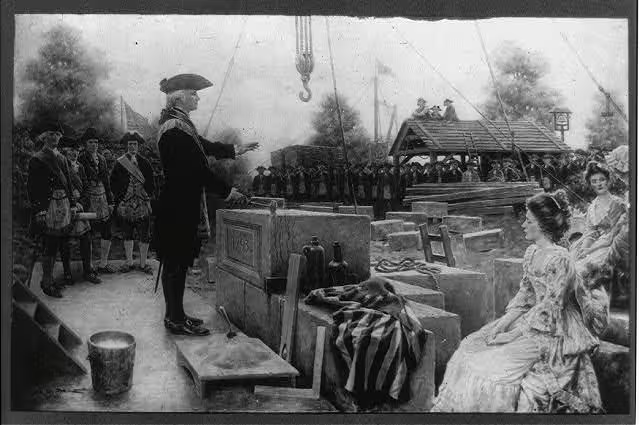
On September 18, 1793, President George Washington took part in a ceremonial procession through the unfinished city that would bear his name and laid the first cornerstone of the United States Capitol.
Washington stepped into the building's foundation trench, placed an engraved silver plate beneath a massive block of sandstone and helped lower the stone into position.
The ceremony combined the symbolism of the young American republic with traditions of Freemasonry, of which Washington was a member.
At the time, there was no great white dome, no monumental staircase and almost none of the city that millions of visitors recognize today.
The site was largely surrounded by undeveloped countryside.
Yet the stone placed there that September day marked the beginning of a building that would become one of the most recognizable political landmarks in the world.
A New Country Needs a Capital
When the United States became independent, it did not immediately have a permanent national capital.
The Continental and early federal governments met in several cities, including Philadelphia and New York.
Deciding where the permanent seat of government should be located became a major political question during the first years of the new republic.
In 1790, Congress passed the Residence Act, establishing that a new federal district would be created along the Potomac River.
President Washington was given an important role in selecting its location.
The area eventually chosen lay between Maryland and Virginia and would become the District of Columbia.
Unlike London, Paris or other established capitals, the new American capital would largely be planned and constructed deliberately for the purpose of national government.
Designing Washington
In 1791, Washington appointed commissioners to oversee the creation of the new federal city.
The French-born engineer Pierre Charles L'Enfant, who had served in the American Revolution, was chosen to prepare its overall plan.
L'Enfant envisioned a city of broad avenues, ceremonial spaces and prominent government buildings arranged across the landscape.
He selected an elevated site known at the time as Jenkins' Hill for the building that would house Congress.
The location stood at the eastern end of what would become the National Mall and provided a commanding view across the future capital.
L'Enfant reportedly described the elevated location as a pedestal waiting for a monument.
Finding a Design for the Capitol
L'Enfant was initially expected to participate in designing the Capitol itself, but disagreements with the commissioners eventually led to his dismissal.
A public competition was then organized to find a design for the new building.
The competition initially produced no proposal that government officials considered completely satisfactory.
Then a late submission arrived from Dr. William Thornton, a physician and amateur architect who had been born in the British West Indies.
Thornton's proposal envisioned a symmetrical classical building divided into three major sections.
One wing would house the Senate, another the House of Representatives, and a central section would connect them beneath a low dome.
George Washington admired the proposal, particularly its combination of grandeur, simplicity and practical organization.
Thornton's design was accepted in 1793 and became the foundation from which the Capitol developed.
Construction Begins
Work on the Capitol's foundations began on August 1, 1793.
The building site bore little resemblance to the carefully landscaped Capitol Hill of later centuries.
The new federal city was still largely a construction zone surrounded by woods, fields, rough roads and scattered settlements.
Building a monumental structure there presented enormous logistical problems.
Workers, tools and construction materials all had to be brought to a site where even basic infrastructure was limited.
One of the most important building materials came from approximately 40 miles south of Washington.
Stone From Aquia Creek
The original Capitol was largely constructed from sandstone quarried near Aquia Creek in Virginia.
The federal government had acquired a quarry there specifically to provide stone for the new capital.
Large blocks had to be cut by hand, transported to the water, loaded onto boats and carried up the Potomac River toward Washington.
The same general source of sandstone supplied material for other important federal buildings, including the President's House, later known as the White House.
The stone chosen for the Capitol cornerstone also came from this region.
Transporting such heavy material was difficult and expensive. Boats could become overloaded, and blocks sometimes arrived damaged or unsuitable for use.
Construction therefore progressed much more slowly than the ceremonial optimism surrounding the project might suggest.
The People Who Built the Capitol
The history of the Capitol's construction also includes labor that was not freely given.
The federal government and its contractors relied substantially on enslaved African Americans rented from their owners.
Enslaved workers participated in many stages of construction, including quarrying and transporting stone, sawing timber, making and laying bricks, carpentry and other physically demanding work.
Free Black workers, white laborers, craftsmen and immigrants also contributed to the building.
Because Washington was still a lightly populated developing city, finding enough skilled and unskilled workers was a persistent problem.
The contributions of enslaved laborers were essential to completing the Capitol and other early federal buildings.
Today, the Capitol Visitor Center includes a commemorative marker recognizing the enslaved people who helped construct the building.
September 18, 1793
On the morning of September 18, Washington crossed the Potomac from Virginia to participate in the cornerstone ceremony.
He was accompanied by a volunteer artillery unit from Alexandria.
Near the construction site of the President's House, the group joined members of Masonic lodges from Virginia and Maryland.
With bands playing, drums beating and flags flying, the procession moved toward Capitol Hill.
The United States Senate describes it as the first parade held in the new city of Washington.
The destination was still little more than an enormous foundation under construction.
But the ceremony surrounding it was intended to emphasize that something of lasting national importance was beginning.
Washington the Freemason
George Washington had been a Freemason for decades.
He had joined the fraternity as a young man in Virginia and maintained connections with Masonic lodges throughout his life.
The laying of important foundation stones had a traditional place in Masonic ceremonies, making those rituals particularly appropriate for the new Capitol.
Representatives of several lodges surrounded the foundation as Washington prepared to place the stone.
The ceremony incorporated traditional Masonic symbols and rituals as well as the formal presence of the president of the United States.
A Silver Plate Beneath the Stone
Before the cornerstone was lowered into position, an engraved silver plate was prepared.
Its inscription recorded the date, identified the building as the Capitol of the United States and named Washington, the federal commissioners, architects and Masonic officials associated with the ceremony.
Washington received the plate and descended into the foundation trench.
He placed it beneath the location selected for the cornerstone.
The massive block was then lowered into place.
The president used ceremonial tools as part of the ritual, while Masonic officials participated around him.
Corn, Wine and Oil
The cornerstone was ceremonially consecrated using corn, wine and oil.
These substances had traditional symbolic meanings within Masonic cornerstone ceremonies.
The ritual connected the physical construction of the building with ideas of prosperity, joy and peace.
Music and ceremonial speeches accompanied the proceedings, while artillery repeatedly fired in celebration.
Washington eventually climbed back out of the foundation trench.
The first cornerstone of the Capitol was in place.
A 500-Pound Ox
The ceremony did not end when the stone was lowered.
A large public celebration followed.
According to historical accounts preserved by the Architect of the Capitol, a roughly 500-pound ox was roasted for those attending.
Food, drink, music and other entertainment continued through the afternoon.
By nightfall, the festivities had ended.
What remained was a foundation, a sandstone block and an ambitious architectural plan for a government building that would take decades to complete in anything resembling its intended form.
Where Is Washington's Cornerstone?
Remarkably, the exact location of the cornerstone eventually became uncertain.
Contemporary reports describe Washington placing it at the southeast corner of the Capitol.
But the building changed so extensively during later construction that historians were left with an important question.
Did the account mean the southeast corner of the first wing being built, or the southeast corner of the entire Capitol as originally planned?
The distinction places the stone in two different potential locations.
The engraved silver plate was never knowingly seen again after the ceremony.
The Search for the Missing Stone
More than two centuries later, investigators have attempted to determine exactly where Washington's cornerstone lies.
In 1991, the Architect of the Capitol worked with scientists from the U.S. Geological Survey to investigate one possible location.
Soil samples were taken and sensitive metal detectors were used in an attempt to detect traces of the silver plate.
No conclusive evidence was found.
A second location was subsequently investigated based on a closer examination of early construction records.
There, investigators found an unusually large sandstone foundation block in approximately the expected position.
The Architect of the Capitol considers the evidence consistent with the possibility that this is Washington's ceremonial cornerstone.
The original silver plate, however, has apparently disappeared.
So one of the most famous foundation stones in American history may still be physically present beneath the Capitol even though its identity cannot be proved with absolute certainty.
The Capitol Was Far From Finished
The ceremony of 1793 might give the impression that construction proceeded steadily from that moment onward.
In reality, progress was difficult.
Money was frequently short.
Materials were difficult to obtain.
Architects disagreed with commissioners over design changes.
Workers were difficult to recruit to the undeveloped federal city.
Several architects successively supervised the early project, including Stephen Hallet, George Hadfield and James Hoban, the last of whom was also the architect associated with construction of the White House.
Congress Arrives in Washington
The federal government remained in Philadelphia while the new capital was being constructed.
Officials faced a fixed deadline: the government was scheduled to move to Washington in 1800.
As that date approached, builders concentrated their efforts on completing enough of the Capitol's north wing for government use.
The result was far from the finished monumental structure envisioned by Thornton.
Some rooms remained incomplete when officials arrived.
Nevertheless, in November 1800, Congress met in the Capitol for the first time.
The building also initially accommodated the Supreme Court, the Library of Congress and other government offices.
A Building That Would Keep Changing
The Capitol placed on its first foundation in 1793 looked dramatically different from the building recognized today.
Thornton had envisioned a central dome, but the enormous cast-iron dome that now dominates the Washington skyline belongs to a much later period.
Construction of the original central Rotunda did not even begin until 1818.
Over the following decades, the Capitol was repeatedly completed, damaged, rebuilt and enlarged.
In effect, Washington's cornerstone began not a single construction project but an architectural process that would continue for generations.
The Burning of Washington
One of the greatest threats to the unfinished Capitol came during the War of 1812.
On August 24, 1814, British forces entered Washington and set fire to important government buildings.
The Capitol was badly damaged.
Its interiors burned, portions of the structure were ruined and years of construction appeared to have been undone in a single night.
The sandstone exterior walls survived sufficiently for much of the building to be reconstructed rather than completely abandoned.
The restoration became another major chapter in the Capitol's development.
The Dome Washington Never Saw
The feature most strongly associated with the Capitol today did not exist during George Washington's lifetime.
An earlier, smaller dome was eventually constructed over the central Rotunda.
But as the country grew and new states joined the Union, the House and Senate required significantly more space.
Large new wings were added during the 1850s.
The older dome suddenly appeared too small for the expanded building.
Architect Thomas U. Walter therefore designed the enormous cast-iron dome whose basic form survives today.
Its construction took place largely during the years surrounding the American Civil War.
The resulting Capitol bears only a partial resemblance to the building imagined when Washington lowered its cornerstone in 1793.
A Second Famous Cornerstone Ceremony
Washington's ceremony was not the last major cornerstone event at the Capitol.
As the building was expanded in the 19th century, another cornerstone was required.
On July 4, 1851, President Millard Fillmore participated in laying a cornerstone for the new House wing.
Secretary of State Daniel Webster delivered the principal address.
By then, the United States and its Capitol had changed enormously.
The ceremony nevertheless echoed the symbolic importance attached to Washington's original act nearly six decades earlier.
The Capitol Today
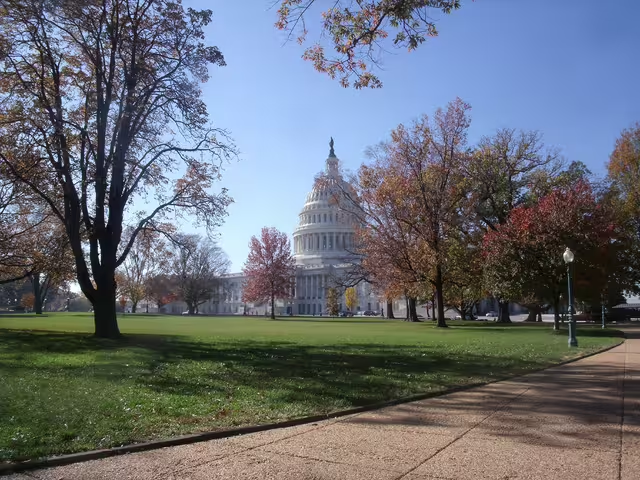
The modern United States Capitol contains more than 600 rooms and over 1.5 million square feet of space.
Its corridors, chambers, staircases and ceremonial rooms reflect many different periods of construction.
The Senate occupies the northern wing and the House of Representatives the southern wing.
Between them rises the Rotunda beneath the great dome.
Much of what visitors see today was constructed long after Washington's lifetime, yet portions of the original sandstone structure remain incorporated within the building.
The Capitol is therefore not simply a monument designed at one moment in history.
It is a structure repeatedly altered as the country, Congress and federal government changed around it.
Remembering the Labor Behind the Monument
The cornerstone ceremony traditionally focused attention on presidents, commissioners, architects and prominent officials.
Modern interpretation of the Capitol's history also recognizes the many people whose physical labor made the building possible.
Among them were enslaved African Americans who quarried stone, cut timber, produced bricks and performed numerous construction tasks.
Their names were often absent from traditional accounts even though their labor was essential.
In 2012, a commemorative marker was dedicated in the Capitol Visitor Center's Emancipation Hall.
It incorporates a block of original Aquia Creek sandstone and explicitly recognizes the role of enslaved laborers in building the Capitol.
The stone still bears visible tool marks left by workers who shaped it.
A Building for a Government That Barely Existed
The circumstances surrounding the 1793 cornerstone are particularly striking when compared with the Capitol today.
The Constitution had been in operation for only a few years.
George Washington was serving his second presidential term.
The government had not yet moved to the city named after him.
The surrounding federal district contained little of the architecture, infrastructure or population that would later define Washington, D.C.
The Capitol was therefore built for institutions that were themselves still new and evolving.
Placing its cornerstone represented confidence that those institutions would endure long enough to require a permanent monumental home.
September 18, 1793
On September 18, 1793, George Washington descended into the foundations of an unfinished building on an undeveloped hill overlooking the Potomac region.
He placed an engraved silver plate beneath a block of Virginia sandstone and participated in a Masonic ceremony marking the beginning of the United States Capitol.
Music played, artillery fired and hundreds of people celebrated around a construction site in a city that scarcely existed.
The original cornerstone later disappeared from certain identification, and the silver plate has never been recovered.
But the building that grew above it became one of the defining landmarks of Washington, D.C.
More than two centuries of fires, reconstruction, expansion and architectural change separate today's Capitol from William Thornton's original design.
Yet somewhere within or beneath that enormous complex may still rest the sandstone block placed there in 1793.
What began with a single cornerstone became the permanent meeting place of the United States Congress and one of the most recognizable buildings in the American capital.
Other Events on This Day
- George I Arrives in Britain as the First Hanoverian King
- The New Theatre Royal, Covent Garden Opens in London
Credits: 1st photo: Painting by Clyde O. DeLand, c. 1920. No known restrictions on publication, via Library of Congress.; 2nd photo by Ibagli. CC0 1.0, via Wikimedia Commons.


