
Sep
15
15
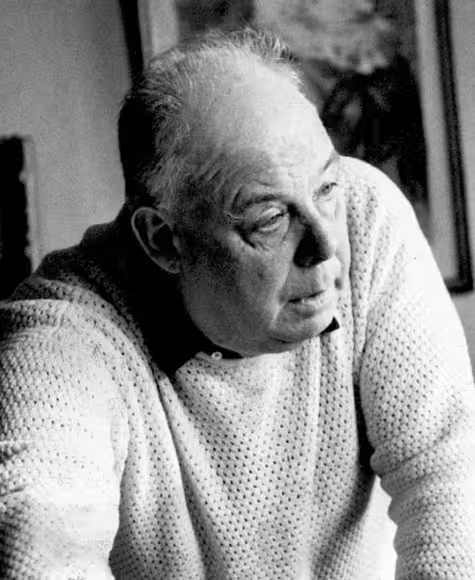
On September 15, 1894, Jean Renoir, the French filmmaker who would become one of the most influential directors in the history of cinema, was born in Paris.
The son of celebrated Impressionist painter Pierre-Auguste Renoir, Jean grew up surrounded by art. Yet rather than following his father into painting, he eventually found his own artistic language through motion pictures.
Over a career stretching from the silent era to television, Renoir worked as a director, screenwriter, producer and actor. His films combined technical innovation with a remarkable interest in human behavior, social class and the complicated motives that shape people's actions.
Two of his works in particular, La Grande Illusion and La Règle du jeu, would come to be regarded as landmarks of world cinema.
The Son of a Famous Painter
Jean Renoir was born in the Montmartre district of Paris into one of France's most remarkable artistic families.
His father, Pierre-Auguste Renoir, was already one of the leading figures of Impressionism, famous for his luminous paintings of people, landscapes and everyday life.
Jean appeared in numerous paintings by his father as a child, sometimes dressed in the long hair and clothing fashionable for young boys of the period.
Art was therefore not something distant or mysterious in the Renoir household. It was part of everyday life.
Another important figure in Jean's childhood was Gabrielle Renard, a relative of his mother who helped care for him. She took him to puppet performances and introduced him to some of the early motion pictures that were beginning to transform popular entertainment.
Those childhood experiences would later seem remarkably appropriate for a man whose career would combine theatrical performance, visual composition and moving images.
War Before Cinema
Renoir initially considered a military career.
When the First World War began in 1914, he served in the French armed forces, first in the cavalry and later in aviation.
In 1915, he was seriously wounded when a bullet struck his leg. The injury damaged his femur and left him with a limp that would remain for the rest of his life.
During his long recovery, Renoir spent considerable time watching films.
He became fascinated by filmmakers such as Charlie Chaplin, D. W. Griffith and Erich von Stroheim, discovering that cinema could be far more than simple entertainment.
The young soldier who had grown up surrounded by paintings was beginning to recognize film as an art form of its own.
From Ceramics to Moving Pictures
After the war, Renoir did not immediately become a filmmaker.
For a time he worked as a ceramic artist, creating pottery influenced by the artistic environment in which he had grown up.
His life changed through his relationship with Andrée Heuschling, one of the last models to work with his father.
Jean married her in 1920. She later adopted the screen name Catherine Hessling and hoped to become a film actress.
Renoir began financing and making films in which Hessling could appear.
What began partly as an attempt to create opportunities for his wife gradually became Renoir's own artistic career.
Learning Cinema in the Silent Era
Renoir began directing during the 1920s, when cinema was still silent.
His early films included La Fille de l'eau, Nana and La Petite Marchande d'allumettes.
These productions were not always commercially successful, and Renoir spent considerable amounts of his own money financing them.
But the failures were also an education.
He experimented with lighting, movement, composition and acting while gradually developing an approach very different from the rigid studio filmmaking that characterized much commercial cinema.
Renoir became increasingly interested in allowing actors to move naturally through space while the camera observed relationships developing around them.
The Arrival of Sound
The introduction of synchronized sound transformed filmmaking at the end of the 1920s.
Some silent filmmakers struggled with the transition, but Renoir quickly recognized its possibilities.
One of his important early sound films was La Chienne, released in 1931.
The dark drama demonstrated Renoir's growing confidence with dialogue, location shooting and complex characters whose actions could not easily be divided into simple categories of good and evil.
In 1932, he directed Boudu sauvé des eaux, known in English as Boudu Saved from Drowning, starring the remarkable French actor Michel Simon.
The comedy about a bourgeois bookseller who rescues a homeless man only to have his orderly household thrown into chaos became another important step in Renoir's development.
People Rather Than Heroes and Villains
A defining quality of Renoir's cinema was his reluctance to present people as purely heroic or purely wicked.
His characters often behaved selfishly, foolishly or destructively, yet Renoir remained interested in understanding why they acted as they did.
Rather than judging people from a distance, his films explored their circumstances, desires and contradictions.
This compassionate approach became one of the most distinctive features of his work.
Renoir's films could be funny and tragic at the same time. Social classes could clash, political systems could fail and people could hurt one another, but individual human beings were rarely reduced to simple symbols.
Toni and a New Kind of Realism
In 1935, Renoir directed Toni, a drama about immigrant workers in southern France.
The film was shot extensively on real locations rather than elaborate studio sets and used a naturalistic visual style that was unusual for its period.
Its emphasis on ordinary workers, authentic environments and everyday life would later be seen as anticipating elements of Italian Neorealism, which emerged after the Second World War.
Renoir was increasingly demonstrating that films could examine society without losing their emotional connection to individual characters.
France in the 1930s
The 1930s were politically turbulent years in France.
The Great Depression, growing political extremism and the rise of fascist governments elsewhere in Europe created an atmosphere of uncertainty.
Renoir sympathized with the political left and became associated with the cultural movement surrounding the Popular Front, the coalition that governed France beginning in 1936.
His films increasingly reflected questions of class, solidarity and social division.
Yet even when dealing with political subjects, Renoir generally avoided turning his characters into simple representatives of competing ideologies.
La Grande Illusion
In 1937, Renoir released one of his greatest films, La Grande Illusion.
Set during the First World War, the story follows French officers held in German prisoner-of-war camps.
Renoir drew partly on his own wartime experiences and those of aviator Armand Pinsard, who had been connected with him during the war.
But La Grande Illusion was not primarily a conventional war film.
Its deeper subject was the artificial nature of the divisions separating human beings.
Nationality divides French prisoners from their German captors, yet social class sometimes creates stronger connections across national boundaries than patriotism does within them.
The aristocratic French officer de Boeldieu and the German commander von Rauffenstein understand one another because they belong to the same disappearing European social class.
Meanwhile, working-class and middle-class prisoners form relationships shaped by entirely different experiences.
A Film Against War
La Grande Illusion appeared at a moment when Europe was moving rapidly toward another major conflict.
Its message of shared humanity and skepticism toward nationalism made it especially powerful.
The film was an international success, but its ideas also made it unacceptable to fascist governments.
It was later banned in Nazi Germany and Fascist Italy.
For Renoir, the tragedy of war was not simply that nations fought one another. It was that political boundaries forced people who might otherwise understand one another into conflict.
The film remains one of cinema's most famous examinations of war, class and human solidarity.
La Bête humaine
Renoir followed with La Bête humaine in 1938, an adaptation of the novel by Émile Zola.
Starring Jean Gabin, one of the great stars of French cinema, the film combined crime, passion and psychological instability against the industrial landscape of France's railway system.
Renoir's camera moved among locomotives, stations and railway workers, giving the film both physical energy and a strong sense of real working life.
By the end of the decade, Renoir had become one of Europe's most respected filmmakers.
Then he made a film that audiences initially seemed to reject.
La Règle du jeu
Released in 1939, La Règle du jeu, or The Rules of the Game, would eventually become perhaps Renoir's most celebrated film.
The story takes place largely during a weekend gathering at a country estate, where wealthy guests and their servants become entangled in romances, jealousies and misunderstandings.
On the surface, the film resembles a sophisticated comedy of manners.
Underneath, it presents a society unable or unwilling to recognize the crisis approaching around it.
Renoir himself appeared in the film as Octave, a sympathetic but ineffective friend whose attempts to help others contribute to the tragedy.
The director therefore literally placed himself among the flawed characters he was observing.
Everyone Has Their Reasons
One of the most famous ideas associated with La Règle du jeu is that everyone has their reasons.
The phrase captures much of Renoir's approach to storytelling.
Characters betray one another, lie, fall in love with the wrong people and make disastrous decisions, but the film continually reveals the circumstances behind their behavior.
Instead of giving audiences a simple villain to blame, Renoir presents a complicated social system in which everyone participates.
His camera frequently moves through rooms filled with several characters at once, allowing different conversations and relationships to exist within the same image.
This use of space and depth would become enormously influential among later filmmakers.
A Disaster That Became a Masterpiece
La Règle du jeu was not immediately recognized as a masterpiece.
Its initial reception in France was hostile, and Renoir shortened the film after negative reactions.
With the outbreak of the Second World War, French authorities banned it as demoralizing.
During the war, elements of the original film were damaged or lost, making the complete version difficult to see for years.
Only after extensive restoration work in the 1950s did audiences begin to encounter something close to Renoir's original conception.
Critical opinion changed dramatically.
A film once rejected by contemporary audiences eventually became a regular presence in international surveys of the greatest films ever made.
War Forces Renoir From France
The Second World War transformed Renoir's life as dramatically as the first had.
After Germany defeated France in 1940, Renoir left Europe and eventually settled in the United States.
He entered Hollywood, but adapting to the American studio system was difficult.
Renoir was accustomed to discovering scenes during filming and giving actors significant freedom. Hollywood studios generally expected tighter schedules, defined scripts and greater producer control.
Despite those frustrations, he made several American films during the 1940s.
The Southerner
Renoir's most acclaimed American production was The Southerner, released in 1945.
The film follows a poor farming family struggling to survive while attempting to build a life on difficult land in the American South.
Its concern for ordinary people and its attention to their environment strongly reflected Renoir's longstanding interests.
The film earned him his only competitive Academy Award nomination for Best Director.
Although Renoir never became completely comfortable within Hollywood, the American period demonstrated that his humanistic approach could cross national and linguistic boundaries.
Becoming an American Citizen
Renoir became a naturalized citizen of the United States in 1946 while maintaining his strong connection with France.
He would spend much of the remainder of his life between the United States and Europe.
His international career increasingly reflected a filmmaker who no longer belonged entirely to one national cinema.
The River
One of Renoir's most visually beautiful films came from an entirely different part of the world.
In 1951, he released The River, filmed in India and adapted from a novel by Rumer Godden.
It was Renoir's first feature film made in Technicolor.
The story follows a group of young people living beside the Ganges and explores childhood, love, death and the cycles of life.
Rather than presenting India primarily as a setting for exotic adventure, Renoir tried to observe everyday rhythms, landscapes and relationships.
The film's extraordinary use of color demonstrated that a director who had become famous for black-and-white cinema could completely reinvent his visual style.
Returning to Europe
During the 1950s Renoir returned to European filmmaking.
His later films included The Golden Coach, French Cancan and Elena and Her Men.
These works were more theatrical and colorful than many of his prewar films.
They frequently explored the relationship between performance and reality, asking what happens when people begin living the roles they have created for themselves.
The subject was particularly appropriate for a director who had spent decades watching actors transform written characters into living human beings.
The Filmmakers Who Rediscovered Renoir
During the 1950s, a new generation of French critics began reassessing the history of cinema.
Writers associated with the magazine Cahiers du cinéma, including future directors such as François Truffaut, Jean-Luc Godard, Éric Rohmer and Jacques Rivette, regarded Renoir as one of cinema's great personal artists.
They admired his fluid camerawork, his freedom with actors and his refusal to force characters into simple moral categories.
When these critics began directing films of their own, helping create the French New Wave, Renoir's influence could be felt in their approach to filmmaking.
A director who had begun working during the silent era had become an inspiration to one of the most modern movements in cinema.
Actor, Writer and Storyteller
Although directing made Renoir famous, his career extended beyond the director's chair.
He appeared as an actor in several films, most memorably as Octave in La Règle du jeu.
He also wrote screenplays, produced films and eventually devoted increasing amounts of time to books.
In 1962, he published Renoir, My Father, an affectionate memoir of Pierre-Auguste Renoir that offered a son's view of one of the great figures of modern painting.
He later wrote novels and his own memoirs, reflecting on the extraordinary transformation of cinema he had witnessed from the silent period through television.
An Honorary Academy Award
By the 1970s, Jean Renoir's place in cinema history was firmly established.
The Academy of Motion Picture Arts and Sciences presented him with an Honorary Academy Award for his lifetime contribution to cinema.
The award recognized a career that had moved through silent films, sound films, documentaries, color productions and television.
Health problems prevented Renoir from attending the ceremony in person, and actress Ingrid Bergman accepted the honor on his behalf.
It represented Hollywood's recognition of a filmmaker whose most important achievements had often taken place far outside the Hollywood system.
The Final Years
Renoir's old wartime injury increasingly affected his mobility as he grew older.
Eventually he required a wheelchair and became less able to work on film sets.
He devoted more of his time to writing while living in California.
Jean Renoir died in Beverly Hills on February 12, 1979, at the age of 84.
His life had stretched across almost the entire development of cinema from a new invention into one of the world's dominant art forms.
A Painter's Son Who Found His Own Canvas
The connection between Jean Renoir and his famous father inevitably shaped discussions of his life.
Both artists were fascinated by people, movement, social gatherings and the pleasures and difficulties of everyday existence.
But Jean never simply reproduced his father's artistic approach.
His canvas moved.
Through actors, cameras, dialogue and sound, Renoir developed a form of cinema in which people could occupy the same frame while experiencing completely different emotions and desires.
His greatest films often seem less interested in telling audiences whom to judge than in encouraging them to look more closely.
A Lasting Influence
Renoir's influence reaches far beyond French cinema.
Filmmakers have continued to study his long takes, fluid camera movements, use of deep space and direction of actors.
But technique alone does not explain his importance.
At the center of Renoir's work was a belief that human beings are complicated.
People may be selfish and generous, ridiculous and dignified, cruel and compassionate, sometimes within the same story or even the same scene.
That refusal to simplify humanity gave his films an unusual emotional richness.
September 15, 1894
When Jean Renoir was born in Paris on September 15, 1894, cinema itself was only beginning to emerge.
The first public film screenings associated with the Lumière brothers were still more than a year away.
Renoir therefore grew up alongside the medium that would eventually define his life.
He saw cinema move from silent black-and-white images to synchronized sound, color, international studio production and television.
And at nearly every stage, he experimented with what the medium could do.
His father became one of the great painters of the 19th century. Jean Renoir achieved something equally remarkable in another art form, becoming one of the filmmakers who helped establish cinema as a serious and enduring form of artistic expression.
Other Events on This Day
Credits: 1st photo: Photographer unknown. Public Domain, Arquivo Nacional Collection, via Wikimedia Commons.


