
Sep
14
14
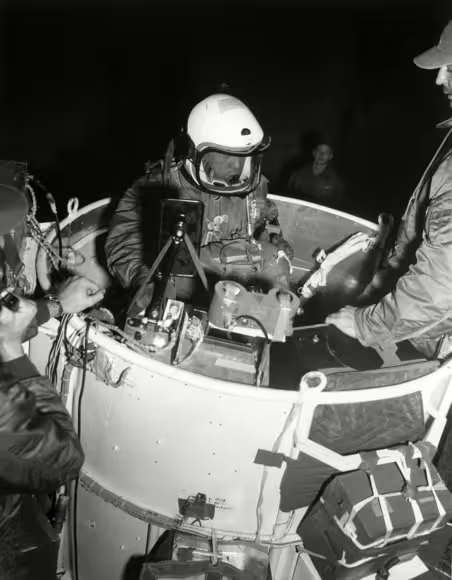
On September 14, 1984, American aviator and balloonist Joe Kittinger lifted off from Caribou, Maine, in a helium-filled balloon called Rosie O'Grady Balloon of Peace.
His goal was extraordinary: to become the first person to cross the Atlantic Ocean alone in a balloon.
For the next several days, Kittinger would drift thousands of miles above the ocean, battling cold, exhaustion and unpredictable winds with no copilot beside him. When he finally reached northern Italy on September 18, he had traveled approximately 3,543 miles, or 5,701 kilometers, and completed the first successful solo transatlantic balloon crossing in history.
A Man Already Famous for Going Higher
For Joe Kittinger, the Atlantic flight was not his first encounter with extreme altitude and danger.
More than two decades earlier, while serving in the United States Air Force, he had participated in experimental high-altitude balloon programs designed to study how humans could survive and escape from aircraft operating near the edge of space.
His most famous mission came on August 16, 1960, during Project Excelsior.
Suspended beneath a helium balloon, Kittinger climbed to approximately 102,800 feet, more than 31 kilometers above New Mexico. Wearing a pressure suit, he stepped from the gondola and fell toward Earth.
His extraordinary parachute jump made him internationally famous and produced valuable information about high-altitude escape systems and human survival in the upper atmosphere.
The records associated with the jump would stand for more than half a century.
War, Captivity and a Return to Flight
Kittinger's career was not limited to experimental ballooning.
He later served as a combat pilot during the Vietnam War and flew hundreds of combat missions. In 1972, while flying an F-4 Phantom II, he was shot down over North Vietnam.
Kittinger ejected from the aircraft and was captured. He spent approximately 11 months as a prisoner of war before returning to the United States in 1973.
He eventually retired from the U.S. Air Force as a colonel in 1978, after a military career spanning nearly three decades.
Retirement, however, did not mean that Kittinger intended to stop flying.
A New Passion for Balloon Racing
Kittinger became deeply involved in civilian ballooning and joined Rosie O'Grady's Flying Circus, an air show organization based in Florida.
He flew balloons and antique aircraft and became a successful competitor in long-distance gas balloon races.
Kittinger won the U.S. James Gordon Bennett Balloon Race in 1982 and would eventually win the competition four times.
Long-distance ballooning required a very different kind of skill from flying a powered aircraft. A gas balloon could not simply be pointed toward its destination and flown there.
The pilot had to understand weather patterns and search for favorable winds at different altitudes, rising or descending to find air currents moving in the desired direction.
Crossing an ocean alone added another level of risk.
The Atlantic Challenge
The Atlantic had already attracted generations of aviation pioneers.
Charles Lindbergh's solo airplane crossing in 1927 had become one of the most celebrated flights in history. Balloonists faced an even less controllable challenge because they depended almost entirely on atmospheric conditions.
In 1978, the American balloon Double Eagle II, flown by Ben Abruzzo, Maxie Anderson and Larry Newman, became the first balloon to complete a successful Atlantic crossing.
But no one had yet accomplished the journey alone.
Several solo attempts had failed, demonstrating just how dangerous the challenge could be.
By 1984, Kittinger's experience in high-altitude flight, military aviation and competitive ballooning made him unusually well prepared to attempt it.
Rosie O'Grady Balloon of Peace
Kittinger's aircraft was a giant helium gas balloon named Rosie O'Grady Balloon of Peace.
The balloon towered above its small gondola, carrying enough helium to remain airborne for days while Kittinger used ballast and altitude changes to manage his flight.
Unlike a hot-air balloon, which must continuously heat the air inside its envelope, Kittinger's balloon obtained its lift from helium, a gas lighter than the surrounding atmosphere.
The pilot's task was not to steer the balloon in the conventional sense but to locate winds that would carry him across the ocean toward Europe.
Weather forecasting was therefore critical. A change in the atmospheric circulation could carry him far from his intended route or leave him facing a dangerous landing at sea.
September 14, 1984
On September 14, approximately a thousand people gathered in Caribou, a small city in northern Maine, to watch Kittinger begin his attempt.
The crowd understood that this was not simply another balloon race.
Once Kittinger left the North American coastline behind, there would be no airport where he could land, no runway to divert to and no second pilot to take control when exhaustion set in.
He climbed aboard the gondola and the enormous helium balloon rose into the sky.
A journey of more than 3,500 miles had begun.
Alone Above the Atlantic
Kittinger crossed the ocean at altitudes generally ranging between approximately 10,000 and 17,000 feet.
The conditions were physically demanding. Temperatures were low, the gondola offered only limited comfort and sleep was a serious problem.
There was no second crew member to maintain watch while Kittinger rested.
He therefore slept only in short intervals, reportedly allowing himself naps of roughly ten minutes while continuing to monitor the balloon and its course.
Fatigue accumulated as one day became another.
Beneath him stretched thousands of miles of ocean. Around him, his direction and speed were determined by winds that could change with altitude and weather.
Yet the balloon continued eastward.
Europe Appears
After crossing the Atlantic, Kittinger reached Europe and continued over southern France toward northern Italy.
By then he had spent approximately three and a half days alone in the air.
On September 18, 1984, the historic objective was achieved. Joe Kittinger had successfully crossed the Atlantic alone in a balloon.
His journey covered approximately 5,700 kilometers from Maine to northern Italy and lasted about 84 hours.
The flight also established new distance records for its class of gas balloon.
A Rough Arrival in Italy
The flight had crossed an ocean successfully, but Kittinger still had to return safely to Earth.
His landing near Cairo Montenotte, close to Savona in northern Italy, was far from gentle.
Wind and rain complicated the descent, and the balloon came down on a wooded hillside.
Kittinger was injured in the hard landing, suffering an injury to his ankle or lower leg, but the accident was not life-threatening.
After days alone over the Atlantic, the 56-year-old aviator had reached Europe alive and entered aviation history once again.
The First Solo Balloon Crossing of the Atlantic
Kittinger's achievement was fundamentally different from earlier successful transatlantic balloon flights because he had made the entire journey alone.
Every decision about altitude, ballast, navigation, weather and rest had been his responsibility.
There was no one else aboard to take over when he became tired and no other pilot with whom to share the continuous demands of the flight.
The successful crossing demonstrated not only technological and aeronautical skill but extraordinary endurance.
It also added another remarkable chapter to a career already defined by pushing the limits of human flight.
From Kittinger to the Edge of Space
Decades later, Kittinger's experience would become important to another record-breaking aviation project.
He served as a mentor and capsule communicator for Austrian skydiver Felix Baumgartner during the Red Bull Stratos project.
On October 14, 2012, Baumgartner ascended beneath a giant balloon to more than 128,000 feet before jumping toward Earth, surpassing several records associated with Kittinger's famous 1960 flight.
Kittinger, then in his eighties, communicated directly with Baumgartner from mission control.
More than half a century separated the two jumps, but the knowledge gained during Kittinger's pioneering high-altitude work remained relevant.
A Life Spent in the Sky
Joe Kittinger's aviation career connected several very different eras of flight.
He had tested equipment near the edge of space during the early years of the Space Age, flown combat aircraft during the Vietnam War, survived captivity as a prisoner of war and competed internationally as a balloonist.
Then, at the age of 56, he undertook one of the most demanding flights of his life.
He died in 2022 at the age of 94, leaving behind a remarkable collection of aviation achievements.
September 14, 1984
When Joe Kittinger lifted off from Caribou, Maine, on September 14, 1984, the outcome was anything but certain.
Ahead of him lay thousands of miles of ocean, several days of isolation and winds that no pilot could completely control.
Four days later, his balloon came down on a hillside in Italy.
He had traveled more than 3,500 miles across the Atlantic and accomplished something no person before him had achieved: crossing the ocean alone in a balloon.
For a man who had once stepped from a balloon more than 100,000 feet above Earth, the historic transatlantic flight proved that Joe Kittinger was still finding new ways to explore the limits of the sky.
Other Events on This Day
- Indonesian Independence Activist and Women's Rights Advocate Rasuna Said Is Born
- Puerto Rican Poet and Activist Lola Rodríguez de Tió Is Born
Credits: 1st photo by U.S. Air Force. Public Domain, via the National Museum of the U.S. Air Force.


