
Sep
13
13
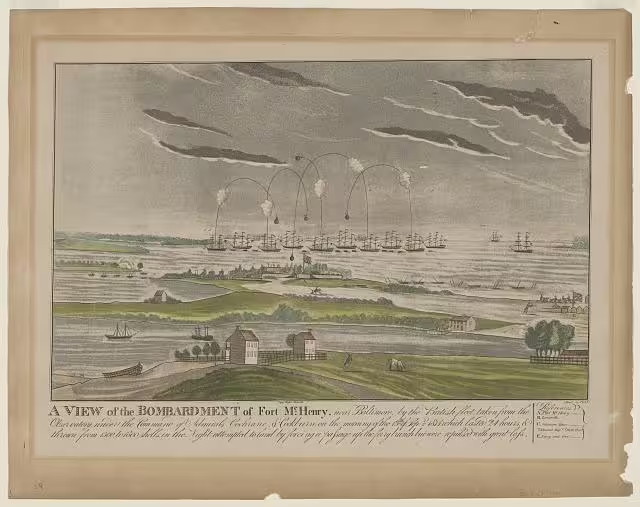
On September 13, 1814, British warships began a massive bombardment of Fort McHenry, the fortress guarding the entrance to Baltimore Harbor. The attack formed a crucial part of the Battle of Baltimore during the War of 1812 and came only weeks after British forces had captured Washington, D.C. and burned several of its public buildings.
For approximately 25 hours, British ships bombarded the fort with bombs, rockets and incendiary shells. Yet the American defenders refused to surrender. When dawn arrived on September 14, the British attack had failed and a large American flag was raised above Fort McHenry.
Watching from a ship in the harbor was American lawyer Francis Scott Key. The sight of the flag still flying after the night-long bombardment inspired him to write a poem originally titled Defence of Fort M'Henry. Set to music, it became known as The Star-Spangled Banner and, more than a century later, became the national anthem of the United States.
Britain Turns Toward Baltimore
The attack on Baltimore took place during the War of 1812, a conflict between the United States and Great Britain that had begun more than two years earlier.
By 1814, Britain was able to devote greater military resources to North America following the defeat of Napoleon in Europe. British forces launched a major campaign in the Chesapeake region, targeting important American cities and military positions.
In August 1814, the British defeated American forces at the Battle of Bladensburg and entered Washington, D.C. They burned the Capitol, the President's House and other government buildings before withdrawing.
Their attention then turned toward Baltimore, one of the most important American ports on the Atlantic coast.
A Valuable and Defiant Port
Baltimore was an especially attractive target because of its commercial importance and its connection with American privateers.
During the war, privately owned American ships operating with government authorization had attacked British merchant shipping. Many of these privateers sailed from Baltimore, making the city particularly unpopular with British military leaders.
Capturing Baltimore would therefore damage American commerce, eliminate an important base for privateers and deliver another powerful psychological blow after the destruction of Washington.
The Battle of Baltimore Begins
The British attack involved both land and naval forces.
Thousands of British troops landed near Baltimore and advanced toward the city. On September 12, 1814, they encountered American forces at the Battle of North Point.
Although the Americans eventually withdrew, they delayed the British advance and inflicted significant losses. Among those killed was British commander Major General Robert Ross, who had played an important role in the capture of Washington.
The British ground force eventually reached the defensive positions surrounding Baltimore but found them strongly fortified and supported by thousands of defenders.
For the attack to succeed, the Royal Navy needed to neutralize Fort McHenry, which guarded the water approach to the city.
The Bombardment of Fort McHenry
At approximately 6:30 a.m. on September 13, British warships began firing on Fort McHenry.
The attacking fleet included specialized bomb vessels capable of firing heavy explosive shells at long range. British forces also used Congreve rockets, dramatic weapons that left fiery trails as they flew through the night sky.
These weapons would later appear in Francis Scott Key's famous description of the rockets' red glare and the bombs bursting in air.
Fort McHenry was commanded by Major George Armistead and defended by approximately one thousand men. American cannon initially struggled to reach the British ships, which deliberately remained beyond the effective range of many of the fort's guns.
When several British vessels moved closer during the afternoon, however, American artillery forced them to retreat to a safer distance.
A Night Under Fire
The bombardment continued through the day and into the night.
British shells and rockets repeatedly crossed the sky above the fort as rain fell over Baltimore Harbor. The defenders suffered casualties and damage, but the fort remained operational.
During the night, British forces also attempted to move smaller vessels past Fort McHenry and threaten Baltimore from another direction. American batteries detected the movement and opened fire, helping defeat the attempted diversion.
By the early hours of September 14, it was becoming clear that the naval attack had failed.
Francis Scott Key Watches the Battle
Among those witnessing the bombardment was Francis Scott Key, a 35-year-old Maryland lawyer.
Key had traveled with American prisoner-exchange agent John Stuart Skinner to negotiate the release of Dr. William Beanes, an American physician who had been detained by the British.
The negotiations succeeded, but Key and his companions had learned details about the planned attack on Baltimore. The British therefore prevented them from returning to shore until the operation was over.
Key was forced to watch the bombardment from a vessel several miles away, uncertain whether Fort McHenry had survived.
By the Dawn's Early Light
As morning approached on September 14, the British guns finally fell silent.
At dawn, Key looked toward Fort McHenry and saw that the American flag was still flying above its defenses. The fort had not surrendered.
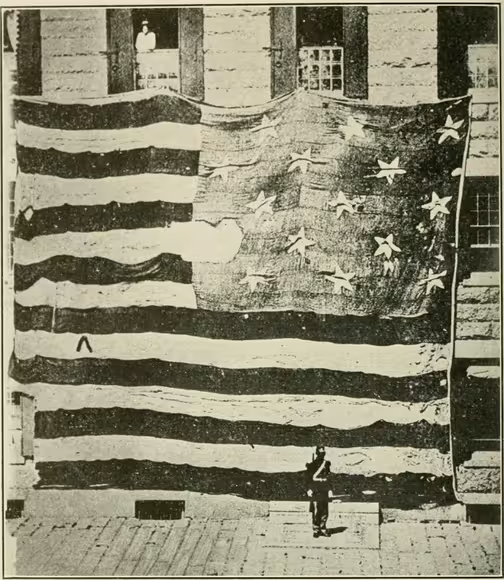
The defenders raised an enormous 15-star, 15-stripe garrison flag measuring approximately 30 by 42 feet. It was large enough to be clearly visible from considerable distance across the harbor.
For Key, the sight confirmed that Baltimore had survived the attack.
Inspired by what he had witnessed, he began forming the words of a poem describing the night of bombardment and the flag he saw at dawn.
Defence of Fort M'Henry
After being released, Key returned to Baltimore and completed a four-stanza poem titled Defence of Fort M'Henry.
The words were soon printed and distributed around the city. They were intended to be sung to an existing melody known as To Anacreon in Heaven, a popular British tune that was already familiar in the United States.
The new song quickly became popular under a different title taken from its lyrics: The Star-Spangled Banner.
Its opening stanza described exactly what Key had experienced: the uncertainty of looking toward the fort through the darkness, the illumination produced by British rockets and exploding bombs, and finally the sight of the American flag at dawn.
The British Withdraw
At about 7:30 a.m. on September 14, the British ended the bombardment of Fort McHenry and began withdrawing their fleet.
Without naval support, British commanders decided against launching a major assault against Baltimore's heavily defended land positions. Their troops withdrew toward their ships, and the attempt to capture the city was abandoned.
The successful defense of Baltimore was a major American victory at a moment when national morale had been badly damaged by the burning of Washington.
Together with other American successes during the final months of 1814, the result strengthened confidence in the United States as peace negotiations with Britain were approaching their conclusion.
From Battlefield Poem to National Anthem
The Star-Spangled Banner became increasingly popular during the 19th century and gradually developed into one of the most important patriotic songs in the United States.
By the late 19th and early 20th centuries, it was regularly used by the American military and performed at public ceremonies.
On March 3, 1931, President Herbert Hoover signed legislation officially designating The Star-Spangled Banner as the national anthem of the United States.
That decision came more than 116 years after Francis Scott Key had watched the bombardment of Fort McHenry from Baltimore Harbor.
The Flag That Survived the Battle
The enormous flag that inspired Key survived as well.
Fort McHenry commander George Armistead kept the flag after the battle, and it remained in his family for generations. It was later entrusted to the Smithsonian Institution.
Today, the original Star-Spangled Banner is preserved at the Smithsonian's National Museum of American History in Washington, D.C., where it remains one of the most important surviving artifacts of the War of 1812.
September 13, 1814
The bombardment that began on September 13, 1814, therefore produced consequences far beyond the battlefield.
Britain's failure to capture Baltimore prevented another major American city from falling and provided the United States with an important victory during the closing months of the War of 1812.
At the same time, the explosions above Fort McHenry and the flag visible at dawn inspired Francis Scott Key to write words that would eventually become inseparable from American national identity.
More than two centuries later, the defense of Fort McHenry is remembered not only as a military victory, but as the moment that gave birth to The Star-Spangled Banner.
Other Events on This Day
- Desmond Tutu Leads a Historic Anti-Apartheid Peace March in Cape Town
- IBM 305 RAMAC Introduces the Era of Hard Disk Storage
Credits: 1st photo: Public Domain, via Library of Congress.; 2nd photo: Public Domain, via Wikimedia Commons.


