
Sep
13
13
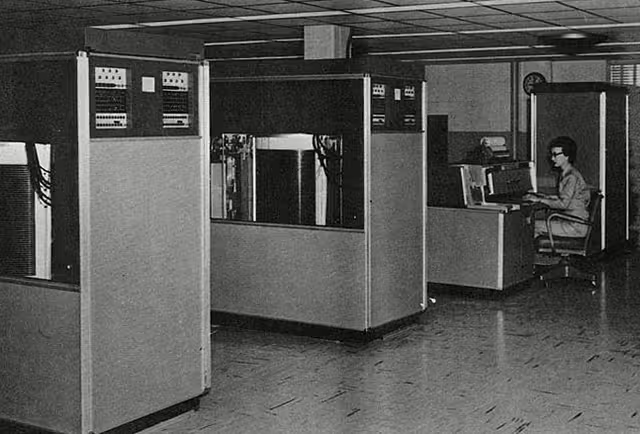
On September 13, 1956, IBM introduced the IBM 305 RAMAC, a revolutionary computer system that helped transform the way information was stored and retrieved. At the heart of the machine was the IBM 350 Disk Storage Unit, the world's first commercial hard disk drive.
For the first time, a computer could quickly access information stored at different locations on rotating magnetic disks instead of having to search sequentially through punched cards or magnetic tape.
It was a technological breakthrough that introduced a concept now taken for granted: direct access to digitally stored information.
Before the Hard Drive
In the early years of electronic computing, storing large amounts of information was a difficult and time-consuming process.
Businesses depended heavily on punched cards. Information was encoded by holes punched into pieces of stiff paper, and enormous collections of cards could be required to maintain payrolls, inventories and customer records.
Magnetic tape offered greater capacity, but it had an important limitation. Like a cassette tape, information was arranged sequentially. To retrieve a particular piece of data, a machine might need to move through everything that came before it.
IBM engineers wanted something fundamentally different: a storage system capable of moving directly to the required information.
A New Laboratory in California
In 1952, IBM established a research laboratory in San Jose, California, and assembled a team led by engineer Reynold B. Johnson.
The group was given the challenge of developing a better method for storing large amounts of business data.
Johnson and his colleagues experimented with several ideas before concentrating on stacks of rotating magnetic disks. Instead of reading information in a fixed sequence, a movable mechanism could travel to a particular disk and track where the desired record was stored.
The concept became the foundation of the modern hard disk drive.
Fifty Spinning Disks
The resulting IBM 350 Disk Storage Unit was enormous by modern standards.
Inside its cabinet was a stack of 50 magnetic disks, each approximately 24 inches in diameter. The disks rotated at about 1,200 revolutions per minute while movable read-and-write heads located the required information.
The system stored approximately five million characters of data. Although tiny compared with modern storage devices, this represented an impressive amount of immediately accessible information in the mid-1950s.
The disk system itself was roughly the size of two large refrigerators and weighed more than a ton.
Random Access Changes Everything
The most important innovation was not simply the amount of information RAMAC could store. It was the way that information could be retrieved.
The name RAMAC stood for Random Access Method of Accounting and Control.
Random access meant that the machine could locate a particular record directly instead of processing every earlier record first. Information that could previously require lengthy searches through cards or tape could now be located in seconds.
For businesses dealing with thousands of transactions, inventories and customer accounts, the difference was enormous.
A Computer Built Around Its Disk
The IBM 305 RAMAC was more than a disk drive. It was a complete data-processing system designed around the possibilities created by rapid access to stored information.
Its components included a processing unit, operator console, card reader, printer and the distinctive IBM 350 storage system.
The 305 used vacuum tubes and other technologies characteristic of the first generation of commercial electronic computers. A complete installation occupied a substantial part of a room.
Yet its underlying concept would survive long after the machine itself became obsolete.
The First Customer
Even before the system was formally introduced, IBM had begun testing its new technology with customers.
An engineering version of the RAMAC system was delivered to the Zellerbach Paper Company in San Francisco in 1956, providing one of the earliest real-world applications of magnetic disk storage.
The technology was particularly attractive to businesses because records could be updated as transactions occurred rather than waiting for large batches of punched cards to be processed later.
IBM described the technology as a way to bring something approaching real-time information processing into everyday business operations.
From Punched Cards to Digital Records
The implications extended far beyond accounting.
Once computers could rapidly retrieve individual records from large stores of data, entirely new types of applications became practical.
Customer records, inventories, airline reservations, banking information and other constantly changing collections of information could increasingly be managed electronically.
Random-access disk storage would eventually become one of the technological foundations of the modern database.
Five Million Characters Then, Terabytes Today
The enormous scale of technological progress becomes particularly clear when the IBM 350 is compared with modern storage devices.
Its cabinet contained dozens of large disks and weighed more than a ton, yet stored only a few megabytes of information by modern measurements.
Today, devices small enough to fit in a pocket can store millions of times more data, while modern data centers contain storage capacities that engineers of the 1950s could scarcely have imagined.
Yet the basic principle remains recognizable: information is encoded digitally, stored on a medium and retrieved when a computer requests it.
The Beginning of the Hard Drive Era
The IBM 305 RAMAC did not remain in production for very long. Computer technology was developing so quickly that smaller, faster and more capable systems soon followed.
Its influence, however, was enormous.
The IBM 350 established the magnetic disk drive as a practical technology for computer data storage. Successive generations became smaller while increasing dramatically in capacity and speed.
Hard disks eventually became standard equipment in business computers, servers and personal computers around the world.
A Foundation of the Information Age
The ability to store enormous collections of information and retrieve individual records almost instantly became essential to the development of modern computing.
Banking systems, airline reservations, databases, search engines, online stores and countless other technologies ultimately depend on the idea that information can be stored and accessed whenever it is needed.
The machines performing those tasks today bear little resemblance to the refrigerator-sized IBM 350 of 1956, but they belong to the technological tradition it helped begin.
When the IBM 305 RAMAC appeared in September 1956, the significance of fifty spinning magnetic disks inside a large metal cabinet could hardly have been fully appreciated. They represented the beginning of an era in which vast amounts of human information could be stored digitally and retrieved almost instantly.
It was, in a very literal sense, the beginning of the hard drive age.
Other Events on This Day
- Britain Fails to Capture Baltimore and the Star-Spangled Banner Is Born
- Desmond Tutu Leads a Historic Anti-Apartheid Peace March in Cape Town
Credits: 1st photo by U.S. Army Red River Arsenal. Public Domain, via Wikimedia Commons.


