
Sep
12
12
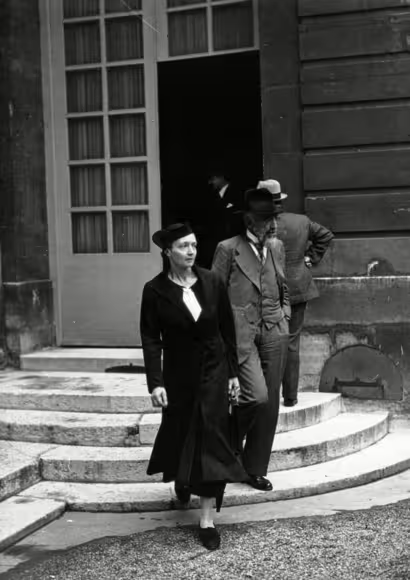
On September 12, 1897, French physicist and chemist Irène Joliot-Curie was born in Paris. The daughter of two of the most famous scientists in history, Marie and Pierre Curie, she would build an extraordinary scientific career of her own and become a Nobel Prize laureate for the discovery of artificial radioactivity.
Working together with her husband, Frédéric Joliot, she demonstrated that radioactive atoms could be created artificially in the laboratory. Their discovery transformed nuclear physics and opened new possibilities for medicine, chemistry and biological research.
Growing Up in the Curie Family
Irène Curie was born into a family already deeply involved in the emerging science of radioactivity. Her parents, Marie and Pierre Curie, were conducting pioneering experiments that would lead to the discovery of polonium and radium.
In 1903, when Irène was six years old, Marie and Pierre Curie shared the Nobel Prize in Physics with Henri Becquerel for their work on radiation. Marie Curie later received a second Nobel Prize, in Chemistry, in 1911.
Irène's childhood education was unusual. For a period, Marie Curie and several other university professors organized a cooperative school in which they personally taught their children subjects including mathematics, physics, literature, languages and art.
Irène demonstrated a strong ability in mathematics and science and eventually began studying at the Faculty of Science at the University of Paris.
Serving During the First World War
Her university studies were interrupted by the First World War. Marie Curie had developed mobile X-ray units that could be taken close to the battlefield and used by military doctors to locate bullets and shrapnel inside wounded soldiers.
Still a teenager, Irène joined her mother and trained as a radiographer. She worked in military hospitals, helping physicians use X-ray equipment to examine wounded soldiers.
The experience gave her valuable practical knowledge of radiation technology while also exposing her at a young age to the risks associated with ionizing radiation, which were not yet fully understood.
A Career in Radioactivity
After the war, Irène returned to her scientific studies and began working at the Radium Institute in Paris, the institution closely associated with her mother's research.
In 1925, she received her doctorate in science for research on the alpha radiation emitted by polonium.
At the institute she met a young chemical engineer named Frédéric Joliot. The two married in 1926 and eventually adopted the combined surname Joliot-Curie. Their marriage also developed into a highly productive scientific partnership.
Creating Radioactivity in the Laboratory
During the early 1930s, Irène and Frédéric Joliot-Curie conducted experiments in nuclear physics using radioactive materials and particle radiation.
The decisive breakthrough came in 1934. The couple bombarded aluminum with alpha particles and observed that the material continued emitting radiation even after the original radioactive source had been removed.
They realized that the aluminum atoms had been transformed into an unstable radioactive isotope of phosphorus.
This was a remarkable discovery. Until then, radioactive elements were known primarily as substances that occurred naturally. The Joliot-Curies had demonstrated that radioactive atoms could be produced artificially.
The Nobel Prize in Chemistry
The importance of the discovery was quickly recognized. In 1935, Irène Joliot-Curie and Frédéric Joliot were jointly awarded the Nobel Prize in Chemistry in recognition of their synthesis of new radioactive elements.
Irène had therefore followed both of her parents in becoming a Nobel laureate, making the Curie family one of the most remarkable scientific families in history.
The discovery of artificial radioactivity had consequences far beyond the laboratory. Artificial radioactive isotopes could be produced for use as tracers, allowing scientists to follow chemical and biological processes in ways that had previously been impossible.
Radioisotopes would eventually become important tools in medical diagnosis, cancer treatment, biological research and many other scientific fields.
On the Road to Nuclear Fission
Joliot-Curie's research continued after her Nobel Prize. In 1938, she conducted important experiments involving the bombardment of heavy elements with neutrons.
Her results formed part of the chain of experimental discoveries that soon led scientists to understand nuclear fission, the process in which a heavy atomic nucleus splits into smaller nuclei while releasing enormous amounts of energy.
The discovery of nuclear fission would transform both physics and world history, eventually making possible nuclear reactors and nuclear weapons.
Science and Public Life
Irène Joliot-Curie was not interested only in laboratory research. She also became involved in French public life and strongly supported scientific education, social progress and greater opportunities for women.
In 1936, she was appointed Undersecretary of State for Scientific Research in the French government. At a time when French women did not yet have the right to vote, her appointment represented a remarkable achievement.
She later became a professor at the Faculty of Science in Paris and, in 1946, director of the Radium Institute.
Joliot-Curie also participated in the creation of the French Atomic Energy Commission and contributed to the development of France's first nuclear reactor, which began operating in 1948.
Building the Future of French Nuclear Physics
During the final years of her life, Joliot-Curie played an important role in planning a major new nuclear physics research center at Orsay, south of Paris.
The facility was intended to provide French scientists with powerful modern equipment, including a large particle accelerator. Construction continued after her death and the center became an important institution for nuclear and particle physics research.
Her career therefore extended far beyond her famous discovery of artificial radioactivity. She helped shape the institutions and infrastructure that would support French nuclear science for generations.
The Risks of Radioactivity
Like her mother before her, Irène Joliot-Curie spent much of her life working with radioactive substances during an era when their long-term health risks were not yet fully appreciated and protective measures were limited.
She died in Paris on March 17, 1956, at the age of 58, from leukemia associated with extensive exposure to radiation.
Her death reflected one of the tragic contradictions of the early history of nuclear science: the same phenomenon that opened extraordinary possibilities in physics and medicine could also cause devastating damage to the scientists who studied it.
A Scientific Legacy of Her Own
Irène Joliot-Curie inevitably lived in the shadow of her famous parents, particularly her mother, Marie Curie. Yet her achievements established her as a major scientist in her own right.
Her discovery with Frédéric Joliot that radioactive isotopes could be created artificially changed the way scientists studied matter and helped make radioisotopes widely available for research and medicine.
Born in Paris on September 12, 1897, Irène Joliot-Curie continued one of science's most extraordinary family traditions while making a discovery that permanently changed nuclear physics, chemistry and medicine.
Other Events on This Day
- Polish Writer and Philosopher Stanisław Lem Is Born
- Space Shuttle Discovery Launches on Mission STS-51
Credits: 1st photo by Agence Meurisse. Public Domain, via Bibliothèque nationale de France / Wikimedia Commons.


