
Sep
12
12
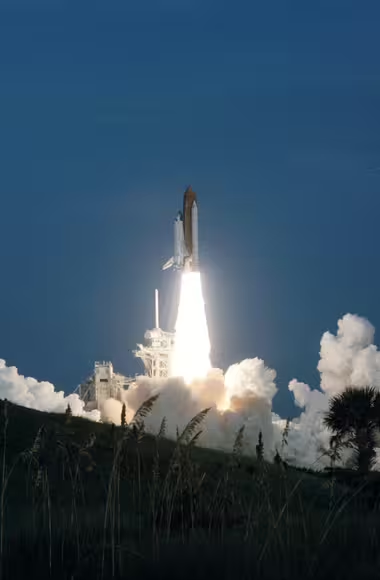
On September 12, 1993, NASA launched the Space Shuttle Discovery from Kennedy Space Center in Florida on STS-51, a nearly ten-day mission combining satellite deployment, astronomical research and preparations for future work in space.
Discovery lifted off from Launch Pad 39B at 7:45 a.m. EDT carrying a crew of five astronauts. During the mission, they deployed an experimental communications satellite, released and later retrieved a free-flying astronomical observatory, conducted scientific experiments and performed a lengthy spacewalk.
The Crew of STS-51
The five-member crew was commanded by Frank L. Culbertson Jr., with William F. Readdy serving as pilot. The three mission specialists were James H. Newman, Daniel W. Bursch and Carl E. Walz.
Together, they would spend almost ten days in orbit aboard Discovery, completing a demanding schedule of scientific, technological and operational objectives.
A Launch After Several Delays
The successful September launch came only after a difficult summer of delays. Discovery's earlier launch attempts had been interrupted by technical problems and other concerns.
A launch attempt on July 17 was scrubbed because of an electrical problem involving the shuttle's pyrotechnic systems. Another attempt was stopped on July 24 because of difficulties associated with one of Discovery's main engines.
The mission was also postponed in August because of concerns about the Perseid meteor shower and later delayed while engineers reviewed issues associated with the Advanced Communications Technology Satellite carried aboard the shuttle.
When Discovery finally rose from the launch pad on September 12, it marked the successful beginning of a mission that had required weeks of additional preparation and testing.
Deploying an Advanced Communications Satellite
One of the primary objectives of STS-51 was the deployment of the Advanced Communications Technology Satellite, commonly known as ACTS.
ACTS was designed as a test platform for new satellite communications technologies. Its experiments were intended to demonstrate methods of transmitting large amounts of information more efficiently and at significantly higher data rates than many existing communications satellites.
The crew deployed ACTS during the first day of the mission. Approximately 45 minutes later, a Transfer Orbit Stage attached to the satellite fired and sent ACTS toward a geosynchronous transfer orbit.
It was the first use of the Transfer Orbit Stage booster on a Space Shuttle mission.
ORFEUS-SPAS Flies Free
The second major payload was ORFEUS-SPAS, a joint German-American astronomical spacecraft designed primarily to observe the universe in far and extreme ultraviolet wavelengths.
Unlike a satellite intended to remain permanently in orbit, ORFEUS-SPAS was designed to be released from Discovery, operate independently for several days and then be recovered by the shuttle.
On the second day of the mission, the crew used Discovery's robotic arm to release the spacecraft into orbit. ORFEUS-SPAS then spent approximately six days collecting astronomical observations while flying separately from the shuttle.
The spacecraft also carried an IMAX camera, which captured remarkable images of Discovery orbiting Earth from the perspective of another spacecraft.
After its period of independent flight, Daniel Bursch used the shuttle's robotic arm to capture ORFEUS-SPAS and return it safely to Discovery's cargo bay.
A Seven-Hour Spacewalk
Another important part of the mission took place on September 16, when mission specialists James Newman and Carl Walz left Discovery's cabin for a spacewalk lasting more than seven hours.
During the excursion, the astronauts tested tools, tethers and a portable foot-restraint system designed to make it easier for astronauts to work outside a spacecraft.
The activity had particular importance because NASA was preparing for the first servicing mission to the Hubble Space Telescope, scheduled for later in 1993. That mission would require astronauts to perform a series of complex spacewalks while repairing and upgrading the orbiting observatory.
The STS-51 spacewalk therefore provided valuable experience with equipment and techniques that could be used during future orbital servicing operations.
Science Aboard Discovery
In addition to its two major satellite payloads, STS-51 carried numerous smaller experiments.
The crew investigated subjects ranging from protein crystal growth and plant cell division to radiation, materials exposure and the behavior of polymer membranes in microgravity.
Other equipment studied the faint glow around the shuttle in orbit and allowed astronauts to photograph atmospheric phenomena from space.
Like many Shuttle missions of the era, STS-51 therefore served not only as a transportation mission but also as a temporary laboratory in low Earth orbit.
Returning to Earth
After completing its objectives, Discovery returned to Kennedy Space Center on September 22, 1993.
The shuttle touched down at approximately 3:56 a.m. EDT after spending 9 days, 20 hours and 11 minutes in space. During the flight, Discovery completed 157 orbits of Earth and traveled approximately 4.1 million miles.
The safe landing brought to an end the fifty-seventh flight of NASA's Space Shuttle program.
A Mission of Technology and Preparation
STS-51 did not attract the same public attention as some Shuttle missions, but it demonstrated several of the qualities that made the program unique.
In a single flight, Discovery served as a satellite launcher, a platform for scientific experiments, a base for a spacewalk and a spacecraft capable of releasing another observatory and recovering it days later.
The mission also helped prepare NASA for an important challenge that was only months away: the first servicing mission to the Hubble Space Telescope.
When Space Shuttle Discovery lifted off on September 12, 1993, it began a mission that combined communications technology, astronomy, scientific research and astronaut training into nearly ten productive days in Earth orbit.
Other Events on This Day
- Nobel Prize-Winning Scientist Irène Joliot-Curie Is Born
- Polish Writer and Philosopher Stanisław Lem Is Born


