
Oct
16
16
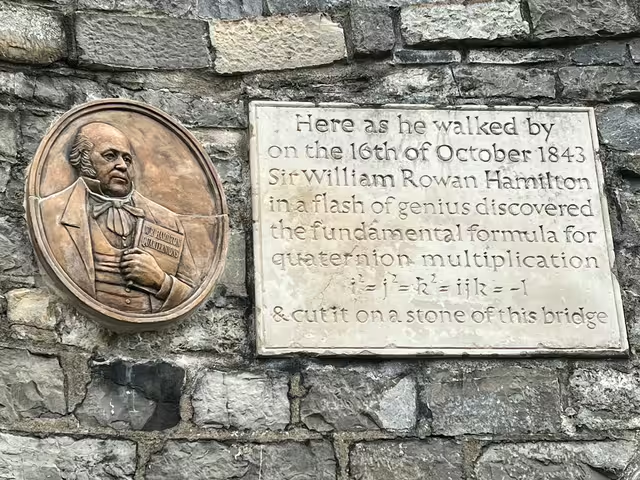
On October 16, 1843, Irish mathematician and physicist William Rowan Hamilton experienced a breakthrough while walking beside Dublin’s Royal Canal with his wife. After years of searching for a way to extend complex numbers, he recognised the rules of a new mathematical system: quaternions.
According to his later account, Hamilton immediately carved the fundamental formula into a stone of Brougham Bridge, now commonly called Broom Bridge. A quiet walk had become one of mathematics’ most memorable discovery stories.
The Unexpected Fourth Component
Ordinary complex numbers have two real components and can be represented on a plane. Hamilton had struggled to develop a comparable system using three components. The crucial insight was to move to four.
A quaternion can be written as a + bi + cj + dk, where a, b, c and d are real numbers. The symbols i, j and k obey special multiplication rules, summarised by the equation Hamilton scratched into the bridge:
i² = j² = k² = ijk = −1
When the Order of Multiplication Matters
Quaternions challenged a familiar rule of arithmetic: changing the order of multiplication can change the result. For example, ij = k, while ji = −k.
This property, called noncommutativity, makes sense when thinking about rotations. Turning an object around one axis and then another can leave it facing a different direction from performing those turns in reverse order.
From a Bridge to Scientific Research
Hamilton presented his discovery to the Royal Irish Academy on November 13, 1843. He continued developing the theory through papers and books, including his extensive Lectures on Quaternions, published in 1853.
The original marks on the bridge disappeared, but a commemorative plaque preserves the formula and the story of that October afternoon.
A Lasting Role in Modern Technology
Today, unit quaternions provide a practical way to represent rotations in three-dimensional space. They are used in computer graphics and animation, as well as in calculations describing the orientation of spacecraft.
Hamilton’s four-component numbers became tools for handling movement in three dimensions—a lasting connection between abstract mathematics and technologies he could never have imagined.
Other Events on This Day
- Belzoni Begins the Excavation That Reveals the Magnificent Tomb of Seti I
- Masaryk Submits a Draft Declaration of Czechoslovak Independence to the United States
Credits: 1st photo: Photo: Brendan Ward, 2022, via Wikimedia Commons. CC0 1.0 — Public domain dedication. Sources: Trinity College Dublin — Letters Describing the Discovery of Quaternions; Trinity College Dublin — Hamilton’s Research on Quaternions; NASA JPL — Rotations and Quaternions; Trinity College Dublin — World-leading Mathematicians Welcomed to Trinity


