
Oct
15
15
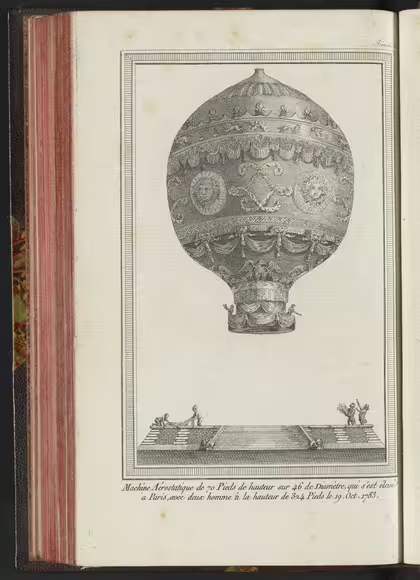
On October 15, 1783, Jean-François Pilâtre de Rozier rose into the air in a hot-air balloon developed by the Montgolfier brothers. The ascent took place in the grounds of Jean-Baptiste Réveillon’s wallpaper works in Paris. Secured to the ground by ropes, the balloon carried him above the spectators in an experiment that helped prepare the way for human flight.
From Paper Mills to Flying Machines
Joseph-Michel and Jacques-Étienne Montgolfier came from a French papermaking family. Their experiments with lightweight materials and heated air led to increasingly ambitious balloons, turning a workshop curiosity into a public spectacle.
In June 1783, they demonstrated an uncrewed balloon at Annonay. On September 19, another balloon rose at Versailles carrying a sheep, a duck and a rooster. The next challenge was to carry a person.
A Carefully Restrained Ascent
Pilâtre de Rozier, a teacher of physics and chemistry, became a central participant in the experiments. His October 15 ascent was a tethered test: the ropes limited the balloon’s movement and prevented it from drifting away.
The distinction matters. This was an early human ascent in a balloon, rather than a journey across the sky. Remaining attached to the ground allowed the experimenters to test their machine before attempting a free flight.
Preparing to Leave the Ropes Behind
Further trials followed. On October 19, Pilâtre de Rozier ascended with André Giroud de Villette, demonstrating the balloon’s ability to carry two people during another tethered experiment.
The decisive next step came on November 21, 1783. Pilâtre de Rozier and François Laurent, the Marquis d’Arlandes, took off from the grounds of the Château de la Muette. Their untethered flight over Paris lasted approximately twenty-five minutes.
A Milestone in Learning to Fly
The October experiments were essential steps between lifting animals and carrying people on an aerial journey. They combined bold ambition with repeated practical tests.
The ascent of October 15 belongs to that extraordinary sequence of events in 1783 when ballooning transformed human flight from an imagined possibility into a demonstrated achievement.
Other Events on This Day
- Andy Green and ThrustSSC Set the World’s First Supersonic Land Speed Record
- Elisabeth Therese of Lorraine, the Princess Who Became Queen of Sardinia, Is Born
- Wayne Gretzky Becomes the NHL’s All-Time Points Leader on a Historic Night in Edmonton
Credits: 1st photo: “Plate 8: Machine aérostatique,” from Barthélemy Faujas de Saint-Fond’s Description des expériences de la machine aérostatique de MM. de Montgolfier (Paris: Cuchet, 1783). Courtesy of Science History Institute. Public domain. Sources: British Balloon Museum & Library — Who Was the First to Fly?; Science History Institute — Plate 8: Machine aérostatique; The Museum of Flight — Montgolfier Balloon


