
Oct
15
15
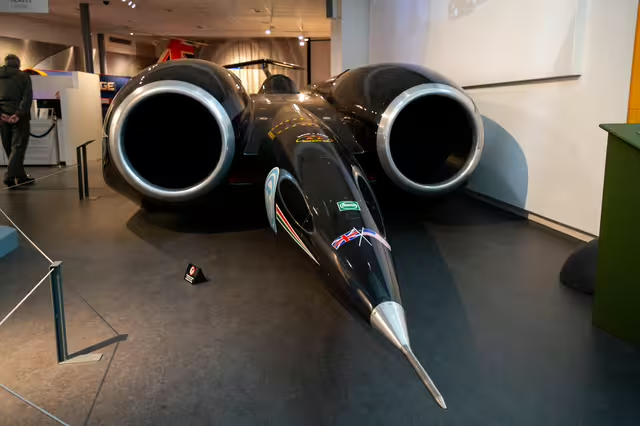
On October 15, 1997, British Royal Air Force pilot Andy Green drove ThrustSSC across Nevada’s Black Rock Desert to establish the first supersonic world land speed record. The officially recognised speed was 1,227.985 km/h (763.035 mph), measured over a flying mile using runs in opposite directions.
A Car Powered by Jet Engines
ThrustSSC was a purpose-built machine powered by two Rolls-Royce Spey jet engines. Its propulsion came from jet thrust, while its wheels kept it travelling across the desert surface.
Led by Richard Noble, the project brought together specialists in aerodynamics, mechanical design, electronics and high-speed testing. Their challenge extended beyond producing enough thrust: the vehicle also had to remain stable and controllable as it approached and exceeded the speed of sound.
Why Two Runs Were Necessary
A land speed record required more than a single spectacular pass. The team had to complete runs in opposite directions within the permitted one-hour interval, establishing a result that reduced the influence of wind and course conditions.
Green had already completed an officially timed supersonic run on October 13. However, the turnaround exceeded the time limit, so the attempt did not establish a new record.
Two days later, the team succeeded. Both passes were supersonic, and the return run was completed within the required time. Sonic booms sounded across the desert as ThrustSSC achieved its goal.
Turning Years of Preparation into Seconds
During each record-setting pass, the measured mile took less than five seconds to cover. Those brief intervals represented years of research, fundraising and testing, including earlier trials in Britain and Jordan.
Green’s performance depended on the work of an entire team, from preparing the vehicle and monitoring its systems to coordinating operations across the desert course.
A New Chapter in Speed
The achievement established that a car could exceed the speed of sound under the conditions required for an officially recognised world record.
October 15, 1997, became a landmark in engineering and motorsport: the day ThrustSSC turned a supersonic ambition into a measured, repeatable achievement on land.
Other Events on This Day
- Elisabeth Therese of Lorraine, the Princess Who Became Queen of Sardinia, Is Born
- Pilâtre de Rozier Rises Above Paris in a Pioneering Human Balloon Ascent
- Wayne Gretzky Becomes the NHL’s All-Time Points Leader on a Historic Night in Edmonton
Credits: 1st photo: Tristan Surtel, April 27, 2018, via Wikimedia Commons. Licensed under CC BY-SA 4.0. Sources: FIA — World Land Speed Records; ThrustSSC — Thrustbrief 45, October 15, 1997; ThrustSSC — Going for the Sound Barrier; Guinness World Records — Land Speed: Fastest Car


