
Oct
10
10
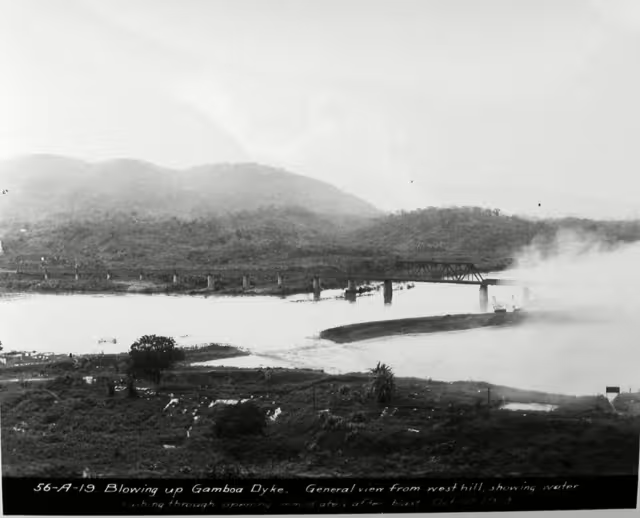
On October 10, 1913, President Woodrow Wilson pressed a button at the White House, sending a telegraphic signal to Panama. Far away, explosives breached the Gamboa Dike, allowing water from Gatun Lake to flow into the Culebra Cut. It was a dramatic milestone in the construction of a waterway that would transform international shipping.
A Barrier Ready to Fall
The Gamboa Dike was a temporary earthen barrier separating Gatun Lake from the Culebra Cut, the excavated passage through the continental divide. During construction, it had kept the lake’s water away from the excavation.
By October 1913, its purpose was nearing an end. Engineers had already begun admitting water through large pipes. Breaching the dike would connect the two sections and allow floating equipment to enter the cut.
A Signal from the White House
Wilson’s signal travelled through a communications network linking Washington, New York, Galveston, and Panama. The resulting explosion broke open the centre of the barrier, turning a presidential gesture into a visible demonstration of engineering and long-distance communication.
The occasion symbolised the approaching connection between the Atlantic and Pacific. It also marked a practical change in the remaining work: dredges could now tackle material that still obstructed the channel.
Why the Canal Was Not Yet Open
The blast did not create an uninterrupted sea-level passage between the oceans. The Panama Canal was designed around locks and an elevated freshwater lake, with vessels lifted above sea level and lowered again on the opposite side.
Nor did the demolition mean construction was complete. Landslide debris remained a serious obstacle, and dredging continued after the celebrations. The destruction of the Gamboa Dike was an essential step towards a navigable route, rather than its official opening.
From Symbolic Breakthrough to Working Waterway
The canal officially opened on August 15, 1914, when the steamship Ancon made the inaugural official transit. The approximately 80-kilometre route offered ships a shortcut between oceans, reducing the time and distance required for many voyages.
Wilson’s button press remains a memorable moment in that larger achievement: a brief action in Washington that signalled the transformation of a vast construction site into a working waterway.
Other Events on This Day
- Harold Pinter Is Born, the Playwright Who Made Silence Speak on Stage
- The Birth of Giuseppe Verdi, the Composer Behind Some of Opera’s Greatest Masterpieces
Credits: 1st photo: U.S. National Archives and Records Administration, NAID 100996152, via Wikimedia Commons. Photographer unidentified. Public domain in the United States. Sources: Panama Canal Authority — Design of the Locks; Panama Canal Authority — End of the Construction; Panama, Past and Present — Chapter XVII; Panama Canal Authority — 100 Years Connecting the World


