
Oct
11
11
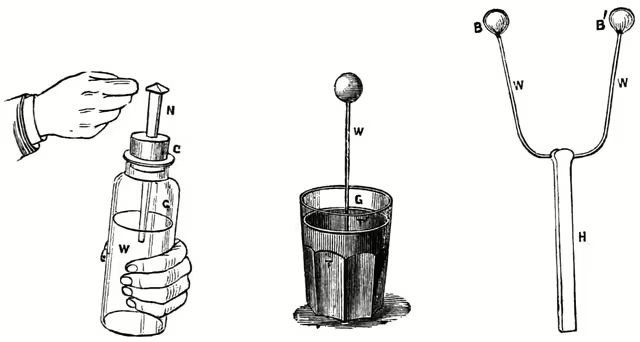
On October 11, 1745, the German cleric and experimenter Ewald Georg von Kleist made a discovery that helped change the study of electricity. Working in Cammin, in Prussian Pomerania, now Kamień Pomorski in Poland, he developed an early form of the electrical capacitor: a device capable of accumulating charge and releasing it later.
A Small Bottle with a Surprising Effect
Kleist’s apparatus was simple: a small glass bottle containing liquid, with a metal nail passing through its stopper. He charged it using an electrostatic machine while holding the bottle in his hand.
When he subsequently touched the nail, he received a powerful electric shock. The bottle had retained an electrical charge after being disconnected from its source. His experiment revealed a way to concentrate electricity in a compact device, making much stronger discharges possible.
Why It Became the Leyden Jar
Kleist’s discovery preceded an independent investigation in the Dutch city of Leiden. In 1746, Pieter van Musschenbroek and his associates explored the same striking effect. Their work became widely known, and the apparatus acquired the name Leyden jar, using an older spelling of the city’s name.
The familiar name can therefore obscure Kleist’s earlier achievement. Both discoveries belong to the history of the first capacitors, emerging from a period when researchers were still trying to understand what electricity actually was.
How the Device Worked
Later Leyden jars commonly used metal foil on the inner and outer surfaces of a glass vessel. These conducting layers were separated by insulating glass. Opposite charges could accumulate on the two sides, storing energy in the electric field between them.
This is the essential principle of a capacitor. The early experimenters did not yet possess that explanation, but their bottles gave them a practical tool for investigating electrical behaviour.
A New Tool for Electrical Research
Leyden jars allowed researchers to collect charge, retain it, and release it in experiments. They became important laboratory instruments and featured in public demonstrations of electricity.
Modern capacitors take many different forms, but they share the basic arrangement of conductors separated by an insulating material. Kleist’s modest bottle helped establish a principle that would become fundamental to electrical science and electronics.
Other Events on This Day
- Jaroslav Seifert Wins the Nobel Prize and Brings Czech Poetry to the World’s Attention
- The University of Sydney Opens, Beginning a New Chapter in Australian Higher Education
Credits: 1st photo: Unknown illustrator, Popular Science Monthly, Vol. 9, 1876, via Wikimedia Commons. Public domain. Sources: Museum of the History of the Kamień Region — Anniversary of Kleist’s Invention; Science Museum Group — Leyden Jar; National MagLab — Leyden Jars, 1745


