
Oct
12
12
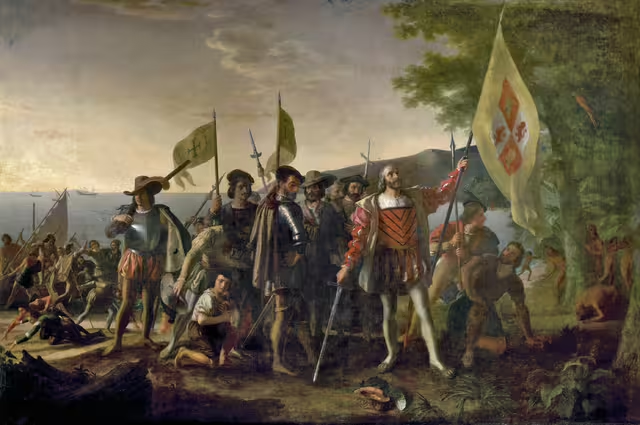
On October 12, 1492, Christopher Columbus’s expedition reached an island in the Bahamas known to its inhabitants as Guanahani. Columbus named it San Salvador, believing that his westward voyage across the Atlantic had brought him to islands near Asia. The landing instead began a new period of sustained contact between Europe and the Americas.
Searching for a Western Route to Asia
Supported by the Spanish monarchs Ferdinand and Isabella, Columbus sought a westward sea route to the wealthy trading regions of Asia. His expedition crossed the Atlantic with three ships: the Niña, the Pinta, and his flagship, the Santa María.
The sight of land ended weeks of uncertainty at sea. For Columbus, the islands appeared to confirm that his plan had succeeded. He interpreted the unfamiliar geography through his expectations of reaching the eastern parts of the known world.
An Island with an Existing Name and People
Guanahani was already home to Indigenous people belonging to the wider Taíno cultural world. They were part of Caribbean societies with established communities, agricultural knowledge, and traditions of navigation.
Columbus nevertheless claimed the island for his royal patrons and gave it a Christian name. Although modern San Salvador is traditionally associated with this first landing, historians have proposed other locations, and the precise identification of Guanahani remains disputed.
A Voyage Shaped by a Misunderstanding
Columbus had crossed an ocean, but he had not reached Asia. His interpretation of the Caribbean persisted through further voyages, even as encounters with unfamiliar lands challenged European geographical knowledge.
Accounts of his journey circulated widely after his return. They attracted attention across Europe and helped secure support for additional expeditions. What had begun as a search for an Asian trade route became the starting point for much larger changes around the Atlantic.
An Encounter with Lasting Consequences
The voyages that followed carried people, crops, animals, and diseases between continents, transforming societies and environments. European expansion also brought conquest, enslavement, and devastating losses to Indigenous communities.
October 12, 1492, therefore marks more than a successful ocean crossing. It was an encounter between already inhabited worlds whose consequences reshaped global history, bringing new connections alongside profound destruction.
Other Events on This Day
- The Royal Wedding That Gave Birth to Oktoberfest
- Voskhod 1 Carries the First Three-Person Crew into Space
Credits: 1st photo: John Vanderlyn, Landing of Columbus, 1846. Architect of the Capitol, via Wikimedia Commons. Public domain. Cropped. Sources: Library of Congress — Columbus and the Taíno; National Geographic — Columbus Makes Landfall in the Caribbean; National Park Service — The Columbian Exchange; Architect of the Capitol — Landing of Columbus


