
Oct
13
13
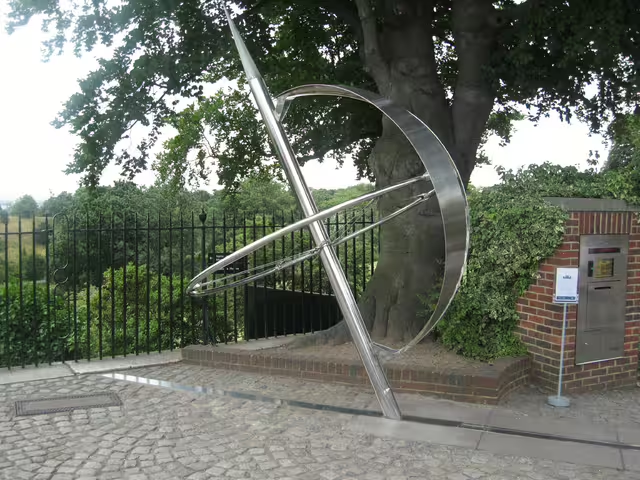
On October 13, 1884, delegates at the International Meridian Conference in Washington, D.C., voted to recommend the Greenwich meridian as the world’s common starting point for longitude. The decision gave international navigation and mapping a shared reference and helped establish a common framework for timekeeping.
Why the World Needed a Common Starting Point
Unlike the equator, which has a natural position halfway between the poles, zero degrees longitude must be chosen by agreement. For centuries, mapmakers and navigators used different starting meridians, often associated with their own national observatories.
As international trade, railways and telegraph networks expanded, these competing systems became increasingly inconvenient. A shared reference could simplify calculations and make it easier to exchange geographical and astronomical information across borders.
The Vote in Washington
Representatives of 25 nations attended the conference. On October 13, the proposal to adopt the meridian passing through the transit instrument at the Royal Observatory in Greenwich received 22 votes in favour. San Domingo, now the Dominican Republic, voted against it, while France and Brazil abstained.
The instrument was the Airy Transit Circle, a telescope used for precise astronomical observations. Greenwich already had a practical advantage: much of the world’s shipping relied on charts using its meridian. Choosing it reduced the disruption involved in adopting a common system.
A Reference for Longitude and Time
The conference’s final resolutions, dated October 22, also recommended a universal day beginning at mean midnight at the chosen meridian and counted from zero to 24 hours. This linked the geographical agreement to the coordination of time.
However, the delegates explicitly allowed local and other standard times to continue. The conference did not impose a complete worldwide system of time zones overnight; its recommendations provided a foundation on which further standardisation could develop.
An Agreement with a Lasting Legacy
The Washington decision made Greenwich an enduring symbol of international cooperation in measurement. An imaginary line through an observatory became a shared reference for describing the planet—demonstrating how agreement on a seemingly simple starting point could make a connected world easier to navigate.
Other Events on This Day
- Margaret Thatcher, Britain’s First Woman Prime Minister and the “Iron Lady,” Is Born
- Yves Montand, the Italian-Born Singer Who Became a Star of French Cinema, Is Born
Credits: 1st photo: Apletters, 2008, via Wikimedia Commons, licensed under CC BY-SA 3.0. Sources: International Meridian Conference, 1884 — Protocols of the Proceedings; Royal Museums Greenwich — What Is the Prime Meridian, and Why Is It in Greenwich?


