Aug
30
30
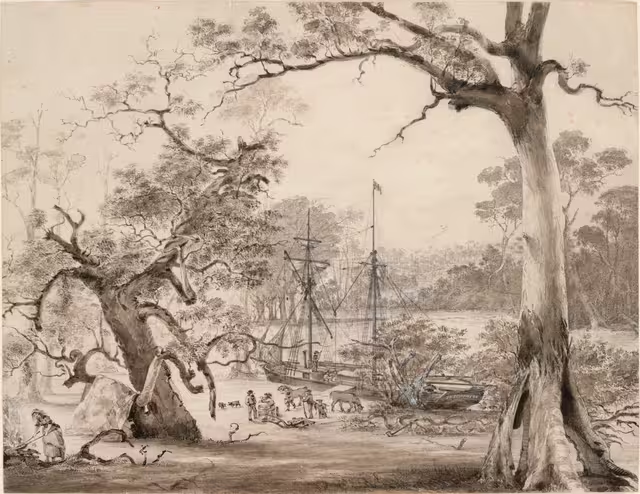
On August 30, 1835, settlers from the schooner Enterprize came ashore on the banks of the Yarra River and began building a permanent European settlement. That small riverside camp would eventually grow into the city of Melbourne.
The date is now remembered as Melbourne Day, marking the beginning of the settlement that became one of Australia's largest and most important cities.
The Enterprize Reaches the Yarra
The schooner Enterprize arrived near the future site of Melbourne on August 29, 1835.
The following day, members of the expedition came ashore and began unloading supplies, constructing shelters, and preparing the land for permanent occupation.
The group was small, but their arrival marked a major turning point in the history of the Port Phillip region.
John Pascoe Fawkner Was Not There
The expedition had been organized and financed by John Pascoe Fawkner, who later became one of the best-known figures associated with Melbourne's foundation.
Curiously, Fawkner himself was not aboard the Enterprize when it reached the Yarra.
Because of financial and legal difficulties, he remained behind in Van Diemen's Land, now Tasmania, and did not arrive at the settlement until October 1835.
The initial landing party was led by men including John Lancey and George Evans.
John Batman Arrived Earlier
Another important figure had already explored the area before the Enterprize arrived.
John Batman had visited the region earlier in 1835 and famously wrote that the site near the Yarra would be a good place for a village.
Batman also attempted to negotiate an agreement with local Indigenous leaders for the use of large areas of land.
The colonial government later declared this arrangement invalid.
Batman and Fawkner would eventually become rivals, each claiming an important role in the creation of Melbourne.
The Land Was Already Home to Indigenous Peoples
The area was not an empty wilderness waiting to be settled.
For thousands of years, the lands around the Yarra River had been home to peoples of the Kulin Nation, including the Wurundjeri Woi-wurrung and Bunurong/Boon Wurrung peoples.
The arrival of European settlers brought enormous changes to their lands, communities, and traditional way of life.
Any history of Melbourne's foundation therefore begins not with an empty landscape, but with a place that already had a deep human history.
It Was Not Yet Called Melbourne
In August 1835, the new settlement did not yet officially have the name Melbourne.
The name was adopted in 1837 in honor of the British prime minister William Lamb, 2nd Viscount Melbourne.
That same year, surveyor Robert Hoddle laid out the street grid that still forms the basic structure of central Melbourne today.
The famous Hoddle Grid remains one of the clearest surviving links between the early colonial town and the modern city.
A Settlement in New South Wales
Another detail is easy to forget: the state of Victoria did not yet exist.
In 1835, the settlement was part of the Port Phillip District of New South Wales.
Victoria became a separate British colony only in 1851 and later became a state of the Commonwealth of Australia in 1901.
Rapid Growth
The settlement grew quickly.
Within less than a year, hundreds of European settlers were living around the Yarra.
More farms, businesses, roads, and buildings followed.
Melbourne's location near Port Phillip Bay made it an increasingly important center for trade and migration.
Gold Changes Everything
The greatest transformation came after the discovery of gold in Victoria in 1851.
Thousands of people arrived from around the world hoping to make their fortunes in the Australian goldfields.
Melbourne became the main commercial and financial center serving this extraordinary rush of people and wealth.
Within only a few decades, the modest settlement on the Yarra had become one of the richest cities in the world.
From Riverside Camp to Global City
Modern Melbourne bears little resemblance to the small settlement established in 1835.
Today it is a major center of business, culture, education, sport, architecture, and tourism.
Its streets are filled with skyscrapers, trams, restaurants, galleries, universities, and millions of residents and visitors.
Yet the city's modern story can still be traced back to the banks of the Yarra.
A City Begins
On August 30, 1835, the people who stepped ashore from the Enterprize could not have imagined the scale of the city that would eventually rise around them.
They began with simple shelters, supplies, livestock, and a plan to establish a permanent settlement.
From that small beginning grew Melbourne — one of the great cities of Australia.
Other Events on This Day
- Bruce McLaren, the Man Behind a Racing Legend, Is Born
- Maurice Hilleman, the Man Behind Modern Vaccines, Is Born
- Queen Mary Becomes the Fastest Liner on the Atlantic
Credits: 1st photo: Unknown artist, c. 1885 — Public Domain / Wikimedia Commons.