Aug
29
29
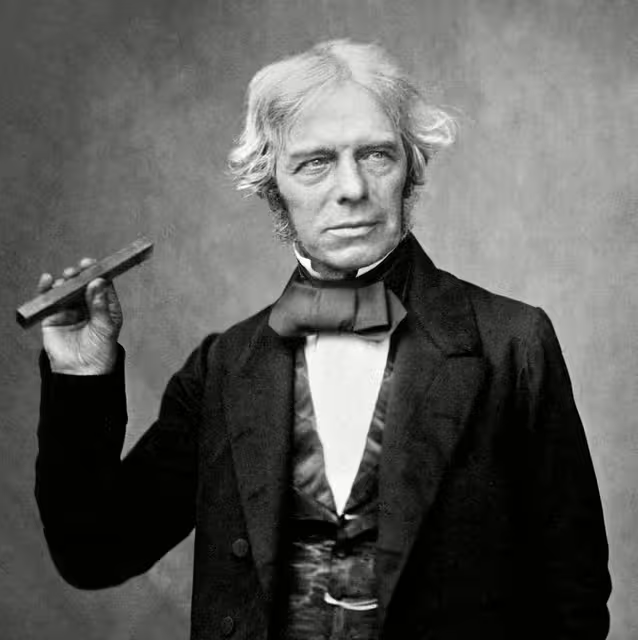
On August 29, 1831, British scientist Michael Faraday demonstrated electromagnetic induction — a discovery that would become fundamental to electric generators, transformers, and the modern power grid.
The experiment itself was simple. Faraday used coils of wire, an iron ring, a battery, and a galvanometer. But the brief movement of a needle during that experiment revealed one of the most important principles in the history of electricity.
Can Magnetism Create Electricity?
By the early 19th century, scientists already knew that electricity and magnetism were connected.
In 1820, Danish physicist Hans Christian Ørsted showed that an electric current could create a magnetic field.
Faraday became fascinated by the opposite question:
If electricity can produce magnetism, can magnetism produce electricity?
For years, he experimented with different arrangements of wires, magnets, batteries, and electrical instruments.
On August 29, 1831, he finally found the answer.
The Iron Ring Experiment
Faraday wrapped two separate coils of insulated wire around opposite sides of an iron ring.
One coil was connected to a battery. The second was connected to a galvanometer, an instrument capable of detecting electric current.
The two electrical circuits were not directly connected.
When Faraday switched on the battery, however, the galvanometer connected to the second coil briefly moved.
When he disconnected the battery, the needle moved again — this time in the opposite direction.
Somehow, a changing magnetic field created by the first coil had produced an electric current in the second.
The Key Was Change
Faraday noticed something especially important.
The current in the second coil did not continue flowing while the battery remained connected.
It appeared only when the magnetic field was changing.
When the battery was switched on, the magnetic field rapidly increased and induced a current. Once the field became stable, the induced current disappeared.
When the battery was disconnected, the magnetic field collapsed and produced another current in the opposite direction.
This phenomenon became known as electromagnetic induction.
An Early Transformer
Faraday's iron ring experiment also contained the basic principle of a modern transformer.
Electrical energy in one coil created a changing magnetic field, which then induced electrical energy in another coil without a direct electrical connection between them.
Transformers based on this principle would later become essential for changing voltage levels and transmitting electricity efficiently over long distances.
Remarkably, Faraday's original induction ring from 1831 still survives in the collection of the Royal Institution in London.
From Magnets to Generators
Faraday continued experimenting throughout the following weeks.
He discovered that moving a permanent magnet into and out of a coil of wire could also generate an electric current.
When the magnet moved in one direction, current flowed one way. When the magnet moved in the opposite direction, the current reversed.
This led Faraday toward an even more important practical achievement: generating continuous electricity through mechanical motion.
Later in 1831, he built an early electrical generator known as the Faraday disk.
The Principle Behind Modern Power Generation
Faraday's discovery remains at the heart of electricity generation today.
The source of energy may change, but the basic process is often the same.
In a hydroelectric plant, moving water turns a turbine. In a nuclear or fossil-fuel power station, steam turns a turbine. In a wind turbine, moving air turns the blades.
In each case, mechanical motion ultimately drives a generator in which conductors and magnetic fields move relative to one another.
Through electromagnetic induction, that motion becomes electrical energy.
From Bookbinder to Scientist
Faraday's achievements were even more remarkable because he had little formal education.
Born in 1791 into a modest family, he began his working life as a bookbinder's apprentice.
While working with books, he read scientific texts and developed a deep interest in chemistry and physics.
He later attended lectures by the famous chemist Humphry Davy at the Royal Institution and sent Davy carefully prepared notes from the lectures.
Davy eventually hired him as a laboratory assistant.
Faraday went on to become one of the most influential experimental scientists of the 19th century.
A Discovery That Powers the Modern World
On August 29, 1831, Faraday was not operating a giant machine or producing large amounts of electricity.
He was watching the needle of a small scientific instrument move for only a moment.
But that movement revealed a principle that would later make possible electric generators, transformers, power stations, and large-scale electrical networks.
What began with an iron ring and two coils of wire became one of the foundations of the electrified world.
Other Events on This Day
- James Hunt, Formula One's Unconventional World Champion, Is Born
- The Final Voyage of HMS Pandora
- The Railway That Learned to Climb a Mountain
Credits: 1st photo by Maull & Polyblank, c. 1857 — Public Domain / Wikimedia Commons.