Aug
29
29
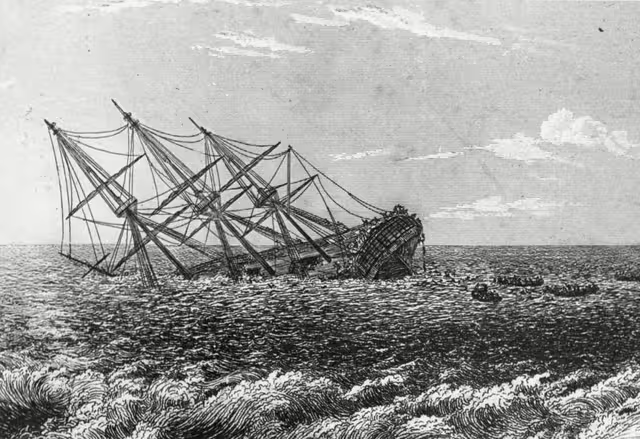
On August 29, 1791, HMS Pandora sank on the Great Barrier Reef after striking coral during its return voyage from the Pacific. The British warship had been sent to capture the mutineers of HMS Bounty, but instead became part of one of the most dramatic maritime stories of the 18th century.
The wreck combined naval history, survival, the famous Bounty mutiny, and even a curious real-life connection to the expression “Pandora's box.”
Sent to Find the Bounty Mutineers
HMS Pandora was a 24-gun Royal Navy warship commanded by Captain Edward Edwards.
In November 1790, the ship left Britain with an unusual mission: to search the Pacific for the men involved in the famous mutiny aboard HMS Bounty.
The mutiny had taken place in 1789, when Fletcher Christian and other members of the crew seized control of the Bounty from Lieutenant William Bligh.
By the time the Pandora reached Tahiti in March 1791, some of the mutineers were still there.
Fourteen Prisoners
The Pandora eventually captured 14 men associated with the Bounty mutiny.
However, Fletcher Christian and several of the principal mutineers could not be found.
They had sailed away and eventually settled on remote Pitcairn Island, which remained unknown to the British expedition.
The prisoners captured by the Pandora were confined in a small wooden enclosure constructed on the ship's quarterdeck.
The Real “Pandora's Box”
The makeshift prison quickly acquired a darkly appropriate nickname:
“Pandora's Box.”
The name was a reference to the ancient Greek myth of Pandora, whose curiosity released troubles into the world.
The nickname became particularly ominous when the ship later began to sink and the prisoners found themselves trapped inside the enclosure.
Searching the Pacific
After leaving Tahiti, Captain Edwards continued searching islands across the South Pacific in the hope of finding the missing mutineers and the Bounty.
The search failed.
Eventually, the Pandora began its return journey toward the Dutch East Indies, carrying the prisoners back to Britain for trial.
That route brought the ship toward the dangerous waters of Australia's Great Barrier Reef.
Disaster on the Reef
While searching for a safe passage through the reef, the Pandora struck coral.
Water began pouring into the hull.
The crew worked desperately through the night, operating pumps, attempting repairs, and throwing heavy equipment and guns overboard in an effort to lighten the ship.
But the damage was too severe.
The Ship Goes Down
By the following morning, it was clear that the Pandora could not be saved.
The ship sank near the outer edge of the Great Barrier Reef.
Thirty-one members of the crew and four of the prisoners died.
Most of the prisoners escaped from the structure known as Pandora's Box before the ship disappeared beneath the water.
A Remarkable Journey to Safety
The disaster was not the end of the survivors' ordeal.
Approximately 99 survivors reached a small sandy island near the wreck.
From there, they crowded into open boats and began an extraordinary voyage toward Timor.
Over roughly 18 days, they travelled more than 2,000 kilometres across tropical seas before finally reaching the Dutch settlement of Kupang.
The journey became another remarkable story of endurance in the age of sail.
Why Do We Say “Open Pandora's Box”?
The expression “to open Pandora's box” is much older than HMS Pandora.
It comes from ancient Greek mythology.
According to the poet Hesiod, Pandora opened a container that released suffering and misfortune into the human world.
Only hope remained inside.
Today, the expression means taking an action that unexpectedly creates many new and difficult problems.
It Was Originally a Jar, Not a Box
There is another curious detail behind the phrase.
In the original Greek story, Pandora did not actually open a box.
Hesiod described a large storage jar known as a pithos.
The familiar “box” appears to have entered later European versions of the story after the Renaissance scholar Erasmus used a Latin word referring to a small container or box.
The mistranslation became so popular that “Pandora's box” eventually became the standard expression.
A Ship With an Appropriate Name
The fate of HMS Pandora gives the ancient expression an unusual historical echo.
A ship named after the mythological Pandora carried a prison literally nicknamed “Pandora's Box,” while its mission followed one of the most famous acts of mutiny in naval history.
Its final voyage then ended with another dramatic sequence of unexpected events.
Rediscovered Nearly Two Centuries Later
For generations, the remains of the Pandora rested beneath the waters of the Great Barrier Reef.
The wreck was located again in 1977.
Archaeologists have since recovered thousands of objects from the site, including weapons, tools, personal belongings, navigation equipment, and everyday items used by the crew.
These discoveries have provided historians with an unusually detailed picture of life aboard a Royal Navy vessel during the late 18th century.
A Maritime Time Capsule
The sinking of HMS Pandora was a tragedy, but the wreck that remained behind became an extraordinary archaeological time capsule.
It preserves a direct connection to the story of the Bounty, European exploration of the Pacific, and life at sea more than two centuries ago.
On August 29, 1791, the Pandora disappeared beneath the waves of the Great Barrier Reef.
More than two hundred years later, its story — and its very appropriately named “Pandora's Box” — continues to fascinate historians, archaeologists, and anyone interested in the great maritime adventures of the age of sail.
Other Events on This Day
- James Hunt, Formula One's Unconventional World Champion, Is Born
- Michael Faraday Discovers Electromagnetic Induction
- The Railway That Learned to Climb a Mountain
Credits: 1st photo: Etching by Robert Batty, based on a sketch by Peter Heywood, published in 1831 — Public Domain / Wikimedia Commons.