Aug
29
29
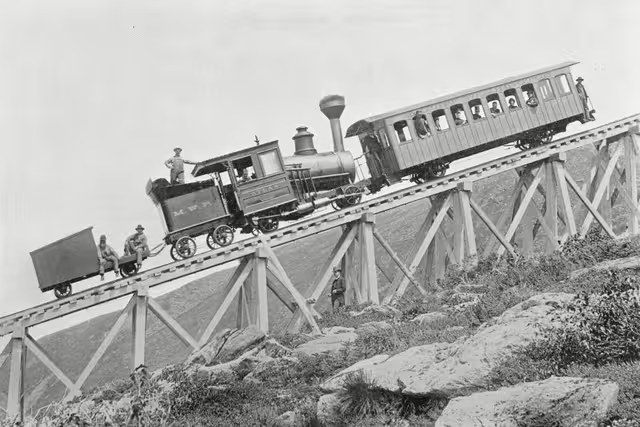
On August 29, 1866, inventor Sylvester Marsh successfully demonstrated his experimental cog railway on Mount Washington in New Hampshire, proving that a train could safely climb slopes far steeper than ordinary railways could handle.
The demonstration was an important step toward the completion of the Mount Washington Cog Railway, which would become the world's first mountain-climbing cog railway.
A Railway to the Summit
Mount Washington is the highest peak in the northeastern United States, rising to 6,288 feet, or about 1,917 meters.
In the mid-19th century, reaching the summit was difficult and sometimes dangerous because of the mountain's steep slopes and rapidly changing weather.
Businessman and inventor Sylvester Marsh believed there was a better way.
After a difficult climb of the mountain in the 1850s, he developed the idea of building a railway directly to the summit.
The “Railway to the Moon”
Marsh's proposal sounded so unrealistic that it was reportedly mocked by some politicians.
According to a famous story, when he asked the New Hampshire legislature for permission to build the railway, one lawmaker joked that he might as well be given permission to build a “railway to the moon.”
The nickname remained, but Marsh received approval and continued developing his unusual system.
Why Normal Rails Were Not Enough
Ordinary trains rely on friction between smooth steel wheels and steel rails.
That works well on relatively gentle slopes, but Mount Washington was far too steep.
Marsh solved the problem by placing a toothed rack rail between the two normal rails.
A cogwheel beneath the locomotive engaged with the teeth of this central rail, allowing the engine to pull itself securely uphill instead of relying only on wheel friction.
This basic rack-and-cog principle remains at the heart of mountain railways today.
The Demonstration of August 29, 1866
By the summer of 1866, Marsh had completed a short experimental section of track.
On August 29, he invited railroad officials, investors, and other guests to watch a public demonstration.
The experimental locomotive successfully climbed the steep track.
The test proved that Marsh's mechanical system worked and helped him gain the confidence and financial support needed to continue construction toward the summit.
Old Peppersass
The first locomotive used on the railway was originally called Hero, but it became famous under the nickname Old Peppersass.
Its tall vertical boiler gave it an unusual appearance that reminded people of a pepper sauce bottle.
The locomotive looked strange even by 19th-century standards, but it successfully demonstrated that Marsh's idea was practical.
Reaching the Summit
Construction continued for several more years.
On July 3, 1869, a train finally reached the summit of Mount Washington.
The completed railway became the world's first fully developed mountain-climbing cog railway and quickly attracted attention from engineers and travelers around the world.
Its success also influenced the development of similar rack railways in Europe, including mountain lines in Switzerland.
An Extremely Steep Railway
The Mount Washington Cog Railway climbs roughly 3,600 feet, or about 1,100 meters, from its base toward the summit.
Its average grade is around 25 percent, far steeper than conventional railways.
The most dramatic section, known as Jacob's Ladder, reaches a grade of about 37 percent.
On such a slope, the difference in height between passengers sitting at the front and rear of the same railcar can be several meters.
Built for Travelers
Unlike many early railways, the Mount Washington line was not primarily built for freight, mining, or industry.
It was designed largely as a tourist railway.
During the 19th century, the White Mountains became increasingly popular with travelers, and the cog railway gave visitors a dramatic new way to reach the summit.
Among its early passengers was U.S. President Ulysses S. Grant.
Still Operating More Than 150 Years Later
One of the most remarkable things about the Mount Washington Cog Railway is that it still operates today.
Modern trains now share the route with historic steam locomotives, but the basic principle remains the same: a cogwheel engages with a toothed rail to pull the train safely up the mountain.
More than a century and a half after Marsh's successful demonstration, passengers can still travel along the route that once seemed so impossible that critics compared it to building a railway to the moon.
A Small Test With a Lasting Legacy
The demonstration on August 29, 1866, did not mark the official opening of the completed railway.
Instead, it proved that the technology needed to build it could actually work.
Three years later, trains were reaching the summit of Mount Washington.
What began as an eccentric idea became a major engineering achievement and helped show that railways could climb mountains once considered impossible for trains.
Other Events on This Day
- James Hunt, Formula One's Unconventional World Champion, Is Born
- Michael Faraday Discovers Electromagnetic Induction
- The Final Voyage of HMS Pandora
Credits: 1st photo by Kilburn Brothers / Library Company of Philadelphia — Public Domain.