Aug
30
30
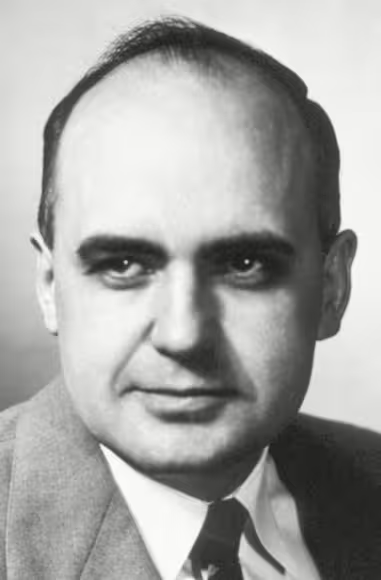
On August 30, 1919, Maurice Hilleman was born in Montana. He would become one of the most influential microbiologists and vaccinologists of the 20th century, helping develop or lead the development of more than 40 vaccines.
His name is far less famous than many scientists of his era, but the impact of his work can still be found in vaccination programs around the world.
A Childhood Far From the Laboratory
Maurice Ralph Hilleman was born in rural Montana and grew up in modest circumstances.
He was raised on a farm and developed an early interest in science despite having few obvious connections to the world of medicine or academic research.
He later studied microbiology and earned a doctorate, beginning a career focused on viruses, immune responses, and the prevention of infectious disease.
Learning How Viruses Change
One of Hilleman's early areas of expertise was influenza.
He helped explain how flu viruses change over time through processes known as antigenic drift and antigenic shift.
These changes are one of the reasons influenza remains difficult to control and why flu vaccines must be regularly updated.
Hilleman's understanding of viral evolution would soon prove enormously important.
Recognizing the 1957 Flu Threat
In 1957, reports emerged of a new influenza strain spreading in Asia.
Hilleman quickly recognized that the virus was significantly different from earlier strains and had the potential to cause a global pandemic.
He helped obtain samples of the virus and encouraged vaccine manufacturers to begin production as rapidly as possible.
Approximately 40 million doses were produced in the United States during the outbreak, helping reduce the impact of the pandemic.
Joining Merck
Later in 1957, Hilleman joined the pharmaceutical company Merck.
There he built and led one of the most productive vaccine research programs in medical history.
His teams worked on vaccines against a remarkable range of infectious diseases.
Vaccines That Became Part of Everyday Medicine
Hilleman was involved in the development or improvement of vaccines against diseases including:
measles, mumps, rubella, hepatitis A, hepatitis B, chickenpox, meningococcal disease, pneumococcal disease, and Haemophilus influenzae type b.
Several of these vaccines later became routine parts of childhood immunization programs.
By preventing diseases that had once caused widespread illness, disability, and death, Hilleman's work had an enormous public-health impact.
A Vaccine That Began With His Daughter
One of the most remarkable stories of Hilleman's career began at home.
In 1963, his five-year-old daughter Jeryl Lynn developed mumps.
Hilleman collected a sample of the virus from her throat and brought it to his laboratory.
His team weakened the virus through repeated laboratory cultivation until it could be used safely as the basis for a vaccine.
The Jeryl Lynn Strain
The resulting virus became known as the Jeryl Lynn strain, named after Hilleman's daughter.
It became the foundation of a widely used vaccine against mumps.
The strain was later incorporated into the combined MMR vaccine against measles, mumps, and rubella.
It remains one of the best-known examples of a medical discovery that began with an ordinary family illness.
More Than 40 Vaccines
Hilleman is often described as the creator of more than 40 vaccines.
A more precise description is that he developed, improved, or led the development of more than 40 vaccines during his career.
Modern vaccine development is usually a team effort involving virologists, microbiologists, clinicians, manufacturers, and public-health authorities.
Hilleman's particular strength was his ability to combine laboratory science with the practical challenge of turning discoveries into vaccines that could be produced and used on a large scale.
Eight Vaccines in the Childhood Schedule
At the time of Hilleman's death, eight vaccines in the recommended American childhood immunization schedule were connected to his work.
They included vaccines against measles, mumps, hepatitis A, hepatitis B, chickenpox, meningococcal disease, pneumococcal disease, and Hib.
Few individual scientists have had such a direct influence on routine preventive medicine.
A Scientist Without Celebrity
Despite his achievements, Hilleman never became a household name.
He spent most of his career working inside laboratories and research organizations rather than seeking public attention.
Among scientists, however, his reputation was enormous.
After his death, infectious-disease specialists described him as one of the most important figures in the history of vaccinology.
National Recognition
In 1988, Hilleman received the National Medal of Science, one of the highest scientific honors in the United States.
The award recognized his discoveries and his role in creating vaccines that had prevented illness, disability, and death on a vast scale.
A Quiet Legacy With Global Impact
Maurice Hilleman died in 2005 at the age of 85.
By then, hundreds of millions of people around the world had benefited from vaccines connected to his work.
Many of those people would never know his name.
But that anonymity is part of what makes his story remarkable: his greatest success was not fame, but the disappearance or dramatic reduction of diseases that had once been common.
The Man Behind Modern Vaccines
On August 30, 1919, Maurice Hilleman was born far from the laboratories where he would later change modern medicine.
Over the course of his career, he helped transform vaccination from a limited collection of preventive tools into one of the most powerful defenses against infectious disease.
His work remains a reminder that some of the most important scientific achievements are measured not by headlines, but by the illnesses that never happen.
Other Events on This Day
- Bruce McLaren, the Man Behind a Racing Legend, Is Born
- Melbourne Begins on the Banks of the Yarra
- Queen Mary Becomes the Fastest Liner on the Atlantic
Credits: 1st photo: Walter Reed Army Medical Center / U.S. National Library of Medicine — Public Domain.