Aug
30
30
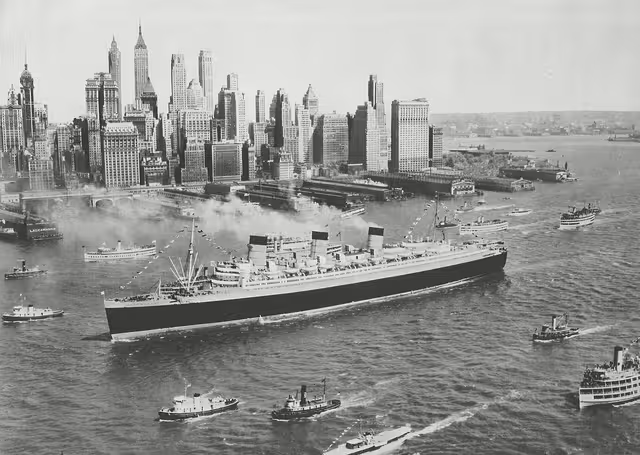
On August 30, 1936, RMS Queen Mary completed a record-breaking eastbound crossing of the North Atlantic, securing the prestigious Blue Riband and becoming the fastest ocean liner of her era.
The achievement came only a few months after the great British liner entered service and marked a major victory in one of the most famous rivalries of the golden age of transatlantic travel.
A New Giant of the Atlantic
RMS Queen Mary was built for the Cunard-White Star Line and entered passenger service in 1936.
She was designed to carry thousands of passengers between Europe and North America in speed, comfort, and luxury.
At more than 300 metres long, with three enormous funnels and powerful steam turbines, the ship became an immediate symbol of British engineering and prestige.
The Rival From France
Queen Mary's greatest competitor was the French liner SS Normandie.
The two ships represented different approaches to the same goal: building the fastest, most impressive, and most luxurious passenger liner on the Atlantic.
Normandie had captured the transatlantic speed record in 1935 and became the ship that Queen Mary was expected to challenge.
What Was the Blue Riband?
The Blue Riband was the traditional title associated with the fastest passenger liner operating regularly across the North Atlantic.
It was not originally a formal competition with a single governing organization.
Instead, it became a widely recognized symbol of maritime speed and technological superiority.
Records were measured separately for eastbound and westbound voyages because winds, ocean currents, and weather conditions could make the two directions very different.
The First Attempt Was Not Enough
Queen Mary began her maiden voyage from Southampton to New York on May 27, 1936.
Expectations were enormous, and many people hoped she would immediately take the record from Normandie.
She did not.
But the ship's designers and engineers continued improving her performance, and only a few months later she was ready for another attempt.
A Record on the Way to America
In August 1936, Queen Mary crossed from Europe to New York at an average speed of more than 30 knots.
The voyage was fast enough to break the westbound transatlantic record previously held by Normandie.
Passengers celebrated aboard the ship as news spread that the British liner had finally surpassed her French rival.
But Queen Mary was not finished.
The Record-Breaking Return
The liner soon departed New York for the return voyage to Europe.
On August 30, 1936, she passed Bishop Rock near the southwestern coast of Britain after completing another extraordinary Atlantic crossing.
The journey from Ambrose Light near New York to Bishop Rock took approximately 3 days, 23 hours, and 57 minutes.
Her average speed was about 30.63 knots, equivalent to roughly 56.7 kilometres per hour.
The Fastest Liner on the Atlantic
The performance broke the existing eastbound record by several hours.
With records in both directions, Queen Mary had secured the Blue Riband and established herself as the fastest transatlantic passenger liner of the moment.
For Cunard, Britain, and the ship's engineers, it was an important technological and symbolic victory.
More Than Just Speed
The competition between Queen Mary and Normandie was about much more than a few hours saved during an ocean crossing.
In the 1930s, great liners were floating demonstrations of national engineering ability.
They combined advanced propulsion systems, navigation equipment, architecture, interior design, and enormous industrial resources.
The fastest liner was therefore also a symbol of technological prestige.
Normandie Strikes Back
The rivalry did not end in 1936.
Normandie regained the speed record in 1937, continuing the competition between the two great liners.
Cunard responded with further improvements to Queen Mary, including changes to her propellers.
In 1938, she captured the Blue Riband again.
This time she would keep it for more than a decade.
A Record That Lasted Until 1952
Queen Mary's 1938 record remained unbeaten until the American liner SS United States entered service in 1952.
By then, the age of the great transatlantic liner was approaching its peak.
Commercial aviation would soon begin transforming the way passengers crossed the Atlantic.
An Icon of Ocean Travel
RMS Queen Mary went on to have an extraordinary career.
She served as a luxury passenger liner, transported troops during the Second World War, and later returned to civilian transatlantic service.
Today, the preserved ship remains in Long Beach, California, where she survives as one of the most famous ocean liners ever built.
A Race Across the Atlantic
On August 30, 1936, Queen Mary demonstrated what the great ocean liners of the 1930s could achieve.
Crossing the Atlantic in less than four days, she combined enormous size with remarkable speed.
Her victory in the race for the Blue Riband became one of the defining moments of the golden age of ocean travel.
Other Events on This Day
- Bruce McLaren, the Man Behind a Racing Legend, Is Born
- Maurice Hilleman, the Man Behind Modern Vaccines, Is Born
- Melbourne Begins on the Banks of the Yarra
Credits: 1st photo: Cunard-White Star Line — Public Domain / Wikimedia Commons.