Aug
31
31
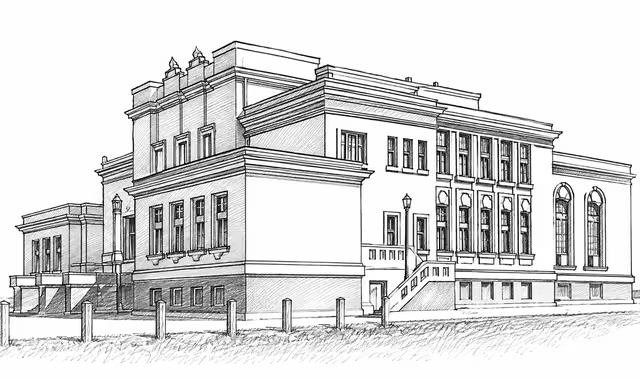
On August 31, 1936, Czechoslovakia launched regular international shortwave broadcasting from Prague, beginning the service that is now known as Radio Prague International.
The new station allowed Czechoslovakia to speak directly to listeners far beyond its borders at a time when radio was one of the most powerful technologies in the world.
A New Voice From Czechoslovakia
The first regular international broadcast began at 10:00 a.m. on August 31, 1936.
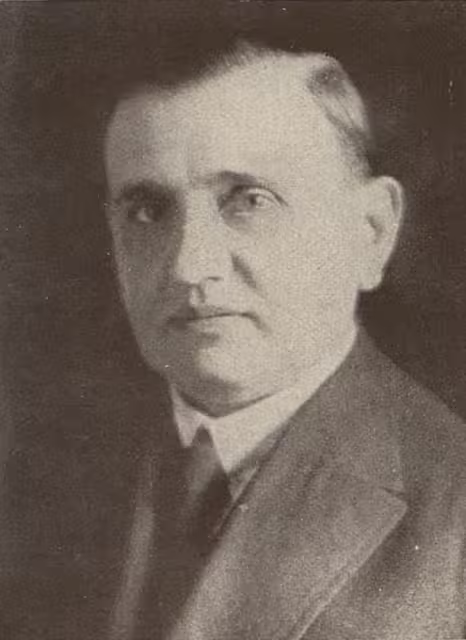
The opening program included an English-language address by Eduard Svoboda, technical director of Radiojournal, the predecessor of today's Czech Radio.
It marked the official beginning of organized foreign broadcasting from Czechoslovakia.
Why Shortwave Radio?
Shortwave radio had one major advantage over ordinary local broadcasting.
Its signals could travel enormous distances by reflecting from layers of the Earth's ionosphere.
Under favorable conditions, a transmission from Central Europe could be heard thousands of kilometres away.
Long before satellites, the internet, or digital streaming, shortwave radio offered one of the few practical ways for a country to speak directly to an international audience.
The Transmitter at Poděbrady
To make international broadcasting possible, Czechoslovakia built a powerful shortwave transmitting station at Poděbrady, east of Prague.
Experimental transmissions had already begun on July 24, 1936.
After several weeks of testing, regular international broadcasting officially started at the end of August.
Music, News, and Several Languages
The earliest programs were relatively simple.
They included music played from gramophone records, announcements, news, and spoken segments in several languages.
The goal was not only to entertain listeners but also to explain Czechoslovakia, its culture, politics, and society to people abroad.
Listeners Respond From Around the World
The new service quickly proved that shortwave broadcasting could reach a real international audience.
Within the first months, the station received thousands of letters from listeners abroad.
These reception reports helped engineers confirm where the signal could be heard and gave broadcasters valuable feedback about program quality.
A New Tool of International Communication
By the late 1930s, radio had become much more than entertainment.
Governments across Europe increasingly used international broadcasting to influence public opinion and present their own view of world events.
For Czechoslovakia, foreign broadcasting became a way to explain the country's position at a time when political tensions in Europe were rapidly increasing.
Broadcasting in a Dangerous Decade
The creation of the station came during the rise of Nazi Germany and the growing crisis surrounding Czechoslovakia.
International radio therefore became part of a wider struggle over information, propaganda, and national reputation.
Programs from Prague attempted to provide foreign listeners with information about Czechoslovakia and respond to misleading claims being spread abroad.
War Changes Everything
After Nazi Germany occupied the Czech lands in March 1939, the independent Czechoslovak international broadcasting service could no longer continue in its original form.
The political situation transformed radio throughout Europe.
After the Second World War, however, international broadcasting from Prague was quickly restored and expanded.
Broadcasting in Many Languages
By the late 1940s, programs from Prague were being transmitted in a remarkable number of languages.
During different periods of its history, the service broadcast to audiences across Europe, the Americas, Asia, Africa, and other regions.
Its role changed repeatedly as Czechoslovakia passed through communist rule, the Prague Spring, the Cold War, the Velvet Revolution, and eventually the peaceful division of Czechoslovakia.
From Radio Prague to Radio Prague International
For decades, the service became widely known abroad as Radio Prague.
After the creation of the Czech Republic in 1993, it continued as the international broadcasting service of Czech Radio.
In 2019, the name was officially changed to Radio Prague International to make its global role clearer.
The End of Regular Shortwave Broadcasting
Technology eventually changed the way international audiences received news.
Regular shortwave broadcasts from Prague ended in 2011.
But the service itself did not disappear.
Radio Prague International continued through the internet, podcasts, digital audio, partner stations, and other modern platforms.
Ninety Years of Broadcasting
On August 31, 2026, Radio Prague International marks 90 years since the beginning of regular international broadcasting from Czechoslovakia.
The technology has changed almost completely, from powerful shortwave transmitters to digital streaming and online media.
But the basic idea remains remarkably similar: to connect Prague with listeners around the world.
A Signal That Crossed Borders
When the first regular broadcast began on August 31, 1936, international radio was still a relatively new technology.
Czechoslovakia used it to send news, music, language, and culture far beyond its borders.
What began as a shortwave signal transmitted from Central Europe became a broadcasting service that has survived war, political change, technological revolutions, and nearly a century of European history.
Other Events on This Day
- Ferdinand von Zeppelin Patents His Vision of the Airship
- The Death of Diana, Princess of Wales, Shocks the World
Credits: 1st photo by artistic reconstruction based on a historical photograph; 2nd photo is portrait from 1927, unknown photographer — Public Domain / Wikimedia Commons.