Aug
31
31
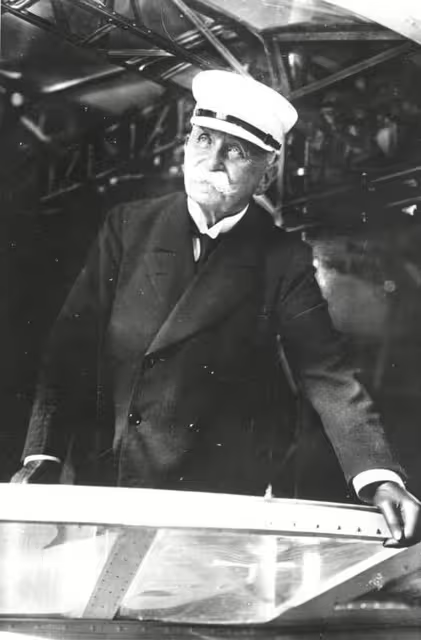
On August 31, 1895, German inventor and former military officer Ferdinand von Zeppelin secured patent protection for a new type of steerable rigid airship. His idea would eventually lead to the famous aircraft that carried his name.
The patent marked an important step toward a new era of lighter-than-air travel and helped establish the basic principles behind the great rigid airships of the early 20th century.
A Soldier With an Engineering Vision
Ferdinand von Zeppelin was born in 1838 in what is now Germany.
He spent much of his early life as a military officer and gained first-hand experience with balloons during the 19th century.
After leaving active military service, Zeppelin devoted increasing amounts of time and money to the idea of building a large aircraft that could be controlled in flight.
More Than an Ordinary Balloon
Traditional balloons could rise into the air, but they were largely carried wherever the wind took them.
Zeppelin wanted something very different.
His concept involved a rigid structural framework containing several separate gas cells, combined with engines, propellers, steering controls, and passenger or crew gondolas.
The result would be an aircraft capable of travelling in a chosen direction rather than simply drifting with the wind.
The 1895 Patent
On August 31, 1895, Zeppelin's design received patent protection in Germany.
The original concept was described as a steerable airship system with several supporting bodies arranged one behind another.
In some ways, the design resembled an airborne train made from multiple connected sections.
That exact configuration was never built, but many of the ideas behind it influenced Zeppelin's later and more practical airships.
A Rigid Framework Changes Everything
One of Zeppelin's most important ideas was the use of a rigid internal structure.
Instead of relying on the pressure of a single gas envelope to maintain the aircraft's shape, the Zeppelin design used a lightweight framework.
Inside it were multiple gas cells filled with lifting gas.
This allowed engineers to construct airships that were far larger than most conventional balloons.
Building the First Zeppelin
Turning the patent into a real aircraft required years of engineering work and considerable financial risk.
Zeppelin invested much of his own money in the project and struggled to convince investors that such a large flying machine could work.
Eventually, construction began on his first practical airship, known as LZ 1.
The First Flight
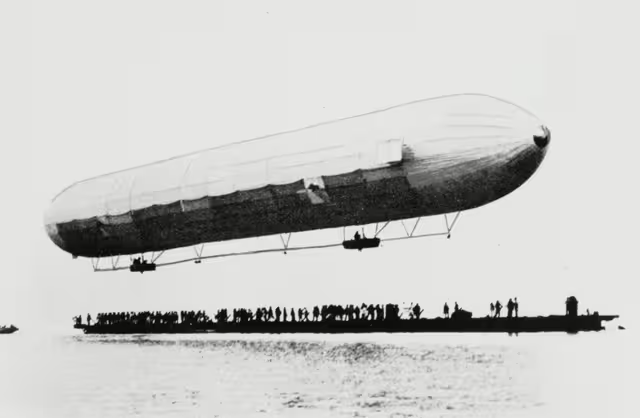
On July 2, 1900, LZ 1 made its first flight over Lake Constance in southern Germany.
The airship was approximately 128 metres long and represented one of the most ambitious flying machines ever built at the time.
The first flight was not perfect, but it proved that Zeppelin's basic concept was possible.
From Experiment to Transportation
Over the following years, Zeppelin and his engineers continued improving their designs.
Later airships became larger, faster, and more reliable.
By the early 20th century, Zeppelins were carrying passengers on scheduled flights, years before commercial airplanes became widely practical.
They offered travellers an entirely new experience: long-distance flight in large cabins suspended beneath enormous lighter-than-air structures.
A Name That Became a Type of Aircraft
Zeppelin's success was so influential that his surname eventually became a common term for large rigid airships.
During the following decades, Zeppelins were used for passenger transportation, exploration, military operations, and long-distance demonstration flights.
Some later airships crossed oceans and travelled thousands of kilometres without landing.
The Dream of Long-Distance Air Travel
Before modern passenger aviation, rigid airships offered one of the first realistic visions of comfortable long-distance travel through the sky.
Passengers could walk through cabins, dine during the journey, and watch the landscape or ocean from high above.
Although airplanes would eventually replace airships as the dominant form of air transportation, Zeppelin's machines played an important role in proving that large-scale aerial travel was possible.
An Idea Patented Before It Could Fly
When Ferdinand von Zeppelin secured patent protection for his concept on August 31, 1895, no full-sized Zeppelin had yet flown.
He was protecting a vision that still existed largely on paper.
Only five years later, LZ 1 rose above Lake Constance and turned that vision into reality.
Zeppelin's persistence transformed an ambitious patent into one of the most recognizable technologies of the early aviation age.
Other Events on This Day
- Radio Prague Begins Broadcasting to the World
- The Death of Diana, Princess of Wales, Shocks the World
Credits: 1st photo: German Federal Archives, Bild 146-1986-031-08 — CC BY-SA 3.0 DE.; 2nd photo: Public Domain / Wikimedia Commons.