
Sep
8
8
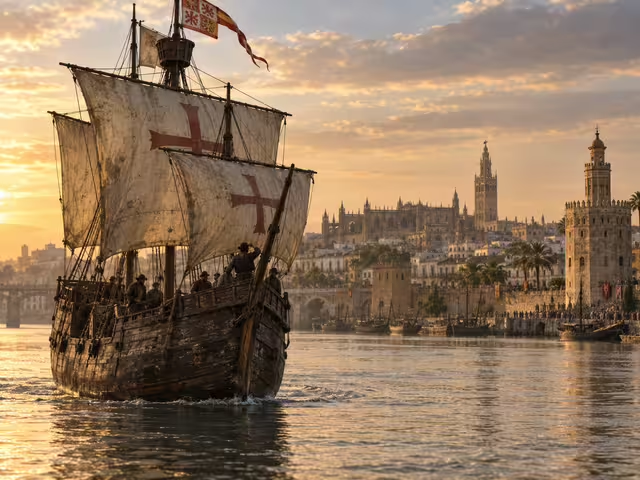
On September 8, 1522, the battered ship Victoria reached Seville after completing the first known circumnavigation of the Earth. Commanded on the final stage by Juan Sebastián Elcano, the vessel was the only one of the expedition's five original ships to complete the extraordinary three-year voyage.
The journey had crossed the Atlantic, discovered a navigable passage through South America, traversed the vast Pacific Ocean, reached Southeast Asia, and returned to Europe across the Indian Ocean.
A Voyage Begins in 1519
The expedition had left Seville on August 10, 1519, before continuing from Sanlúcar de Barrameda toward the Atlantic.
It was commanded by the Portuguese navigator Ferdinand Magellan, known in Portuguese as Fernão de Magalhães, sailing in the service of the Spanish Crown.
Its original goal was not to sail around the world. Magellan hoped to find a western sea route to the spice-producing islands of Southeast Asia.
Five Ships Sail West
The expedition consisted of five ships: Trinidad, San Antonio, Concepción, Santiago, and Victoria.
They carried a multinational crew of roughly 270 men.
Few of them could have imagined that only one of those ships would eventually return to Spain.
A Passage Through South America
After crossing the Atlantic and exploring the coast of South America, the expedition found a difficult channel leading through the southern end of the continent.
The route became known as the Strait of Magellan.
Passing through it opened the way to an enormous ocean that Europeans had not yet crossed from east to west.
Across the Pacific
Magellan named the ocean the Mar Pacífico — the “peaceful sea” — because of the relatively calm conditions encountered when the expedition entered it.
But the crossing proved far longer than expected.
For months the crews travelled across an immense expanse of water while food supplies deteriorated and hunger and disease took a heavy toll.
The voyage demonstrated just how enormous the Pacific Ocean really was.
Magellan Does Not Complete the Journey
The expedition eventually reached the Philippines in 1521.
There, on April 27, 1521, Magellan was killed during the Battle of Mactan after becoming involved in a local conflict.
The commander who had begun the expedition would therefore never see its completion.
Leadership passed through several hands as the surviving crews continued toward the Spice Islands.
Elcano Takes Command
Eventually, the Spanish-Basque navigator Juan Sebastián Elcano took command of the Victoria.
Rather than attempting to return across the Pacific, Elcano made a daring decision.
He would continue westward across the Indian Ocean and around the southern tip of Africa.
If successful, the expedition would unintentionally complete a full voyage around the planet.
A Dangerous Journey Home
The Victoria crossed the Indian Ocean while attempting to avoid Portuguese-controlled ports and shipping routes.
The crew suffered from hunger, exhaustion, disease, and severe shortages of supplies.
They rounded the Cape of Good Hope and continued north through the Atlantic toward Spain.
By then, the men had travelled farther by sea than any previous expedition known to European history.
Only One Ship Returns
On September 6, 1522, the Victoria reached Sanlúcar de Barrameda on the Spanish coast.
Only 18 members of the original expedition, including Elcano, were aboard.
Two days later, on September 8, the ship continued up the Guadalquivir River and arrived in Seville.
The voyage was finally complete.
A Ship Loaded With Spices
Despite the enormous human cost of the expedition, Victoria returned carrying a valuable cargo of spices, particularly cloves from the Moluccas.
These spices were among the most valuable commodities in Europe and had been one of the main reasons for launching the expedition in the first place.
Proof That the World Could Be Circumnavigated
The expedition did more than find a maritime route.
For the first time, a single voyage had travelled continuously around the globe.
It demonstrated in practical terms that the world's oceans were connected and provided Europeans with a dramatically clearer understanding of the true scale of the Earth.
The Pacific in particular proved far larger than many contemporary geographers had imagined.
A Journey of More Than Three Years
From its departure in 1519 to the return of Victoria in 1522, the expedition lasted more than three years.
It had crossed some of the world's most dangerous waters, navigated unknown coastlines, endured storms, starvation, conflict, and disease, and travelled tens of thousands of kilometres.
The survival of Victoria was itself an extraordinary achievement of early modern navigation.
Magellan and Elcano
The first circumnavigation is often associated primarily with Magellan because he conceived and led the expedition through its most important early discoveries.
But it was Juan Sebastián Elcano who commanded the Victoria during the final and decisive voyage back to Spain.
The achievement therefore belongs to both men — and to the many sailors from different countries who took part in the expedition.
The Ship That Changed the Map of the World
On September 8, 1522, Victoria entered Seville after completing something no ship had ever done before.
Of the five vessels that had departed three years earlier, she alone had sailed all the way around the Earth.
Her return transformed geographical knowledge and became one of the defining achievements of the Age of Exploration — the first completed voyage around the world.
Other Events on This Day
- Catherine of Bologna, Artist, Writer and Saint, Is Born
- The Northern Pacific Railroad Celebrates Its Transcontinental Completion


