
Sep
7
7
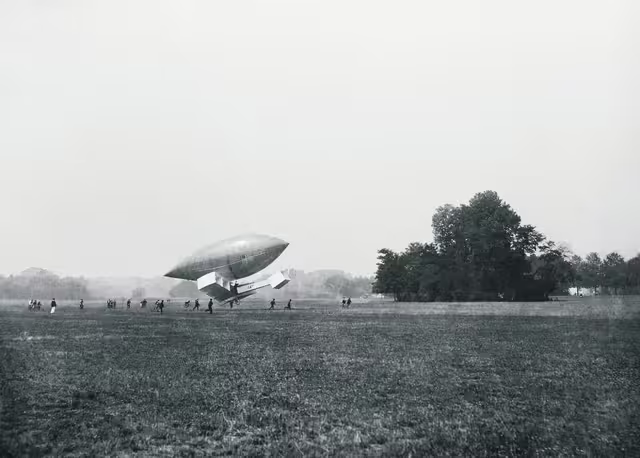
On September 7, 1906, aviation pioneer Alberto Santos-Dumont succeeded in lifting his experimental 14-bis aircraft from the ground during trials at Bagatelle near Paris. The brief attempt was not yet the famous officially recognized flight that would follow, but it was an important step toward one of the great breakthroughs of early aviation.
Only weeks later, Santos-Dumont and his strange-looking flying machine would capture international attention with increasingly successful public flights.
A World Learning to Fly
At the beginning of the 20th century, powered flight was still an experimental technology.
Inventors across Europe and the United States were trying different combinations of wings, engines, propellers, and control systems.
No one yet knew exactly what the successful airplane of the future should look like.
From Airships to Airplanes
Alberto Santos-Dumont was already famous before he began experimenting with the 14-bis.
The Brazilian-born inventor had become well known in Paris for building and flying balloons and powered airships.
He was fascinated by the possibility of personal flight and frequently demonstrated his machines publicly rather than conducting his experiments entirely in private.
The Unusual 14-bis
The 14-bis looked very different from a modern airplane.
Its large box-like wings were constructed from lightweight materials and covered with fabric, while a prominent control surface projected from the front.
The pilot stood inside the structure rather than sitting in an enclosed cockpit.
Its unusual appearance reflected just how experimental aviation still was.
Why Was It Called 14-bis?
The name came from Santos-Dumont's earlier airship No. 14.
During some of the first experiments, the airplane was suspended beneath the airship so Santos-Dumont could investigate its balance and controls while reducing the effective weight of the aircraft.
The new machine therefore became known as 14-bis — essentially “14 again” or “14 second version.”
A More Powerful Engine
Early tests showed that the original engine did not provide enough power.
At the beginning of September 1906, Santos-Dumont installed a stronger 50-horsepower Antoinette engine.
The additional power allowed the aircraft to accelerate much more effectively across the grass at Bagatelle.
September 7, 1906
During trials on September 7, the 14-bis accelerated across the field and briefly rose into the air.
Contemporary records associated with Santos-Dumont's experiments describe the machine reaching a height of roughly two metres during one attempt.
Other attempts that evening were less successful, but the aircraft had demonstrated that it could generate enough lift to leave the ground.
Learning One Attempt at a Time
Early aviation developed through repeated experimentation.
A short hop could reveal problems with balance, steering, power, or stability that could not easily be discovered while the aircraft remained on the ground.
Santos-Dumont continuously modified the 14-bis after each test.
Every attempt brought him closer to sustained controlled flight.
The First Public Flights Follow
On September 13, 1906, Santos-Dumont made another public attempt at Bagatelle and succeeded in flying approximately seven metres.
That flight was still too short to win the aviation prizes being offered in France, but it demonstrated clear progress.
A much greater achievement came the following month.
Sixty Metres Through the Air
On October 23, 1906, Santos-Dumont flew the 14-bis for approximately 60 metres before an audience and officials from the Aéro-Club de France.
The flight won the Archdeacon Prize for the first officially observed powered flight in France covering more than 25 metres.
It made Santos-Dumont an international aviation celebrity.
An Even Longer Flight
On November 12, 1906, the 14-bis flew again at Bagatelle.
This time Santos-Dumont covered approximately 220 metres, setting an officially recognized early aviation record.
The aircraft had progressed from experimental hops to sustained public flight in only a few months.
A Pioneer Who Flew in Public
One reason Santos-Dumont became so famous was the public nature of his experiments.
Crowds, journalists, photographers, and officials could watch his machines directly.
His flights helped convince many Europeans that powered airplanes were becoming practical reality rather than distant dreams.
One of Aviation's Great Experimenters
Santos-Dumont was not alone in the race to develop powered flight. The Wright brothers and several other experimenters had already achieved important advances.
But Santos-Dumont's highly visible European demonstrations made him one of the most influential figures of aviation's pioneering era.
In Brazil, he remains especially celebrated as a national aviation hero.
A Small Leap Toward the Age of Flight
On September 7, 1906, the 14-bis did not yet make the spectacular flight for which it would become famous.
Instead, it briefly lifted above the grass at Bagatelle — one more experimental step in a rapid sequence of improvements.
Within weeks, Santos-Dumont would turn those short attempts into successful public flights, helping demonstrate that the age of powered aviation had truly arrived.
Other Events on This Day
- Philidor, the Man Who Mastered Both Chess and Music, Is Born
- The Organization That Became INTERPOL Is Founded in Vienna
Credits: 1st photo: Unknown photographer / Museu Casa Natal de Santos Dumont — Public Domain / Wikimedia Commons.


