
Sep
7
7
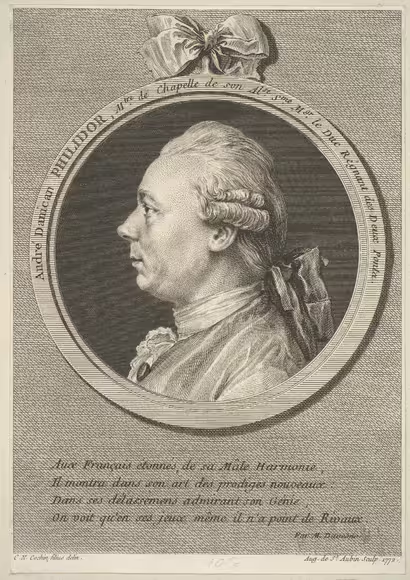
On September 7, 1726, François-André Danican Philidor was born in Dreux, France. He would become one of the strongest chess players of the 18th century and, at the same time, a successful composer whose music was performed on major French stages.
Few historical figures combined two demanding arts so successfully.
Born Into a Musical Family
Philidor came from a family with deep connections to the French royal musical establishment.
Music was therefore part of his world from an early age.
He received musical training as a child and eventually became known as a composer of operas, motets, and instrumental works.
A Composer With a Serious Career
Philidor was not simply an amateur musician who happened to play chess.
He built a real professional career as a composer and wrote numerous works for the French stage.
His music belonged to the lively world of 18th-century opera and comic theatre.
Another Talent Emerges
At the same time, Philidor developed an extraordinary talent for chess.
He became one of the strongest players in Europe and was widely regarded as the leading chess master of his generation.
His analytical approach to the game helped move chess toward a more systematic understanding of strategy.
The Importance of Pawns
Philidor became especially famous for emphasizing the strategic importance of pawns.
At a time when many players concentrated mainly on dramatic attacks with major pieces, Philidor argued that pawn structure often determined the entire character of a position.
His famous idea is often summarized as:
“Pawns are the soul of chess.”
A New Way to Understand the Game
Philidor believed that pawns were not simply expendable pieces.
Their arrangement controlled space, supported attacks, restricted enemy pieces, and shaped long-term plans.
This was an important strategic insight and became part of the foundation of modern positional chess.
L’Analyse des Échecs
In 1749, Philidor published his influential chess book L’Analyse des Échecs.
The book presented examples, strategic principles, and detailed analysis of positions.
It became one of the most important chess manuals of the 18th century and was translated and reprinted many times.
Playing Without Seeing the Board
Philidor was also famous for his remarkable ability to play chess blindfolded.
He could keep the positions of entire games in his memory while calculating moves without looking at the board.
In London in 1783, he famously played three blindfold games at the same time.
To contemporary audiences, this seemed almost unbelievable.
His Name Still Appears on Chessboards
Philidor's name remains part of chess terminology today.
The Philidor Defense begins with:
1. e4 e5 2. Nf3 d6
The opening is still played, studied, and discussed more than two centuries after his lifetime.
The Philidor Position
His name is also attached to one of the most important defensive ideas in rook endgames.
The Philidor position describes a standard method of defending a rook-and-pawn ending that every serious chess player eventually learns.
This is a remarkable legacy for a player born before modern competitive chess even existed.
Two Worlds, One Mind
Chess and music may seem very different, but Philidor excelled in both.
Each requires structure, memory, pattern recognition, timing, and the ability to think several steps ahead.
His life offers a fascinating example of how creativity and analytical thinking can exist side by side.
A European Reputation
Philidor travelled widely and spent significant periods in cities such as Paris and London.
He performed music, played chess against leading opponents, and built an international reputation in both fields.
His chess exhibitions attracted considerable attention, especially when he played without sight of the board.
A Legacy That Survived Centuries
Philidor died in 1795, but his influence never disappeared.
Musicians remember him as an important French composer of the 18th century.
Chess players still encounter his name in openings, endgames, strategy, and chess history.
The Master of Two Arts
Born on September 7, 1726, François-André Danican Philidor achieved something unusual even by the standards of the Enlightenment.
He became both a respected composer and one of the greatest chess players of his age.
More than two centuries later, his name still appears in concert history and on chessboards around the world.
Other Events on This Day
- Alberto Santos-Dumont Takes the 14-bis Into the Air
- The Organization That Became INTERPOL Is Founded in Vienna
Credits: 1st photo: Engraving by Augustin de Saint-Aubin, after Charles-Nicolas Cochin II — CC0 1.0 / The Metropolitan Museum of Art / Wikimedia Commons.


