
Sep
8
8
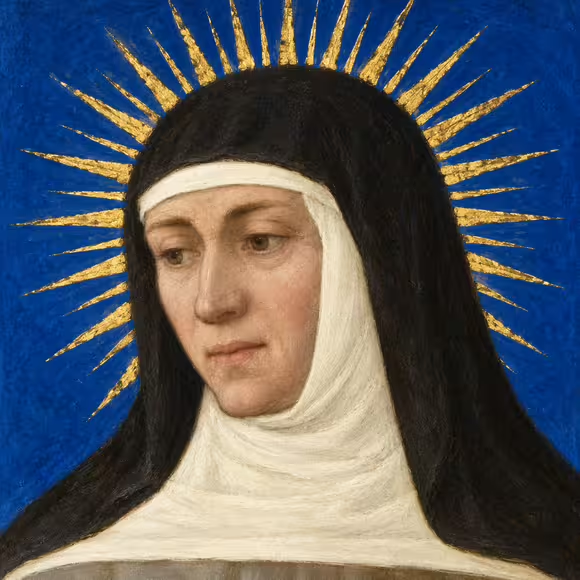
On September 8, 1413, Catherine of Bologna was born in Bologna, Italy. Known in Italian as Caterina de’ Vigri, she would become a Poor Clare nun, writer, musician, painter, and one of the most remarkable religious women of the Italian Renaissance.
Her life combined deep spirituality with a striking range of artistic and intellectual talents.
Growing Up in Renaissance Italy
Catherine was born into a well-connected family and spent part of her youth at the court of the Este family in Ferrara.
There she received an unusually broad education for a young woman of her time.
She studied literature, music, drawing, and manuscript illumination, developing skills that would remain important throughout her life.
From Court Life to Religious Life
Despite the opportunities of court life, Catherine gradually turned toward a more spiritual path.
She joined a religious community in Ferrara that eventually followed the rule of the Poor Clares, a Franciscan order known for prayer, poverty, and communal life.
Catherine became respected for both her discipline and her ability to guide others.
An Artist in the Convent
Catherine continued to create art after entering religious life.
She is associated with paintings, devotional images, and illuminated manuscripts.
Her artistic work reflected the spiritual world in which she lived, combining religious devotion with the visual traditions of 15th-century Italy.
A Writer and Teacher
Catherine also wrote about spiritual life.
Her best-known work is The Seven Spiritual Weapons, a guide intended to help believers remain strong in faith and resist spiritual difficulties.
The text later became one of the most important works associated with her legacy.
Music and Learning
Her talents were not limited to writing and painting.
Catherine was also trained in music and is believed to have played instruments during her years in religious communities.
Her education made her an unusual example of a medieval woman who combined intellectual, artistic, and religious pursuits.
Returning to Bologna
In 1456, Catherine returned to her native Bologna to help establish a new Poor Clare convent.
She became the abbess of the community at Corpus Domini and remained there for the rest of her life.
Her leadership strengthened her reputation as a spiritual teacher and respected religious figure.
A Life Remembered After Death
Catherine died on March 9, 1463.
Her reputation for holiness continued to grow after her death, and devotion to her spread beyond Bologna.
Centuries later, in 1712, Pope Clement XI formally canonized her as a saint.
Patron of Artists
Because of her own artistic activity, Catherine of Bologna became especially associated with painters and other artists.
She is often remembered as a patron saint of artists, linking creative work with spiritual devotion.
Faith and Creativity
Catherine's life stands out because she refused to separate intellectual and artistic creativity from religious commitment.
For her, painting, writing, music, and prayer were all parts of the same search for meaning.
A Renaissance Woman Before the Renaissance Fully Arrived
Born on September 8, 1413, Catherine of Bologna lived at a time when opportunities for women in education and the arts were limited.
Yet she became a respected writer, artist, musician, teacher, and religious leader.
More than five centuries later, she is remembered not only as a saint, but also as a remarkable example of how faith, learning, and creativity could come together in one life.
Other Events on This Day
- The First Circumnavigation Ends as Victoria Reaches Seville
- The Northern Pacific Railroad Celebrates Its Transcontinental Completion
Credits: 1st photo is artistic reconstruction based on a public-domain 15th-century depiction by Guglielmo Giraldi.


