
Sep
8
8
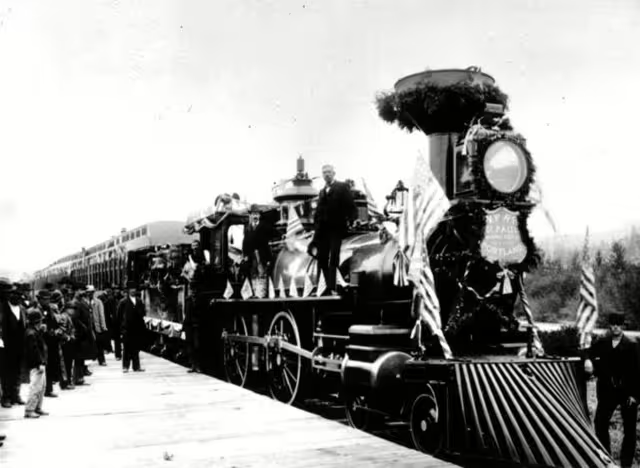
On September 8, 1883, hundreds of guests gathered at Gold Creek in Montana Territory to celebrate the completion of the Northern Pacific Railroad. Former U.S. President Ulysses S. Grant was among the prominent figures who took part in the ceremonial driving of the final spike.
The event marked the culmination of a vast engineering project designed to connect the Great Lakes region with the Pacific Northwest by rail.
A Railroad Across the Northern United States
The Northern Pacific Railroad had been chartered by the U.S. Congress in 1864.
Its ambitious goal was to build a northern transcontinental railway linking the upper Midwest with the Pacific coast.
The project required thousands of workers to construct tracks across plains, mountains, rivers, and enormous stretches of sparsely settled territory.
Years of Difficult Construction
Building the line was neither quick nor easy.
The railroad faced financial problems, difficult terrain, severe winters, and the economic turmoil surrounding the Panic of 1873.
Construction stopped and restarted several times before the company finally pushed its eastern and western sections toward one another.
The Tracks Meet in Montana
By the summer of 1883, the two advancing sections of railroad were approaching each other near Gold Creek, Montana Territory.
The tracks were technically connected on August 22, 1883.
For the much larger public celebration planned for September, part of the final section was removed so that the completion could be ceremonially repeated before invited guests.
A Grand Celebration
On September 8, special trains brought politicians, businessmen, railway officials, journalists, and international visitors to Gold Creek.
Among the most famous guests was Ulysses S. Grant, who had served as president of the United States from 1869 to 1877.
The ceremony symbolized the completion of one of the largest transportation projects of its era.
The Ceremonial Last Spike
The celebration centered on the driving of a ceremonial final spike.
Although it is sometimes described as a “golden spike,” the spike itself was not actually made of gold.
It had symbolic importance because it had also been associated with the beginning of Northern Pacific construction years earlier.
Company president Henry Villard, Ulysses S. Grant, and other dignitaries participated in the ceremony.
Connecting Distant Regions
The completed Northern Pacific created a continuous rail route across the northern part of the United States.
It connected communities in the Great Lakes region with Montana, the Pacific Northwest, and ports on the western coast.
Journeys that had once required weeks or months could increasingly be completed in a matter of days.
Railroads Transform the American West
The arrival of transcontinental railways dramatically changed settlement, trade, travel, and communication across the western United States.
Railroads carried passengers, mail, agricultural products, timber, minerals, and manufactured goods over enormous distances.
They also encouraged the rapid growth of new towns and cities along their routes.
A Complicated Transformation
The expansion of the railways also had profound consequences for Indigenous peoples whose lands the tracks crossed.
Railroad construction and the settlement it encouraged accelerated the loss of Indigenous territory and transformed landscapes and communities throughout the American West.
The Northern Pacific was therefore both an extraordinary engineering achievement and part of a much larger period of dramatic social and territorial change.
A New Transportation Network
By linking previously distant regions, the Northern Pacific became an important part of the growing national transportation system.
Its trains helped move people and goods between the interior of the continent and the Pacific coast while opening new commercial connections across thousands of kilometres.
The Celebration at Gold Creek
The ceremony of September 8, 1883, was designed to represent more than the laying of a final piece of track.
It celebrated decades of planning, investment, engineering, and physical labor.
With former President Ulysses S. Grant among the guests, the occasion became a national symbol of the expanding American railway network.
A Railroad Reaches Across a Continent
When the Northern Pacific celebrated its completion at Gold Creek, it joined the growing network of railways that had transformed travel across North America.
The final spike ceremony became a memorable moment in railroad history — a symbol of an era when steel rails were rapidly connecting places that had once seemed impossibly far apart.
Other Events on This Day
- Catherine of Bologna, Artist, Writer and Saint, Is Born
- The First Circumnavigation Ends as Victoria Reaches Seville
Credits: 1st photo by F. Jay Haynes / University of Washington Special Collections — Public Domain / Wikimedia Commons.


