
Sep
6
6
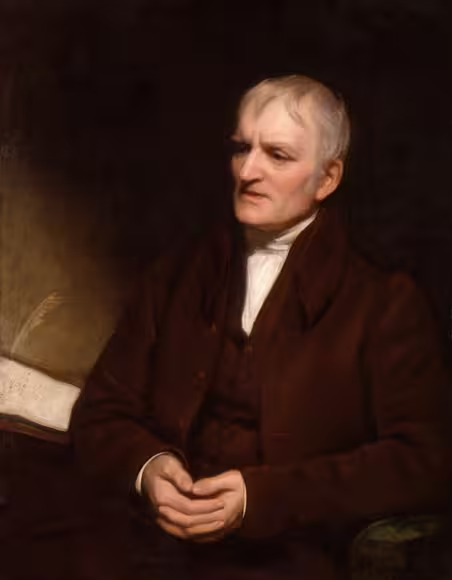
On September 6, 1803, British scientist John Dalton recorded one of his earliest known systems of atomic symbols, using simple graphic marks to represent the atoms of different elements. The same notes also included an early table of relative atomic weights — an important step toward modern atomic theory.
Dalton did not invent the idea of atoms, but he helped turn atoms from a philosophical concept into something chemists could use, compare, and calculate.
A New Way to Think About Matter
For centuries, philosophers had debated whether matter was made from tiny indivisible particles.
By the beginning of the 19th century, chemistry was becoming increasingly quantitative.
Scientists could measure how substances combined, but they still lacked a clear model explaining why certain elements reacted in fixed proportions.
Dalton believed atoms provided the answer.
Symbols for Invisible Particles
In his notebook on September 6, 1803, Dalton used a series of symbols to represent different kinds of atoms.
Unlike the letter-based chemical symbols used today, Dalton's system relied largely on circles containing dots, lines, crosses, and other markings.
Each design represented a different element.
Drawing Compounds
Dalton could combine these atomic symbols to illustrate simple compounds.
For example, two different atomic symbols placed together could represent a substance formed from two different elements.
This made chemistry more visual and helped connect chemical composition with the idea of individual atoms.
An Early Table of Atomic Weights
Dalton's notes also included estimates of the relative weights of atoms.
He used hydrogen as a reference and compared the masses of other elements against it.
Many of his numerical values were later corrected, but the underlying idea was extremely important.
Different elements, he argued, were made from atoms with characteristic masses.
Atoms and Simple Ratios
Dalton proposed that chemical compounds form when atoms combine in simple whole-number ratios.
A substance might therefore contain one atom of one element combined with one or two atoms of another.
This helped explain why chemical substances appeared in regular and predictable proportions.
The Foundations of Modern Atomic Theory
Dalton's atomic theory developed around several important ideas.
He argued that matter is composed of atoms, that atoms of different elements differ from one another, and that chemical reactions involve the rearrangement of those atoms.
These ideas were not perfect by modern standards, but they gave chemistry a powerful new framework.
From Philosophy to Experimental Science
The ancient Greek idea of atoms had been largely philosophical.
Dalton's achievement was to connect atomic thinking with measurements, chemical reactions, and experimental evidence.
Atoms could now help scientists explain why substances formed in particular ratios and why different elements behaved differently.
Dalton's Symbols Were Only the Beginning
Dalton's circular symbols were imaginative, but they were not especially convenient for writing complicated chemical formulas.
A few years later, Swedish chemist Jöns Jakob Berzelius introduced a simpler system based on letters from the names of elements.
That approach eventually became the basis of the familiar chemical symbols used today.
From Circles to H, O, and C
Modern students write symbols such as H for hydrogen, O for oxygen, and C for carbon.
Dalton's system looked very different, but it represented the same fundamental idea: each element should have a clear symbolic identity.
This made it possible to describe chemical relationships in a compact visual language.
A Scientist of Many Interests
Dalton's work extended beyond atomic theory.
He also studied weather, gases, and colour vision.
His investigation of colour blindness became so influential that the condition was once commonly called Daltonism.
A New Language for Chemistry
On September 6, 1803, Dalton's notebook captured an important moment in the development of chemistry.
By assigning symbols and relative weights to atoms, he helped scientists imagine matter as a world of distinct particles that could be counted, compared, and combined.
His symbols themselves were eventually replaced, but the atomic language they represented became one of the foundations of modern science.
Other Events on This Day
- Columbus Leaves His Last Port Before Crossing the Atlantic
- Susumu Tonegawa, the Scientist Who Explained Antibody Diversity, Is Born
Credits: 1st photo: Public Domain / Wikimedia Commons.


