
5
Peter IV of Aragon, the King Who Turned Ceremony Into Power, Is Born
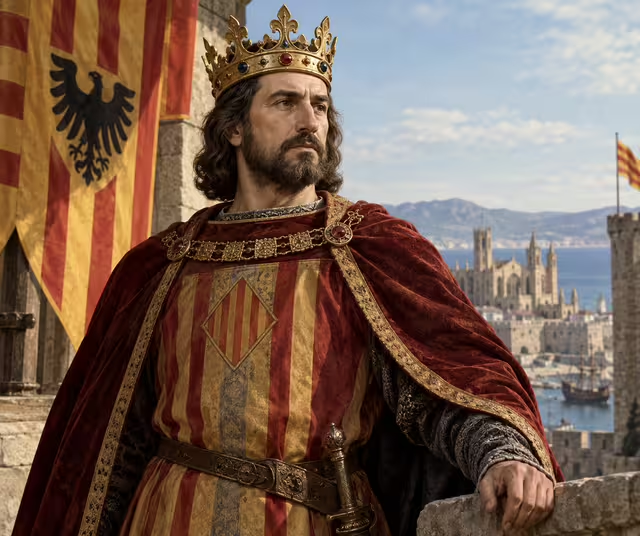
On September 5, 1319, Peter IV of Aragon was born in Balaguer. Later known as “Peter the Ceremonious,” he became one of the most important rulers of the Crown of Aragon and used royal ritual, courtly ceremony, and political symbolism as tools of power.
His long reign helped shape the political culture of the western Mediterranean during the 14th century.
A Prince of the Crown of Aragon
Peter was born into the royal house of Aragon, a dynasty that ruled a complex collection of territories around the western Mediterranean.
The Crown of Aragon included Aragon, Catalonia, Valencia, and other lands connected by dynastic rule rather than by a single uniform political system.
This meant that its kings had to work with different laws, traditions, assemblies, and local elites.
A Weak Child Who Became a Powerful King
According to accounts connected with Peter's own chronicle, he was born physically weak and there were doubts about whether he would survive infancy.
He did survive, however, and eventually became one of the most energetic and determined rulers of his dynasty.
He succeeded his father, Alfonso IV, in 1336.
Why He Was Called “the Ceremonious”
Peter became famous for his careful attention to royal ceremony, court protocol, and the public image of monarchy.
For him, ceremony was not simply decoration.
It was a political language.
Coronations, public appearances, court rituals, and the ordering of royal officials all helped communicate the authority and dignity of the crown.
Rules for Royal Power
Peter encouraged the detailed organization of court ceremonies and royal procedures.
These rules helped define how members of the court should behave, how ceremonies should be performed, and how royal authority should be presented to subjects and foreign visitors.
In a medieval world where symbols carried enormous political meaning, such details could strengthen a ruler's position.
Expanding Royal Authority
Peter spent much of his reign defending and expanding the influence of the Crown of Aragon.
One of his most important successes came in 1344, when he brought the Kingdom of Majorca back under the control of the main Aragonese crown.
This strengthened his position in the western Mediterranean and reduced the independence of a rival branch of the royal family.
A Mediterranean Monarchy
The Crown of Aragon was deeply involved in Mediterranean politics.
Its rulers had interests in the Iberian Peninsula, the Balearic Islands, Sardinia, Sicily, and other territories connected by trade, dynastic alliances, and military power.
Peter's reign therefore required constant diplomacy as well as military and political negotiation.
Conflict and Compromise
Like many medieval monarchs, Peter often struggled with powerful nobles and representative institutions.
His reign included internal political conflicts as well as wars with neighbouring rulers.
But his ability to combine force, negotiation, law, and ceremony allowed him to preserve royal authority during a difficult period.
A King Interested in How History Would Remember Him
Peter was also closely associated with the Chronicle of Peter the Ceremonious.
The work records major events of his reign and that of his father and is one of the most important narrative sources for the history of the Crown of Aragon in the 14th century.
It also reveals something unusual about Peter himself: he cared deeply about how his rule would be explained and remembered.
Writing Royal History
The chronicle was not simply a neutral record of events.
It presented Peter's political decisions from the perspective of the monarchy and helped justify his actions to future generations.
In this sense, Peter understood that history itself could become another instrument of royal authority.
Institutions That Continued to Develop
During Peter's reign, representative institutions within the Crown of Aragon continued to grow in importance.
In Catalonia, the Diputació del General developed further during the 14th century.
This institution would eventually become historically connected with the later Generalitat de Catalunya.
Its development was gradual, but Peter's reign formed part of that important institutional evolution.
A Long Reign
Peter IV ruled for more than 50 years, from 1336 until his death in 1387.
That longevity gave him unusual influence over the political development of his territories.
He witnessed wars, dynastic struggles, economic change, and the devastating effects of the Black Death.
The Power of Symbols
Peter's reputation rests not only on territory or warfare.
He understood that monarchy depended on perception as well as force.
Titles, ceremonies, public rituals, clothing, precedence, and written chronicles all helped define what royal authority meant.
That careful management of royal image earned him the name by which he is still remembered: Peter the Ceremonious.
A Medieval King Who Understood Political Theatre
Born on September 5, 1319, Peter IV of Aragon became a ruler who treated political symbolism with extraordinary seriousness.
He governed a diverse Mediterranean monarchy, defended its interests, expanded royal authority, and helped shape how kingship was performed and remembered.
His life offers a vivid example of how, in the Middle Ages, power was exercised not only through armies and laws, but also through ritual, image, and carefully staged ceremony.