
5
Freddie Mercury, the Man Who Gave Queen Its Voice, Is Born
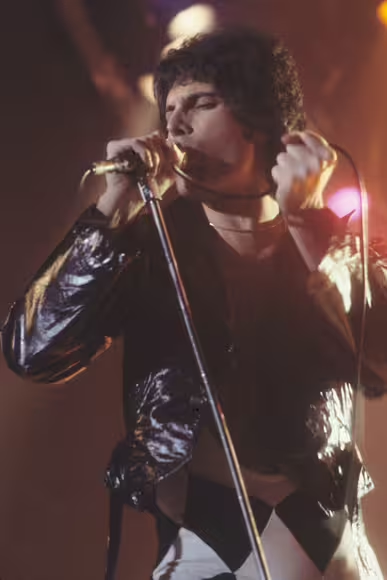
On September 5, 1946, Freddie Mercury was born as Farrokh Bulsara in Zanzibar. He would become the charismatic lead singer and one of the principal songwriters of Queen, creating some of the most recognizable songs and performances in rock history.
His extraordinary voice, theatrical stage presence, and instinct for melody helped turn Queen into one of the world's most influential rock bands.
Born Farrokh Bulsara
Freddie Mercury was born on the island of Zanzibar, then a British protectorate, to a Parsi family.
He spent much of his childhood in India, where he attended boarding school and began taking piano lessons at a young age.
Music quickly became an important part of his life.
A Young Musician
While still at school, he performed with an early band and developed his skills as a pianist and singer.
In 1964, his family moved to England, where Mercury continued his education and became increasingly involved in the London music scene.
Art Before Rock Stardom
Mercury studied graphic art and design at Ealing College of Art.
His artistic background later influenced the visual identity of Queen, including the band's elaborate presentation, costumes, stage design, and imagery.
He also designed the famous Queen crest using the zodiac signs of the band's members.
The Birth of Queen
Mercury became close to guitarist Brian May and drummer Roger Taylor, who had played together in a band called Smile.
After joining them, Mercury suggested the name Queen.
Bassist John Deacon later completed the classic lineup.
By the early 1970s, the band was developing a distinctive sound that combined hard rock, harmony, theatricality, and ambitious studio experimentation.
A Songwriter as Well as a Singer
Mercury wrote many of Queen's best-known songs.
His compositions included “Bohemian Rhapsody,” “Somebody to Love,” “We Are the Champions,” “Killer Queen,” “Don't Stop Me Now,” and “Crazy Little Thing Called Love.”
His songwriting could move effortlessly between rock, pop, balladry, opera-inspired arrangements, and playful experimentation.
Bohemian Rhapsody
Released in 1975, “Bohemian Rhapsody” became one of Mercury's most celebrated creations.
The song combined a piano ballad, elaborate vocal harmonies, an operatic middle section, and hard rock in a structure unlike a conventional pop single.
Its success showed that audiences were willing to embrace music that ignored many of the usual rules of radio songwriting.
A Unique Stage Presence
Mercury became famous for his ability to command enormous audiences.
His performances were energetic, dramatic, and intensely interactive.
He could turn a stadium crowd into part of the show, often using short vocal phrases and gestures to communicate with thousands of people at once.
Queen at Live Aid
One of the defining moments of Mercury's career came on July 13, 1985, when Queen performed at the Live Aid concert at Wembley Stadium in London.
During a short set, Mercury led the crowd through some of the band's biggest songs and transformed the stadium into a massive sing-along.
The performance became one of the most celebrated live appearances in rock history.
A Voice Unlike Any Other
Mercury's voice was remarkable not simply because of its range, but because of its flexibility and character.
He could move from delicate passages to powerful rock vocals and dramatic theatrical performances while maintaining a distinctive sound.
His combination of technical control and emotional intensity made his voice instantly recognizable.
Music Beyond Queen
Mercury also pursued solo projects.
His collaboration with Spanish soprano Montserrat Caballé produced the album Barcelona, blending rock and operatic music in a way that reflected his lifelong interest in theatrical and classical styles.
The title song later became closely associated with the city and the 1992 Barcelona Olympic Games.
A Lasting Cultural Influence
Mercury died on November 24, 1991, at the age of 45.
His death came only one day after he publicly confirmed that he had AIDS.
Afterward, his Queen bandmates and manager helped establish the Mercury Phoenix Trust to support organizations fighting HIV and AIDS around the world.
The Music Lives On
Decades after his death, Mercury's songs continue to reach new generations.
Queen's recordings remain widely played, their concerts are remembered as landmarks of live performance, and Mercury's distinctive presence continues to influence singers and performers around the world.
The Man Who Gave Queen Its Voice
Born on September 5, 1946, as Farrokh Bulsara, Freddie Mercury transformed himself into one of the most recognizable performers in modern music.
Through his voice, songwriting, visual imagination, and fearless stage presence, he helped create a musical legacy that has survived far beyond his own lifetime.
For millions of listeners, the sound of Freddie Mercury remains inseparable from the sound of Queen.
Other Events on This Day
- An 18-Year-Old Cassius Clay Wins Olympic Gold in Rome
- Peter IV of Aragon, the King Who Turned Ceremony Into Power, Is Born
Credits: 1st photo by Carl Lender — CC BY 2.0 / Wikimedia Commons. Cropped from the original.