
Sep
30
30
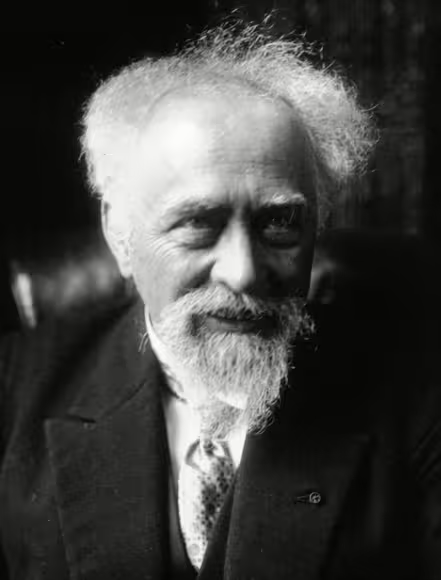
On 30 September 1870, Jean Baptiste Perrin was born in Lille, France. His experiments would help answer one of science’s most fundamental questions: are atoms and molecules real physical objects, or merely useful ideas for explaining how matter behaves?
By studying tiny particles suspended in liquids, Perrin gathered compelling evidence for the atomic nature of matter. His achievements earned him the 1926 Nobel Prize in Physics.
Finding Evidence for an Invisible World
Although atomic theory had become a powerful tool in nineteenth-century science, the physical existence of atoms and molecules was still debated. Perrin approached the question through measurements that connected visible behaviour with processes too small to observe directly.
One key phenomenon was Brownian motion: the irregular movement of microscopic particles suspended in a liquid. These particles are continually jostled by the surrounding molecules. Perrin’s experiments tested theoretical predictions developed by Albert Einstein and Marian Smoluchowski, helping establish that this restless motion revealed the activity of an unseen molecular world.
What Settling Particles Revealed
Perrin also investigated sedimentation equilibrium. Gravity tends to draw suspended particles downward, while thermal motion keeps them dispersed. At equilibrium, their concentration varies with height in a predictable way.
By carefully counting particles at different levels, Perrin could compare his observations with the predictions of molecular theory. These measurements helped him determine Avogadro’s number, which relates the amount of a substance to the number of particles it contains.
The strength of the evidence came from agreement: different experimental approaches produced closely matching results. Atoms and molecules were becoming measurable features of nature.
A Nobel Prize and a Wider Audience
In 1926, Perrin received the Nobel Prize in Physics for his work on the discontinuous structure of matter, particularly sedimentation equilibrium. The award recognized experiments that helped settle a long scientific debate.
He also sought to share these ideas beyond the laboratory. His book Les Atomes, published in 1913, brought together the evidence for atomic and molecular reality.
A Legacy of Careful Observation
Perrin’s work showed how patient observation could reveal something far beyond the microscope’s direct view. The movements and distribution of tiny suspended particles became evidence for the invisible building blocks of the material world.
Other Events on This Day
- Hydroelectric Power Lights Up Appleton
- William Morton Performs a Painless Tooth Extraction Using Ether
Credits: 1st photo: Agence de presse Meurisse / Bibliothèque nationale de France, via Wikimedia Commons. Public domain. Sources: NobelPrize.org — Jean Baptiste Perrin: Facts; NobelPrize.org — Perrin’s Nobel Lecture; CNRS — Pourquoi il faut relire « Les Atomes


