
Sep
20
20
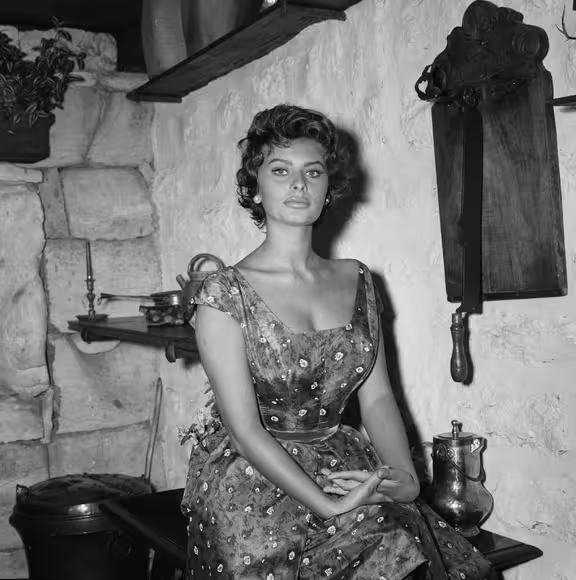
On September 20, 1934, a girl named Sofia Villani Scicolone was born in Rome.
She would grow up in poverty near Naples, survive the hardships of the Second World War, enter beauty contests as a teenager and eventually transform herself into one of the most internationally recognized stars in the history of Italian cinema.
The world would know her as Sophia Loren.
Over a career spanning more than seven decades, Loren moved between Italian cinema and Hollywood, worked with filmmakers including Vittorio De Sica and Ettore Scola, appeared opposite stars such as Marcello Mastroianni, Cary Grant, Frank Sinatra and Gregory Peck, and became the first performer to win an Academy Award for acting in a non-English-language role.
Her journey from wartime Pozzuoli to the Academy Awards became one of the most remarkable careers of postwar European cinema.
Born in Rome, Raised Near Naples
Sophia Loren was born in Rome to Romilda Villani and Riccardo Scicolone.
Her parents were not married, and her father was largely absent from the household in which Sophia grew up.
Her mother eventually returned with Sophia and her younger sister Maria to Pozzuoli, a coastal town near Naples, where they lived with relatives.
The region would become central to Loren's identity.
Although she was born in Rome, the language, humor, temperament and culture of Naples remained visible throughout her career.
Some of her most memorable performances would later draw directly on the world in which she had grown up.
A Childhood During War
Loren's childhood coincided with the Second World War.
Pozzuoli was located near strategically important military and industrial facilities around the Bay of Naples and experienced repeated bombing.
For Loren's family, wartime life meant fear, overcrowding and severe shortages of food.
She later remembered hunger as one of the defining experiences of her childhood.
Night after night, families faced the possibility of bombing raids while searching for shelter and enough food to survive.
The glamorous international star of later decades therefore emerged from circumstances dramatically different from the luxury associated with her screen image.
A Very Thin Girl
As a child, Sophia did not resemble the image that would later make her famous.
She was unusually thin and was teased because of her long, slender appearance.
Later accounts recalled childhood nicknames referring to her thinness.
Adolescence changed her appearance dramatically.
By her mid-teens, the awkward child had become a striking young woman, and beauty contests offered one of the few possible routes toward a different life.
Beauty Contests and a Journey to Rome
As a teenager, Sophia began entering local beauty competitions.
In 1950, she participated in the Miss Italia competition and received the specially created title Miss Eleganza.
Beauty contests in postwar Italy frequently served as gateways into modeling, photo-romances and the rapidly expanding film industry.
Sophia and her mother increasingly looked toward Rome and its studios as a possible escape from poverty.
The Italian film industry was beginning one of the most important periods in its history.
Cinecittà studios were attracting both Italian productions and major international films.
The teenager from Pozzuoli arrived at exactly the right moment.
Entering Cinecittà
One of Sophia's earliest experiences in filmmaking came as an uncredited extra in the enormous historical production Quo Vadis.
The film, produced in Rome with a huge cast of extras, provided work for many aspiring performers.
Sophia began accepting small roles while also appearing in photo-romances, illustrated stories that were enormously popular in postwar Italy.
For a time she used the name Sofia Lazzaro.
Then another stage name emerged.
Sofia Scicolone became Sophia Loren.
The new name would soon appear on cinema screens around the world.
Meeting Carlo Ponti
During the early stages of her career, Loren met film producer Carlo Ponti.
Ponti was already an important figure in Italian cinema and recognized that the young actress had the potential to become far more than a beauty-contest celebrity.
He helped develop her career and encouraged opportunities that allowed her to move beyond minor decorative roles.
Their professional relationship also developed into a personal one.
It would become one of the most important relationships of Loren's life.
The legal circumstances surrounding Ponti's previous marriage made their eventual marriage complicated, but the couple ultimately married legally in France in 1966.
They remained together until Ponti's death in 2007.
The Gold of Naples
Loren's breakthrough came during the middle of the 1950s.
In 1954, director Vittorio De Sica cast her in The Gold of Naples.
Loren played a lively pizza seller in one of the film's episodes.
The role used qualities that would become central to her screen personality: humor, sensuality, energy and a powerful connection with southern Italian life.
The film helped demonstrate that Loren possessed more than physical beauty.
She could command the screen as a comic and dramatic performer.
It also began one of the most important artistic collaborations of her career.
Vittorio De Sica
Vittorio De Sica was already one of Italy's internationally celebrated filmmakers.
His earlier works included Shoeshine, Bicycle Thieves and Umberto D., films associated with Italian neorealism.
With Loren, however, he developed a different kind of collaboration.
He understood how to combine her natural comic energy with emotional vulnerability and dramatic intensity.
Over the following two decades, De Sica repeatedly returned to Loren for roles that became among the most important performances of her career.
Marcello Mastroianni
Another crucial screen partner was Marcello Mastroianni.
Together, Loren and Mastroianni became one of the most recognizable acting partnerships in European cinema.
Their contrasting personalities worked particularly well in Italian comedy.
Mastroianni could appear weary, restrained or ironic, while Loren brought explosive energy and emotional directness.
They would eventually appear together in numerous films across several decades.
Their collaborations included Too Bad She's Bad, Yesterday, Today and Tomorrow, Marriage Italian Style, Sunflower and A Special Day.
International Stardom
By the middle of the 1950s, Loren's fame was spreading beyond Italy.
Her role in The River Girl helped establish her international reputation.
Hollywood studios soon became interested.
Unlike many European performers who remained associated primarily with national cinema, Loren developed a career that moved repeatedly between Italy and English-language productions.
In 1957, she appeared in Boy on a Dolphin, one of her first major English-language films.
The same year she starred with Cary Grant and Frank Sinatra in The Pride and the Passion.
Hollywood
Loren soon found herself acting alongside some of Hollywood's most famous leading men.
She appeared with Cary Grant again in Houseboat.
She worked with Clark Gable in It Started in Naples.
She starred opposite Charlton Heston in the historical epic El Cid.
Other international productions paired her with actors including William Holden, Anthony Perkins, Peter Sellers and Marlon Brando.
For Hollywood, Loren represented both European sophistication and the vibrant image of postwar Italy.
But the performance that established her as a major dramatic actress came not from Hollywood.
It came from Vittorio De Sica.
Two Women
In 1960, Loren starred in De Sica's La ciociara, released internationally as Two Women.
She played Cesira, a widowed shopkeeper attempting to protect her teenage daughter during the Second World War.
The two flee Rome for the countryside, hoping to escape bombing and violence.
Instead, the war eventually reaches them there as well.
The role was dramatically different from the glamorous characters Loren had frequently played.
Her appearance was deliberately plain.
The emphasis was on exhaustion, fear, maternal determination and the psychological destruction caused by war.
Elements of the story inevitably carried echoes of Loren's own childhood experience of wartime Italy.
A Triumph at Cannes
Two Women became a major international success.
At the 1961 Cannes Film Festival, Loren received the award for Best Actress.
The performance demonstrated that the actress often marketed internationally as a glamorous Italian beauty could carry an intensely serious drama.
An even greater recognition followed in the United States.
A Historic Academy Award
At the Academy Awards ceremony in 1962, Sophia Loren won the Oscar for Best Actress for Two Women.
The achievement was historic.
She became the first performer to win an acting Academy Award for a performance in a non-English-language film.
Her competitors included Audrey Hepburn, Natalie Wood, Piper Laurie and Geraldine Page.
Loren did not attend the ceremony in person.
Nevertheless, the victory transformed her position in international cinema.
She was no longer simply an Italian star who had succeeded in Hollywood.
She was an Academy Award-winning dramatic actress whose most important performance had been delivered in Italian.
Yesterday, Today and Tomorrow
Loren reunited with De Sica and Mastroianni for Yesterday, Today and Tomorrow.
The film consists of three separate stories in which Loren and Mastroianni play different characters.
The episodes allowed Loren to move between comedy, seduction and social satire.
One sequence, in which Loren performs a striptease while Mastroianni's character watches, became one of the most famous scenes of their careers.
The film won the Academy Award for Best Foreign Language Film.
Decades later, Loren and Mastroianni humorously recreated elements of the famous scene in Robert Altman's Prêt-à-Porter.
Marriage Italian Style
In 1964, Loren again worked with De Sica and Mastroianni in Marriage Italian Style.
She played Filumena, a former prostitute who has spent years in a complicated relationship with a wealthy businessman.
The role combined comedy with anger, vulnerability and determination.
For her performance, Loren received another Academy Award nomination for Best Actress.
The film confirmed the extraordinary strength of the Loren-De Sica-Mastroianni partnership.
More Than Glamour
Loren's appearance was always an important part of her stardom.
Photographers and magazines helped turn her into an international symbol of Italian beauty.
But reducing her career to glamour misses what made her endure.
She was particularly effective at moving between comedy and drama.
A character could be loud, sensual and funny in one scene, then emotionally vulnerable in the next.
Her strongest roles often involved women who possessed enormous energy but were constrained by poverty, social expectations or difficult relationships.
That combination gave Loren a screen identity that was both larger than life and closely connected with everyday Italian experience.
Marriage and Family
Loren's personal relationship with Carlo Ponti attracted enormous media attention.
Ponti had previously been married, and Italian divorce law created serious legal complications for the couple.
An earlier attempt to marry abroad was not initially recognized under Italian law.
After Ponti obtained French citizenship and legally resolved his earlier marriage, he and Loren married in France in 1966.
They had two sons.
Carlo Ponti Jr. was born in 1968 and became a conductor.
Edoardo Ponti, born in 1973, became a film director.
Family life increasingly influenced the number and type of film projects Loren accepted.
A Special Day
One of Loren's finest later performances came in 1977 with Ettore Scola's A Special Day.
Once again she appeared opposite Marcello Mastroianni.
The film takes place in Rome on May 6, 1938, when Adolf Hitler visited Benito Mussolini.
While much of the city attends the public celebrations, two people remain behind in an apartment building.
Loren plays Antonietta, an exhausted housewife and mother living within the expectations of Fascist Italy.
Mastroianni plays Gabriele, a radio announcer facing persecution because he is gay and politically suspect.
The restrained film gave both actors roles dramatically removed from their glamorous screen images.
It became another landmark in their partnership.
A Career Across Decades
By the 1980s, Loren was appearing in fewer films.
She had already achieved a level of international fame that allowed her to choose projects selectively.
She continued appearing in cinema and television while devoting substantial time to her family.
Later roles allowed audiences to see her alongside new generations of actors.
In 1994, she appeared with Mastroianni once more in Robert Altman's Prêt-à-Porter.
In 1995, she joined Walter Matthau and Jack Lemmon in the American comedy Grumpier Old Men.
In 2009, she appeared in the musical Nine.
An Honorary Oscar
Three decades after her historic victory for Two Women, the Academy again honored Sophia Loren.
At the 1991 Academy Awards, she received an Honorary Academy Award recognizing her contribution to world cinema.
By then, Loren's significance extended well beyond individual performances.
She had become one of the rare European film stars whose career remained equally recognizable to audiences in Italy, elsewhere in Europe and the United States.
A Golden Lion
Further recognition came in 1998, when the Venice Film Festival presented Loren with the Golden Lion for Lifetime Achievement.
The honor connected her with the festival culture that had helped Italian cinema achieve enormous international prestige during the postwar decades.
Her career now represented much of that history.
She had moved from the era of Italian neorealism and Cinecittà epics through Hollywood studio productions, Italian comedy, international co-productions and modern European cinema.
The 2,000th Hollywood Star
Hollywood also permanently marked Loren's place in film history.
On February 1, 1994, she received a star on the Hollywood Walk of Fame.
It was officially designated the 2,000th star installed on the famous boulevard.
For an actress who had arrived in the United States from postwar Italy decades earlier, the symbolism was difficult to miss.
Working With Her Son
Loren's later career brought an unusual collaboration.
Her younger son, Edoardo Ponti, became a filmmaker and directed his mother in several projects.
In 2014, she starred in his short film The Human Voice, based on Jean Cocteau's play.
It was a demanding performance centered almost entirely on Loren as a woman experiencing the end of a relationship during a telephone conversation.
The collaboration allowed her to return to serious dramatic acting while working with someone who understood both her public image and private personality.
The Life Ahead
An even more significant collaboration arrived in 2020.
At the age of 86, Loren starred in Edoardo Ponti's The Life Ahead.
She played Madame Rosa, an elderly Holocaust survivor who cares for children in the Italian port city of Bari.
The role represented Loren's first major feature-film performance in years.
Rather than relying on nostalgia or recreating the glamour of her earlier career, the film presented her as an aging, physically vulnerable woman with a difficult past.
Once again, Loren demonstrated that the dramatic power first recognized in Two Women had survived decades of stardom.
A David di Donatello at 86
For The Life Ahead, Loren won the David di Donatello for Best Actress in 2021.
She was 86 years old, making her the oldest winner of the award in that category.
It was her seventh competitive David di Donatello as Best Actress.
The award connected one of the newest performances of her career with films stretching back to the early 1960s.
Seven Decades of Cinema
Few film careers have connected so many different eras.
When Loren entered cinema, the postwar Italian film industry was attracting international attention through neorealism.
Cinecittà was becoming known as Hollywood on the Tiber.
Color epics, international co-productions and Italian comedies were transforming the country's film industry.
Loren participated in all of these worlds.
She acted in Italian, English and international productions.
She moved from small parts to major Hollywood films and then repeatedly returned to Italian directors for some of her finest work.
The Partnership With Mastroianni
Of all Loren's co-stars, Marcello Mastroianni remains the one most closely associated with her.
Their partnership lasted for approximately four decades.
They could portray passionate lovers, unhappy couples, comic adversaries or ordinary people caught inside larger political and social forces.
The relationship was professional rather than romantic, but their screen chemistry became so convincing that generations of audiences associated them with one another.
Together they represented a particular period when Italian cinema possessed extraordinary international visibility.
The Partnership With De Sica
Vittorio De Sica was equally important.
Without him, Loren might still have become an international celebrity.
But films such as The Gold of Naples, Two Women, Yesterday, Today and Tomorrow and Marriage Italian Style demonstrated the full range of her acting.
De Sica understood how to use Loren's connection to Naples while also pushing her toward emotionally demanding performances.
Their work together transformed a movie star into an internationally respected actress.
From Pozzuoli to World Cinema
Loren's life story became inseparable from her public image.
She had experienced poverty and war as a child.
She entered the entertainment industry through beauty contests and tiny film roles.
Within a few years, she was working with some of the most important actors and directors in the world.
Yet she repeatedly returned to characters whose lives were rooted in working-class Italy.
The strongest performances often seemed to connect the international star with the girl who had grown up near Naples.
More Than a Movie Star
Sophia Loren became famous during an era when film stars were carefully constructed international personalities.
Her photographs appeared in magazines around the world, and her style became associated with a particular image of Italian glamour.
But the longevity of her reputation rests on performances that went beyond that image.
Cesira in Two Women is frightened, exhausted and devastated by war.
Filumena in Marriage Italian Style uses intelligence and determination to defend her children.
Antonietta in A Special Day is trapped within a household and political culture that has defined her entire life.
Madame Rosa in The Life Ahead is elderly, damaged and vulnerable.
These characters have little in common with the simple image of an international glamour icon.
September 20, 1934
When Sofia Villani Scicolone was born in Rome on September 20, 1934, nobody could have predicted the path ahead.
Her childhood would be shaped by poverty, wartime bombing and hunger near Naples.
As a teenager, beauty contests and small jobs at Cinecittà opened the first doors into film.
She adopted the name Sophia Loren and quickly became one of Italy's most recognizable young actresses.
Hollywood followed.
Then came Vittorio De Sica, Marcello Mastroianni and the performances that established her as something more than a star.
In 1962, Two Women made Loren the first performer to win an acting Oscar for a non-English-language performance.
Decades later, the Academy honored her entire career, Venice awarded her a Golden Lion for Lifetime Achievement, and at the age of 86 she was still winning Italy's leading acting awards.
The girl who grew up during wartime near Naples became one of the defining faces of Italian cinema and one of the country's most successful international film stars.
Other Events on This Day
Credits: 1st photo by Comet Photo AG (Zürich). ETH-Bibliothek Zürich, Bildarchiv. Licensed under CC BY-SA 4.0, via Wikimedia Commons.


