
Sep
16
16
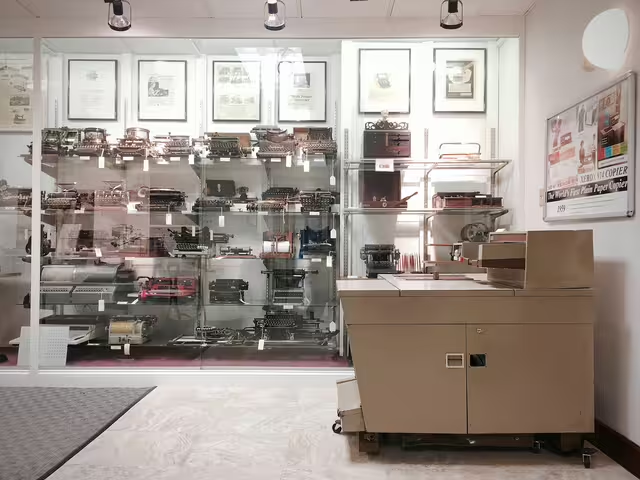
On September 16, 1959, a machine was demonstrated at New York City's Sherry-Netherland Hotel that would transform offices around the world.
It was the Xerox 914, the first commercially successful automatic office copier capable of producing copies directly onto ordinary paper.
The demonstration was shown on live television, allowing viewers to watch something that today seems completely ordinary but at the time appeared almost magical: a document was placed on a glass surface, a button was pressed, and seconds later a dry paper copy emerged from the machine.
No special photographic paper was required. No wet chemical processing was necessary. The operator did not need specialized training.
The Xerox 914 helped turn photocopying from a complicated specialist process into an everyday office activity.
Before the Photocopier
Making a duplicate document had once been surprisingly difficult.
Offices relied on carbon paper, mimeographs, photographic copying systems and other processes that often required special materials or considerable preparation.
If only a few copies of a letter were needed, a typist might simply type the document again.
Various copying machines already existed before 1959, but none combined the convenience, speed and plain-paper output that would make the Xerox 914 so successful.
The technology behind it had begun more than two decades earlier with an inventor named Chester Carlson.
Chester Carlson's Problem
Carlson worked in a patent department, where making copies of technical documents and drawings was a constant necessity.
Because of arthritis and difficulties with existing copying methods, he became interested in finding a simpler way to reproduce documents.
He began experimenting with a process based on electrostatic electricity and light.
Instead of photographing a document onto chemically treated photographic paper, Carlson imagined creating an electrically charged image that could attract a dry powder and then transfer that image onto ordinary paper.
The concept eventually became known as xerography.
The First Xerographic Image
On October 22, 1938, Carlson and his assistant Otto Kornei conducted a successful experiment in a small laboratory in Astoria, Queens, New York.
They produced a simple image containing the words and date 10-22-38 ASTORIA.
The result was crude, but it proved that Carlson's idea could work.
He received a U.S. patent for his electrophotographic process in 1942.
Finding a company interested in developing it was much more difficult.
An Idea Few Companies Wanted
Carlson approached numerous corporations with his invention.
Again and again, he was rejected.
The existing market for document copying did not appear large enough to justify investing in a complicated new technology.
Eventually, in 1944, the Battelle Memorial Institute agreed to help develop Carlson's process.
A few years later, a relatively small photographic-paper company in Rochester, New York, called the Haloid Company became involved.
Haloid licensed the technology from Battelle and began investing heavily in developing practical xerographic machines.
It was a risky decision.
The company was competing in an industry dominated by much larger corporations and was committing significant resources to a technology whose commercial future was uncertain.
From Electrophotography to Xerography
The word electrophotography was technically accurate but hardly ideal for marketing.
A new name was developed from Greek words meaning roughly dry writing.
The result was xerography.
The name emphasized one of the technology's greatest advantages: unlike many earlier copying methods, it did not depend on liquid chemical processing.
Haloid began using the name Xerox for its xerographic products.
In 1958, the company itself became Haloid Xerox, and in 1961 it would officially become the Xerox Corporation.
The Xerox 914
The breakthrough machine developed by the company was called the Xerox 914.
The number came from the maximum size of documents the machine could copy: approximately 9 by 14 inches.
By modern standards, the 914 was enormous.
It weighed roughly 650 pounds, or almost 300 kilograms, and stood about as large as a substantial piece of office furniture.
Yet what happened inside the machine was revolutionary.
An office worker could place an original document face down on the glass, close the cover and press a button.
The machine then performed the complicated xerographic process automatically.
How Xerography Worked
Inside the copier was a light-sensitive surface that received an electrical charge.
Light reflected from the original document created an electrostatic image corresponding to the dark and light areas of the page.
Fine powdered material called toner was attracted to the electrically charged image.
The toner was then transferred onto a sheet of ordinary paper and fused permanently to the surface using heat.
The result was a dry copy that could be handled immediately.
Today the process is familiar because variations of it are still used in laser printers and photocopiers.
In 1959, however, seeing the entire process happen automatically at the touch of a button was extraordinary.
September 16, 1959
Haloid Xerox chose the elegant Sherry-Netherland Hotel in New York City for the public unveiling of the new copier.
On September 16, company executives demonstrated the Xerox 914 before an audience while the presentation was also shown on live television.
The purpose was straightforward: people needed to see the machine working to understand why it was different.
A document could be copied quickly onto ordinary office paper without the operator preparing a master, mixing chemicals or waiting for photographic paper to develop.
It was copying transformed into a simple office task.
Seven Copies Per Minute
The Xerox 914 could produce approximately seven copies per minute.
That sounds slow compared with modern office machines capable of producing dozens or even hundreds of pages per minute.
But speed alone was not what made the 914 revolutionary.
Its great advantage was convenience.
The user could produce a single copy or several copies directly from an original document with very little preparation.
The machine could even reproduce material from books and certain three-dimensional objects placed on its glass surface.
For offices accustomed to carbon paper, photographic processes or centralized reproduction departments, the difference was enormous.
A Machine With a Temper
The Xerox 914 was revolutionary, but it was certainly not perfect.
It was mechanically complex, generated considerable heat and required regular maintenance.
Some early machines became notorious for overheating.
Xerox even supplied a small fire extinguisher with some machines, humorously referred to as a scorch eliminator.
The problem reflected the challenge of turning a laboratory process into a machine capable of producing thousands of copies in ordinary offices.
Despite those difficulties, customers loved the convenience of the 914.
Renting Instead of Buying
The machine was also extremely expensive.
Buying one outright cost tens of thousands of dollars, putting it beyond the reach of many ordinary businesses.
Xerox therefore relied heavily on a leasing model.
Instead of forcing customers to make a huge initial investment, the company could install a machine and charge according to its use.
The strategy lowered the barrier to adoption.
It also created an unexpected discovery.
Companies made far more copies than anyone had predicted.
The Copy Explosion
Before the Xerox 914, business planners often assumed that offices had only a limited need for copies.
The new machine proved exactly the opposite.
Once copying became easy, people found reasons to copy almost everything.
Reports could be distributed to every employee.
Letters could be preserved before being mailed.
Meeting documents could be reproduced in minutes.
Teachers, lawyers, government employees, engineers and researchers could distribute material without retyping or reprinting it.
The easier copying became, the more copying people wanted to do.
One of Xerox's Greatest Successes
The Xerox 914 became an enormous commercial success.
The Smithsonian Institution describes it as one of the most successful products Xerox ever produced.
A single machine was capable of producing as many as 100,000 copies per month.
Demand dramatically exceeded early expectations.
The copier transformed Haloid Xerox from a relatively small photographic company into one of America's most important technology corporations.
The product was so successful that the word Xerox itself became widely used as a synonym for making a photocopy.
Changing Office Culture
The impact of the Xerox 914 extended far beyond the company that built it.
It changed the way information moved through organizations.
Before inexpensive photocopying, distributing a document to dozens of people could require considerable work.
Afterward, information could spread almost instantly through an office.
The copier became part of everyday corporate life alongside the telephone and typewriter.
Entire workflows developed around the assumption that documents could be duplicated whenever necessary.
Education and Research
Photocopying also changed universities, libraries and research institutions.
Researchers could copy journal articles rather than copying passages by hand.
Professors could distribute readings to students.
Libraries could reproduce documents while keeping valuable originals protected.
The ability to duplicate information cheaply contributed to a much broader circulation of written material.
It also created new questions about copyright, intellectual property and how easily published works could be reproduced.
From Paper to Information Technology
The success of the Xerox 914 provided Xerox with enormous financial resources during the 1960s.
Those resources later helped fund research into technologies far removed from conventional photocopying.
In 1970, Xerox established the Palo Alto Research Center, better known as Xerox PARC.
Researchers there would make major contributions to personal computing, graphical user interfaces, computer networking, Ethernet and laser printing.
In an indirect sense, therefore, the commercial success of the photocopier helped finance some of the technologies that would eventually reduce the world's dependence on paper.
The Laser Printer Connection
Xerography also became fundamental to another technology that remains common today: the laser printer.
Instead of projecting the image of a physical document onto the photoreceptor, a laser printer uses a precisely controlled laser beam to create the electrostatic image.
Toner is then transferred and fused onto paper using principles closely related to those used by xerographic copiers.
The technological descendants of the Xerox 914 therefore remain present in offices decades later, even when no photocopying glass is involved.
A Copying Machine in the Smithsonian
The historical importance of the Xerox 914 was eventually formally recognized.
In 1985, Xerox donated an early production example to the Smithsonian's National Museum of American History.
The machine was number 517 off the production line.
It weighs approximately 648 pounds and survives as a physical reminder of how large and complicated the first generation of automatic office copiers could be.
Its size makes the achievement even more striking when compared with today's compact printers and scanners.
Why the Xerox 914 Mattered
The Xerox 914 did not invent the concept of copying a document.
It did something arguably more important for everyday life.
It made copying easy.
That distinction is why the machine became so influential.
Many technologies exist for years before a product finally makes them simple enough, reliable enough and affordable enough for widespread use.
For xerography, the Xerox 914 was that product.
It brought a complicated scientific process out of the laboratory and placed it beside ordinary office desks.
September 16, 1959
When the Xerox 914 was unveiled in New York on September 16, 1959, the demonstration involved something as ordinary as copying a sheet of paper.
Yet that simple task represented more than twenty years of experimentation, failed attempts, rejected proposals and engineering development.
Chester Carlson had created the basic xerographic process in 1938.
Haloid had taken the enormous financial risk of developing it into a practical machine.
And the Xerox 914 finally placed the technology in the hands of ordinary office workers.
Within a few years, photocopiers would become so common that it would be difficult to imagine an office without one.
The machine unveiled that September day did not merely make copies.
It changed how information could be reproduced, shared and distributed throughout the modern workplace.
Other Events on This Day
- African American Inventor and Educator Miriam Benjamin Is Born
- W.O. Bentley, Founder of Bentley Motors, Is Born
Credits: 1st photo by Marcin Wichary, licensed under CC BY 2.0, via Wikimedia Commons.


