
Sep
11
11
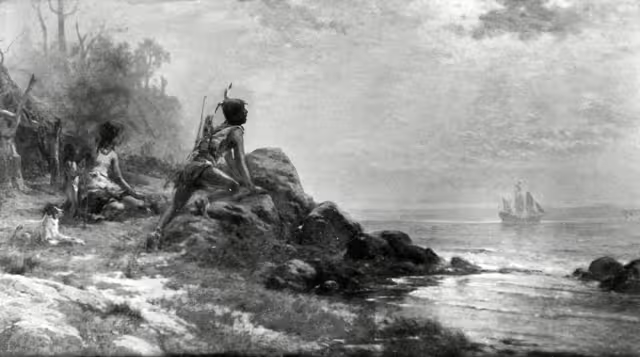
On September 11, 1609, English explorer Henry Hudson, sailing for the Dutch East India Company, entered New York Bay aboard the Half Moon and reached the waters around what is now Manhattan. His voyage would become one of the most significant European expeditions in the early history of New York.
Hudson and his crew encountered Indigenous people who had lived in the region for countless generations. These encounters marked an important moment in the growing contact between Europeans and the Native peoples of the Hudson River region, while also foreshadowing enormous changes that European trade and colonization would eventually bring.
A Search for a Route to Asia
Henry Hudson was an experienced English navigator whose great ambition was to find a shorter maritime route from Europe to Asia. In 1609, he entered the service of the Dutch East India Company and was given command of the Half Moon, known in Dutch as the Halve Maen.
Hudson initially sailed toward northern Europe in search of a passage around Russia. When ice prevented further progress, he changed course and crossed the Atlantic Ocean, eventually exploring parts of the eastern coast of North America.
His ultimate objective remained the same: to find a navigable waterway that might lead across the continent toward Asia.
Entering New York Bay
After exploring the coastline near present-day New Jersey, Hudson sailed into the great natural harbor now known as New York Bay. On September 11, 1609, the Half Moon reached the area near the southern end of Manhattan.
The landscape that Hudson saw was dramatically different from the modern city that occupies the island today. Manhattan was covered with forests, wetlands, streams and rich wildlife. The surrounding waterways provided abundant fish and other resources.
Most importantly, the region was not an empty wilderness waiting to be discovered. It formed part of the homeland of Lenape-speaking Indigenous peoples, whose communities had long-established social networks, trade routes and relationships with the land.
Encounters with Indigenous Peoples
Hudson's voyage brought the crew of the Half Moon into repeated contact with Indigenous communities living around New York Bay and along the river that would later bear his name.
Contemporary accounts describe exchanges in which Native people brought food, tobacco and other goods and Europeans offered items such as knives, beads and manufactured objects. Some encounters were peaceful and involved trade, while others during the expedition became tense and sometimes violent.
These meetings were part of a much larger historical process. Hudson was neither the first person to reach Manhattan nor the first European to see the region. Indigenous peoples had inhabited the area for generations, and European navigators such as Giovanni da Verrazzano had entered New York Harbor decades earlier.
Exploring the Great River
Hudson soon continued northward into the broad river flowing from the interior. Hoping that it might provide a passage across North America, the Half Moon traveled far upstream.
The expedition eventually reached the area near present-day Albany before shallow water convinced Hudson that the river did not provide the long-sought route to Asia.
Although his primary mission had failed, Hudson returned to Europe with reports describing a region rich in natural resources and opportunities for trade.
The Beginning of a New Era
Hudson's 1609 voyage helped strengthen Dutch interest in the region. In the following decades, Dutch traders and settlers established settlements throughout the Hudson Valley, and New Amsterdam eventually developed at the southern end of Manhattan.
The colony later passed into English hands and New Amsterdam became New York City.
For the Indigenous peoples of the region, however, European expansion brought profound consequences. Growing settlement led to competition for land and resources, disease, conflict and the gradual displacement of Native communities from much of their ancestral territory.
September 11, 1609
The arrival of the Half Moon in New York Bay on September 11, 1609, therefore represents much more than the voyage of a single explorer. It was an encounter between different worlds at a place that would eventually become one of the most influential cities on Earth.
Henry Hudson never found the passage to Asia he had been searching for, but the river he explored was later named the Hudson River, and his 1609 expedition became a defining chapter in the early European history of Manhattan, New York and the Hudson Valley.
Other Events on This Day
- Australian Sprinter and Olympic Champion Stan Rowley Is Born
- BART Begins Passenger Service in the San Francisco Bay Area
Credits: 1st photo by Edward Moran, 1898. Public Domain, via Wikimedia Commons / Library of Congress.


