
Sep
10
10
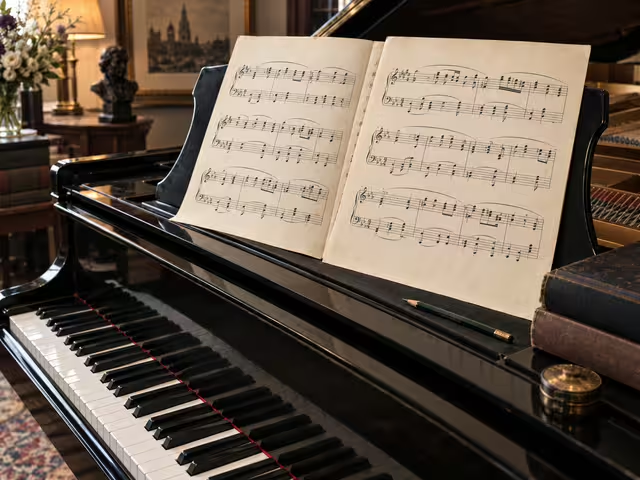
On September 10, 1925, Boris Alexandrovich Tchaikovsky was born in Moscow. He would become a respected Russian composer and pianist whose music included symphonies, concertos, chamber works, and scores for film and radio.
Although he shared a famous surname with Pyotr Ilyich Tchaikovsky, the two composers were not related.
A Musical Childhood
Tchaikovsky showed an early interest in music and began studying piano and composition while still a child.
His talent eventually led him to the Moscow Conservatory, one of Russia’s leading musical institutions.
Studying With Great Composers
At the Moscow Conservatory, Tchaikovsky studied composition with several important musicians, including Vissarion Shebalin, Nikolai Myaskovsky, and Dmitri Shostakovich.
He also studied piano with the distinguished pianist Lev Oborin.
This combination of composition and performance training gave him a strong foundation for his later career.
Choosing Composition
Although Tchaikovsky was an accomplished pianist, composition became the main focus of his professional life.
He developed a distinctive musical voice characterized by clear melodies, careful structure, and imaginative orchestral writing.
Music for the Orchestra
Orchestral music became one of the central parts of Tchaikovsky’s work.
Among his major compositions are the Second Symphony, the Sevastopol Symphony, Music for Orchestra, and Theme and Eight Variations.
His scores often combine strong melodic ideas with colorful and carefully balanced orchestration.
Concertos for Solo Instruments
Tchaikovsky also wrote important concertos for several instruments.
His works include concertos for cello, violin, piano, and clarinet.
The Cello Concerto, composed in the 1960s, became one of his best-known works and was written for the celebrated cellist Mstislav Rostropovich.
Chamber Music
Alongside his large orchestral works, Tchaikovsky wrote extensively for smaller ensembles.
His chamber music includes string quartets, instrumental sonatas, and other works that allowed him to explore musical ideas in a more intimate setting.
This part of his catalogue remains an important element of his musical legacy.
Music for Film and Radio
Tchaikovsky’s music also reached audiences outside the concert hall.
He composed scores for numerous films, television productions, radio programs, and theatrical works.
This wide range of projects demonstrated his ability to adapt his musical style to very different settings.
A Teacher of Composition
During the later years of his life, Tchaikovsky also became a teacher.
He taught composition and orchestration at the Gnessin Russian Academy of Music in Moscow, passing his experience on to a new generation of composers.
A Composer With His Own Voice
Boris Tchaikovsky’s music remained rooted in melody and traditional musical forms while also making use of fresh rhythms, harmonies, and orchestral colors.
Rather than following a single formula, he approached each new composition as an opportunity to explore a different musical idea.
A Lasting Musical Legacy
Tchaikovsky died in Moscow on February 7, 1996, at the age of 70.
His music continued to be performed and recorded after his death, helping new audiences discover a composer whose work spanned much of the 20th century.
A Life Devoted to Music
Born on September 10, 1925, Boris Tchaikovsky built a career that embraced orchestral music, concertos, chamber works, film scores, piano performance, and teaching.
Today, he is remembered as a distinctive voice in 20th-century Russian music and as a composer whose works continue to reward performers and listeners alike.
Other Events on This Day
- Henry Purcell, One of England’s Greatest Composers, Is Born
- The LHC is not the work of a single country or laboratory.


