
Sep
10
10
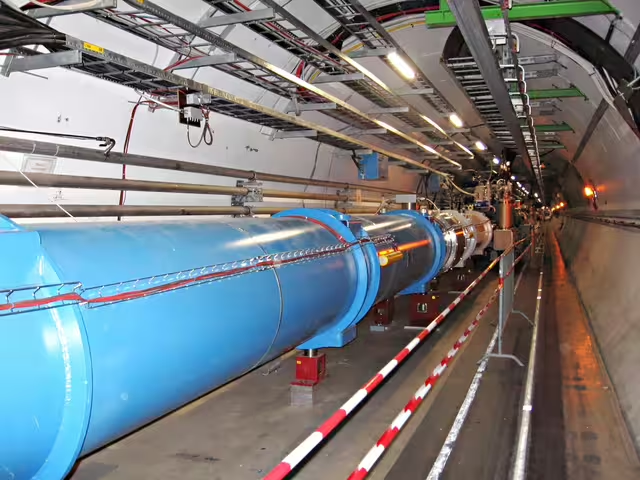
It represents one of the largest international collaborations in science, involving researchers from universities and institutes across the world.
The enormous volumes of data produced by its experiments are processed using a worldwide computing network.
Exploring Fundamental Questions
The LHC continues to investigate questions that remain unanswered.
Scientists use it to study the Higgs boson in greater detail, search for unknown particles, examine the differences between matter and antimatter, and recreate conditions similar to those that existed shortly after the Big Bang.
A New Era of Particle Physics
On September 10, 2008, the first proton beam completed its journey around the Large Hadron Collider.
That single circuit represented the culmination of years of engineering and the beginning of an extraordinary scientific program.
Since then, the LHC has allowed scientists to explore matter at unprecedented energies and has transformed our understanding of the smallest building blocks of the universe.
Other Events on This Day
- Boris Tchaikovsky, Russian Composer and Pianist, Is Born
- Henry Purcell, One of England’s Greatest Composers, Is Born
Credits: 1st photo by Julian Herzog — CC BY-SA 3.0 / Wikimedia Commons.


