Sep
1
1
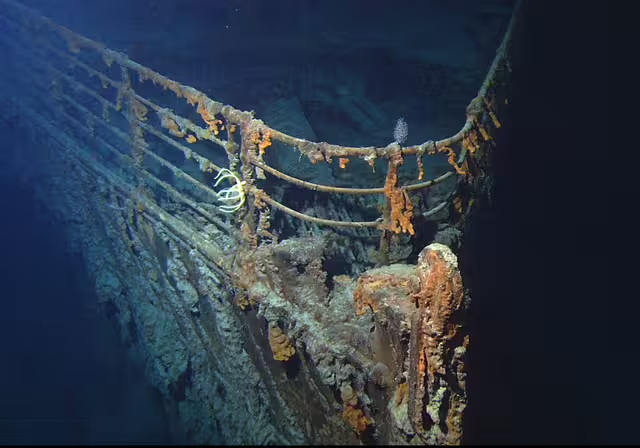
On September 1, 1985, a joint American-French expedition discovered the wreck of RMS Titanic deep in the North Atlantic. The ship had remained lost for more than 73 years after sinking on its maiden voyage in 1912.
The discovery was not only a major historical moment, but also an important breakthrough in deep-sea exploration technology.
A Ship Lost for Generations
RMS Titanic sank in the early hours of April 15, 1912, after striking an iceberg during its maiden voyage from Southampton to New York.
More than 1,500 people died in the disaster.
For decades, the exact location of the wreck remained unknown.
The great depth of the North Atlantic and the enormous size of the search area made finding the ship extremely difficult.
A Joint American-French Expedition
In 1985, researchers from the United States and France joined forces to search for the wreck.
The American team was led by oceanographer Robert Ballard of the Woods Hole Oceanographic Institution.
The French team was led by Jean-Louis Michel of IFREMER, France's national institute for ocean science and technology.
The two teams used different but complementary technologies to search the ocean floor.
The French Search Begins
The French expedition began searching the area in July 1985 aboard the research vessel Le Suroît.
They used a sophisticated sonar system to scan long strips of the seafloor in a systematic pattern.
Although they did not find Titanic, they eliminated a large part of the search area.
This made the later American search much more focused.
A Different Strategy
Robert Ballard's team approached the problem in a different way.
Instead of searching only for the enormous hull of the ship, Ballard decided to look for the debris field created when Titanic broke apart and sank.
Thousands of objects had fallen from the ship during its descent to the ocean floor.
Ballard believed this trail of debris would be easier to locate than the wreck itself.
The Argo Camera System
The American team used a deep-sea imaging system called Argo.
The device was towed behind the research vessel Knorr and carried cameras capable of transmitting images from the ocean floor back to the ship.
Researchers watched the video feeds for hours as Argo moved slowly above the dark seabed.
The First Sign of Titanic
Late on August 31 and into the early hours of September 1, 1985, the team began seeing unusual objects on the seafloor.
Then one of the cameras captured the unmistakable shape of a large ship's boiler.
The design matched the boilers used aboard Titanic.
After decades of unsuccessful searches, the expedition finally knew it had found the wreck.
Following the Debris Trail
The researchers followed the scattered debris across the ocean floor.
It eventually led them to the main sections of the ship.
The discovery revealed that Titanic had broken apart during the sinking.
The bow and stern were found separated by hundreds of metres, surrounded by an enormous field of wreckage and personal objects.
Almost Four Kilometres Below the Surface
The wreck lies approximately 3,800 metres below the surface of the North Atlantic.
At that depth, sunlight never reaches the seafloor and the water pressure is immense.
These extreme conditions had helped keep Titanic hidden for more than seven decades.
A Moment of Celebration — and Reflection
The discovery initially brought excitement to the scientists aboard Knorr.
But the mood soon changed when they remembered that the wreck was also the final resting place of more than 1,500 people.
The expedition paused to hold a memorial ceremony for those who had died in the disaster.
The wreck was treated not simply as an archaeological discovery, but as a maritime grave site.
Returning to Titanic
The 1985 expedition photographed the wreck remotely, but no people descended to it during the discovery mission.
Ballard returned the following year.
In 1986, the deep-sea submersible Alvin carried researchers down to Titanic for the first close-up human inspection of the wreck.
A small remotely operated vehicle called Jason Jr. was also used to explore areas that the larger submarine could not reach.
Images Seen for the First Time Since 1912
The 1986 expedition produced extraordinary images of the ship.
Researchers saw the massive bow, windows, railings, machinery, and objects scattered across the seabed.
For the first time since the night of the sinking, people were able to see the remains of Titanic in its deep-ocean resting place.
A Breakthrough in Deep-Sea Exploration
The discovery demonstrated the growing power of underwater cameras, sonar, remote vehicles, and systematic deep-sea search methods.
Techniques developed and refined during the search would later be used to study shipwrecks, geological formations, hydrothermal vents, and other features of the deep ocean.
The expedition therefore helped advance ocean science as well as maritime archaeology.
A Ship That Never Stopped Fascinating the World
The discovery renewed worldwide interest in the story of Titanic.
New expeditions, documentaries, books, exhibitions, and scientific studies followed.
The wreck also provided researchers with physical evidence that helped answer long-standing questions about how the ship broke apart and sank.
Found After 73 Years
On September 1, 1985, a small image of a boiler appearing on a monitor aboard a research ship ended one of the most famous searches in maritime history.
After more than 73 years beneath the Atlantic, RMS Titanic had finally been found.
The discovery connected modern technology with one of the defining stories of the early 20th century and opened a new chapter in the exploration of the deep ocean.
Other Events on This Day
- Annie Ernaux, the Writer Who Turned Memory Into Literature, Is Born
- The SR-71 Blackbird Flies from New York to London in Under Two Hours
Credits: 1st photo by NOAA / Institute for Exploration / University of Rhode Island — Public Domain.