Sep
1
1
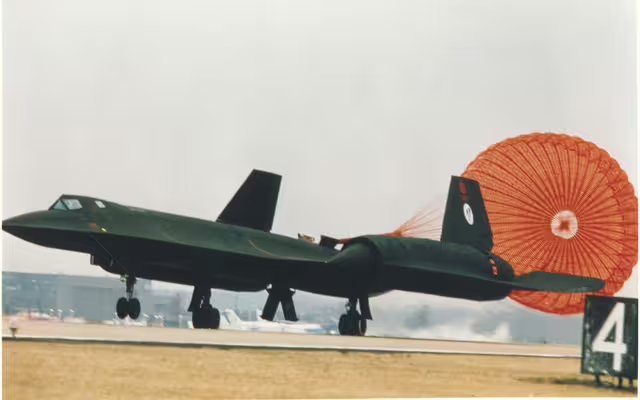
On September 1, 1974, a Lockheed SR-71 Blackbird set a remarkable transatlantic speed record, flying the officially measured New York-to-London route in just 1 hour, 54 minutes, and 56.4 seconds.
More than half a century later, the achievement remains one of the most impressive demonstrations of speed in aviation history.
A Record-Breaking Blackbird
The aircraft was an SR-71A Blackbird, serial number 61-7972.
It was flown by Major James V. Sullivan, with Major Noel F. Widdifield serving as Reconnaissance Systems Officer.
The pair crossed the officially recognized New York-to-London course at an average speed of approximately 1,807 miles per hour, or about 2,908 kilometres per hour.
Not an Ordinary Airport-to-Airport Flight
The famous record is often described simply as a flight from New York to London, but the actual mission was more complicated.
The Blackbird took off from Seymour Johnson Air Force Base in North Carolina.
The record timing began only when the aircraft crossed an official starting line near New York while already flying at very high altitude and speed.
The timing ended when it reached the designated point near London.
Less Than Two Hours Across the Atlantic
The final official time was:
1 hour, 54 minutes, 56.4 seconds.
The recognized course covered roughly 3,460 miles, or about 5,570 kilometres.
To put the achievement into perspective, a modern passenger flight between New York and London usually takes several times longer.
Even the Record Flight Needed Fuel
The SR-71's enormous speed did not mean it could simply cross the Atlantic without logistical support.
During the mission, the aircraft had to slow down for aerial refuelling from a tanker aircraft.
After taking on fuel, it accelerated again to extreme speed and altitude.
The refuelling stop makes the average speed of the overall timed route even more impressive.
Flying Above Mach 3
The SR-71 was designed to cruise at speeds greater than Mach 3.
It routinely operated at altitudes around 80,000 feet, more than 24 kilometres above the Earth's surface.
At such speeds, air friction heated the aircraft's skin to temperatures that ordinary aluminium structures could not tolerate.
Much of the Blackbird was therefore constructed from titanium.
A Machine Built for Reconnaissance
The SR-71 was not designed as a passenger aircraft or a racing machine.
It was a strategic reconnaissance aircraft developed during the Cold War.
Its mission was to fly extremely high and extremely fast while collecting intelligence over or near areas where slower aircraft would have been vulnerable.
Speed itself became one of its most important defensive features.
Heading for Farnborough
The 1974 record flight had another purpose.
The aircraft was travelling to Britain for the Farnborough International Air Show.
The appearance gave the public a rare opportunity to see one of the most advanced and secretive aircraft of the era.
Its record-breaking arrival provided an unforgettable demonstration of what the Blackbird could do.
How Fast Was the Blackbird?
At its normal high-speed operating altitude, the SR-71 could cover enormous distances in remarkably short periods of time.
Travelling at around Mach 3 meant moving faster than a rifle bullet and crossing hundreds of kilometres in only a few minutes.
Its crews had to wear specialized pressure suits similar to those used by astronauts because of the extreme altitude at which they operated.
Faster Than Concorde
The comparison with Concorde shows how extraordinary the Blackbird's performance was.
Concorde was itself one of the fastest passenger aircraft ever built and could cross the Atlantic in less than three and a half hours.
Its fastest recorded New York-to-London passenger crossing, achieved in 1996, took just under three hours.
The SR-71's 1974 record was almost an hour faster.
The Record Still Stands
No conventional crewed aircraft has since beaten the SR-71's officially recognized New York-to-London speed record.
Advances in aviation have produced more efficient, quieter, and more economical aircraft, but very few have attempted to match the Blackbird's extraordinary combination of sustained speed and altitude.
The Record-Breaking Aircraft Survives
The story has an unusually satisfying ending.
The exact SR-71 that made the record flight, aircraft 61-7972, still exists.
It is preserved by the Smithsonian National Air and Space Museum at the Steven F. Udvar-Hazy Center in Virginia.
Visitors can therefore stand beside the same aircraft that crossed the Atlantic in less than two hours.
A Monument to Extreme Engineering
On September 1, 1974, the SR-71 Blackbird demonstrated just how far aerospace engineering had advanced during the first seven decades of powered flight.
Its record-breaking journey from New York to London remains a powerful symbol of an era when engineers were pushing aircraft higher and faster than almost anyone had imagined possible.
More than fifty years later, the Blackbird's transatlantic record still inspires fascination — and still has not been surpassed.
Other Events on This Day
- Annie Ernaux, the Writer Who Turned Memory Into Literature, Is Born
- The Wreck of Titanic Is Found After 73 Years
Credits: 1st photo: U.S. Air Force — Public Domain.